
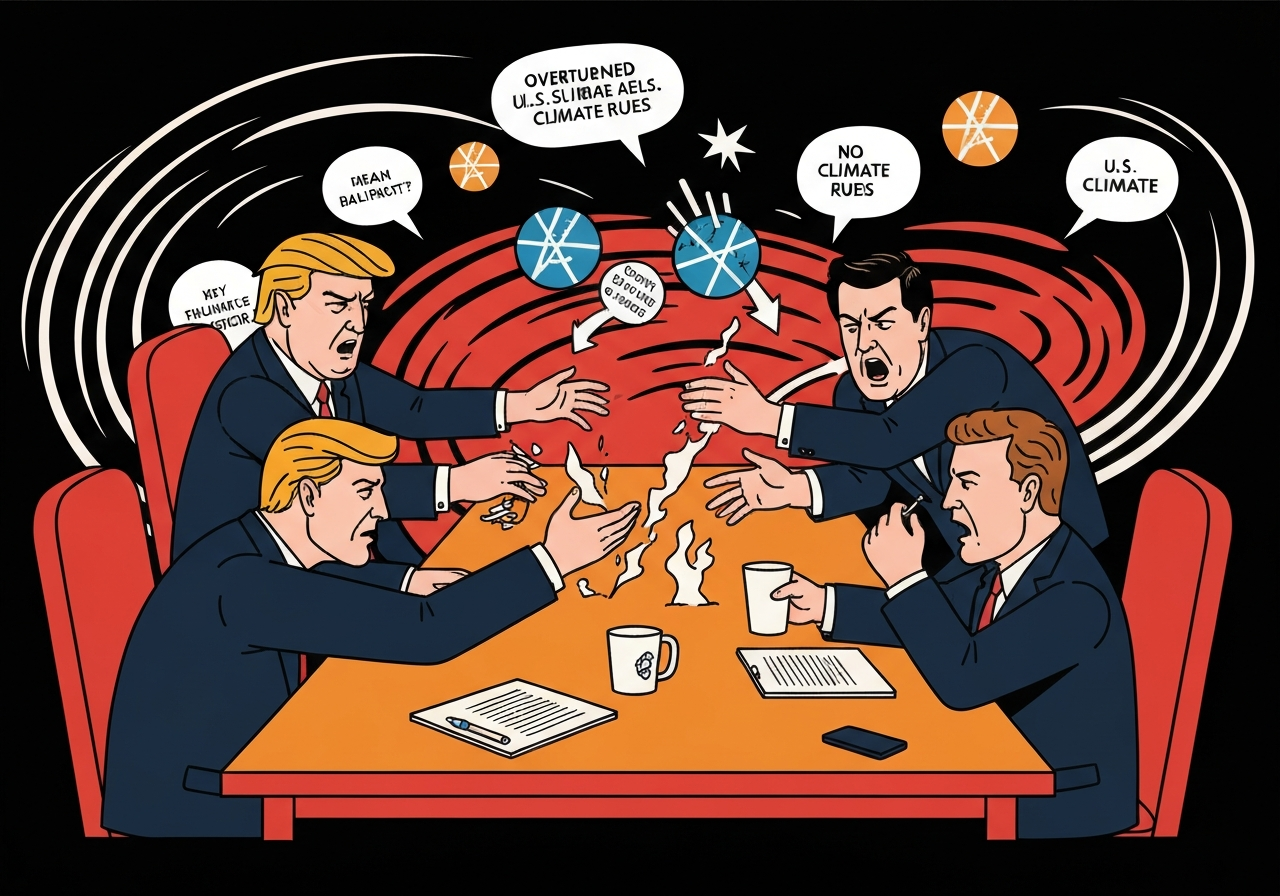
Lead: In early February 2026, documents and interviews show four former Trump-administration advisers quietly prepared a blueprint to dismantle federal climate policy once Republicans regained power. Those plans center on undoing the Environmental Protection Agency’s 2009 “endangerment finding,” the legal basis for regulating greenhouse gases. If the EPA proceeds with the expected revocation, many federal climate regulations could lose their primary legal foundation. The move follows years of conservative legal strategy and arrives amid lingering political divisions over how the U.S. addresses global warming.
Key Takeaways
- Four conservative operatives—Russell T. Vought, Jeffrey B. Clark, Mandy Gunasekara and Jonathan Brightbill—prepared orders and legal material aimed at stripping federal climate authority, according to reporting on Feb. 9, 2026.
- The EPA is expected in the days following Feb. 9, 2026, to announce a revocation or rollback of the 2009 endangerment finding that underpins greenhouse gas regulation.
- The 2009 finding established that CO2, methane and other greenhouse gases threaten public health and welfare, enabling regulation under the Clean Air Act.
- The campaign to undo climate rules traces back at least 16 years and combines executive-order drafting, litigation strategy and curated scientific critiques.
- Revoking the endangerment finding would not by itself cancel all regulations immediately but would invite litigation and could force the administration to rewrite or withdraw specific rules.
- Environmental and public-health groups pledge legal challenges; industry groups and conservative legal networks praise the move as a rollback of what they call regulatory overreach.
- Key uncertainties include how courts will rule on any revocation and whether Congress or future administrations will restore statutory authority for greenhouse-gas limits.
Background
Beginning in 2009, the Environmental Protection Agency concluded that greenhouse gases endanger public health and welfare, a determination that provided the legal foundation for regulating emissions from vehicles, power plants, and other sources under the Clean Air Act. That “endangerment finding” was central to multiple Obama-era rules and subsequent federal actions addressing climate risks such as stronger storms, drought, heat extremes and sea-level rise.
In summer 2022, Democrats in Congress pushed to enshrine large-scale climate and clean-energy investments, and President Joseph R. Biden Jr. publicly framed climate change as a pressing national threat. At the same time, conservative lawyers and policy officials who served in the Trump administration cultivated strategies to reverse those policies if Republicans won control of the federal government. Their toolkit combined executive orders ready for immediate rollout, litigation ready to challenge agency science, and compiled materials intended to cast doubt on prevailing scientific conclusions.
Main Event
Documents reported on Feb. 9, 2026, show that four individuals—Russell T. Vought and Jeffrey B. Clark, both with high profiles in Trump-era policy circles, and attorneys Mandy Gunasekara and Jonathan Brightbill—collated executive templates and legal arguments aimed at neutralizing federal climate rules. Vought, described in reporting as skeptical of “climate alarmism,” and Clark, who has used harsh rhetoric about climate regulations, drafted orders designed to remove agency authority. Gunasekara and Brightbill gathered scientific critiques and legal briefs to underpin a reversal of the 2009 finding.
The immediate administrative step reported as imminent is an EPA move to revoke or narrow the endangerment finding. Agency officials preparing the action argue regulators must reassess the scientific and legal bases for regulation; opponents say the step would discard decades of peer-reviewed science linking greenhouse gases to environmental harms. Agency documents and press briefings indicate the revocation is framed as an exercise of executive authority over regulatory priorities.
If finalized, the revocation would alter the legal scaffolding that courts have used to uphold federal limits on greenhouse gases. Some existing rulemakings could be weakened, delayed, or rescinded as agencies rework justifications. However, many regulatory actions also rely on other legal provisions and rulemaking records, so the practical outcome will depend on subsequent agency decisions and judicial review.
Analysis & Implications
Legally, the endangerment finding is not a single regulation but a scientific-legal determination that authorized the EPA to treat greenhouse gases as air pollutants. Removing it would force the agency and potentially other federal entities to develop alternative legal rationales for the same regulatory ends or to abandon some regulations entirely. Courts may fast-track litigation over any revocation because of the sweeping implications for regulatory authority.
Politically, the move crystallizes a longstanding conservative strategy to use executive power and the courts to limit government climate action. For Republicans and allied groups, striking the endangerment finding fulfills a regulatory rollback objective dating back more than a decade. For Democrats and climate advocates, the action is likely to be framed as an attempt to ignore scientific consensus and weaken pollution controls that protect communities from extreme weather and health harms.
Economically, the short-term effects could include reduced compliance costs for some fossil-fuel producers and utilities, potentially altering investment signals in energy markets. Over time, however, legal uncertainty could chill long-term capital flows into clean energy and resilience measures if companies and states face an unstable federal policy environment.
Comparison & Data
| Year | Action | Legal/Policy Impact |
|---|---|---|
| 2009 | EPA issues endangerment finding | Provides statutory basis to regulate greenhouse gases under the Clean Air Act |
| 2022 (summer) | Congress passes major climate and clean-energy measures | Expanded federal spending and incentives to reduce emissions (legislative) |
| 2026 (Feb.) | EPA expected to move to revoke finding | Would remove a central legal basis for many federal climate regulations; triggers litigation |
The table shows the sequence from the legal foundation set in 2009 to the political push for new measures in 2022 and the potential administrative reversal in 2026. While revocation threatens the legal basis for regulation, the practical outcomes will vary rule by rule and hinge on litigation and administrative follow-up.
Reactions & Quotes
Key stakeholders reacted quickly after the reporting of the documents and the anticipated EPA action, signaling immediate legal and political conflict.
Reporting indicates conservative advisers prepared targeted orders and legal materials to dismantle federal climate authority.
The New York Times (media)
Environmental advocates say revoking the finding would remove the backbone of decades of climate protections and will prompt lawsuits to restore the determination.
Environmental organizations (advocacy)
Some industry and conservative legal groups characterize the change as correcting regulatory overreach and restoring agency discretion.
Conservative legal networks / industry statements (advocacy/industry)
Unconfirmed
- Whether a formal revocation will survive judicial review remains unresolved; courts may block or stay any administrative change.
- The degree to which revocation would force the immediate rollback of specific regulations (versus prompting new rulemaking) is uncertain and will depend on agency follow-up actions.
- The extent to which the documented plans reflect direct White House directives versus outside conservative strategy documents is not fully established in public records.
Bottom Line
The reported effort by former Trump administration figures to dismantle the EPA’s 2009 endangerment finding represents an unprecedented administrative push to remove a central legal underpinning of U.S. climate policy. If the EPA follows through with revocation, the result will be a protracted legal and political battle over whether and how the federal government can regulate greenhouse gases.
For policymakers, businesses, states and communities, the primary near-term risks are legal uncertainty and shifting regulatory expectations. Long-term climate outcomes will depend on court rulings, future administrations, and whether Congress chooses to legislate clearer authority for greenhouse-gas regulation.