
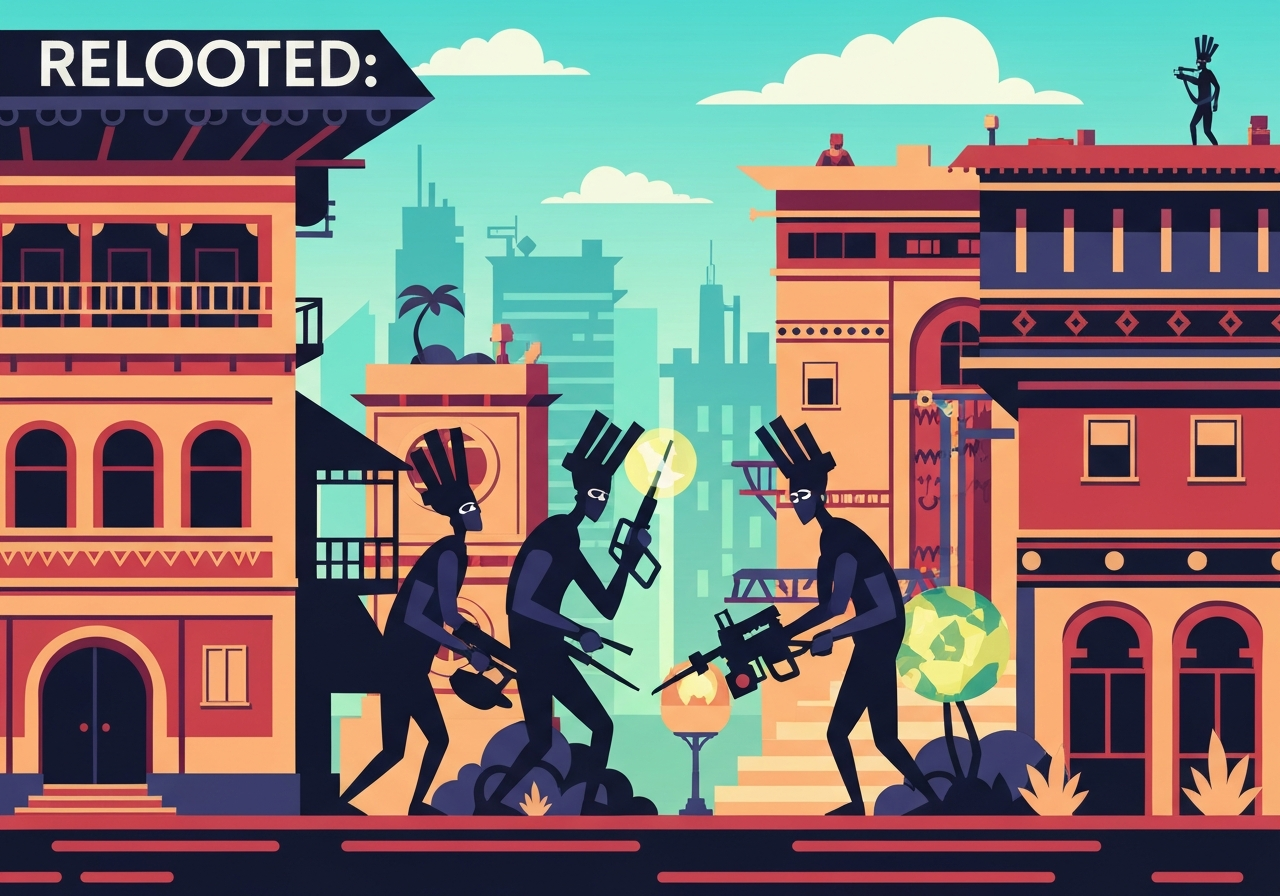
Relooted, a new “African‑futurist” heist game from South African studio Nyamakop, debuted on Tuesday and casts players as Nomali, a parkour expert who must retrieve 70 sacred and cultural objects taken mostly during colonial-era plunder. Set in a near‑future 2099 where a Transatlantic Returns Treaty is weakening, the game frames its missions as restorative rather than for profit and emphasizes puzzle‑solving, teamwork and non‑violent infiltration. The title is designed for PC and console play and is aimed primarily at a global audience, including the African diaspora.
Key takeaways
- Relooted asks players to recover 70 African artefacts and sacred objects, modeled on real items taken in the late 19th and 20th centuries.
- The game was released Tuesday by Nyamakop, the South African studio behind 2018’s Semblance, and was created by a pan‑African team across multiple countries.
- Nomali, the playable lead, is a parkour specialist; supporting characters include Trevor (locksmith), Etienne (inside intel), Cryptic (hacker) and Fred (driver/gadgeteer).
- Relooted is built for PCs and consoles using motion capture and animated cinematics; it is not available on smartphones due to scope and production format.
- Developers say the game aims to raise awareness of cultural looting and restitution debates while remaining primarily an entertainment product.
- The narrative references high‑profile objects such as Kabwe 1 (a 300,000‑year‑old skull), the Asante Gold Mask (Kumasi, 1874) and the Ngwi Ndem/Bangwa Queen removed from Cameroon in 1899.
- Design and voice work involved creators from Nigeria, Angola, Malawi, Ethiopia, Tanzania, Kenya and other countries, reflecting Nyamakop’s pan‑African approach.
Background
Debates about the return of African cultural property have intensified in recent decades. Formal requests for repatriation date back to efforts in the 1930s from the Kingdom of Benin, and only from 2021 did major Western institutions begin larger, though still limited, repatriation measures. Museums and universities in Europe and North America maintain extensive collections that often trace to colonial appropriation, wartime seizures and the 20th‑century art market.
Nyamakop’s founders and creative leads place Relooted within this wider historical and political conversation. The studio frames the game as a narrative device to imagine reparative outcomes rather than as advocacy for illegal acts. The fictional Transatlantic Returns Treaty and its changing clauses (for example, a rule that returns only displayed objects) are used in the story to highlight how legal frameworks can be altered to delay or deny restitution.
Production choices—motion capture, cinematic sequences and platform targeting—were shaped both by creative ambition and market realities. While smartphone gaming dominates much of the African continent, high‑fidelity PC/console development plays to global markets and to diasporic communities with higher console/PC penetration.
Main event
The game’s framing sequence places players in Johannesburg in a derelict warehouse where Professor Grace, an artefacts expert, briefs her grandchildren and former students on a high‑stakes plan: retrieve objects moved to Western collections and private holdings. The story’s timeline is set in 2099, where diplomatic accords on restitution are unraveling and museums exploit loopholes to move contested items off public display and into storage.
Nomali is introduced as a reluctant but committed protagonist who uses parkour—running, jumping, climbing and vaulting—to access and extract artefacts. Gameplay emphasizes stealth, puzzle resolution and non‑violent strategies rather than combat; the creators intentionally contrast the game’s methods with the historic violence that accompanied many removals of African objects.
Players take staged missions across fictionalized museum and private collection environments. Briefings in the game’s Hideout Room provide contextual dossiers on each artefact, its cultural significance and the communities of origin; the Hideout Room itself references real Johannesburg landmarks such as the Northcliff Water Tower.
Relooted features a roster of characters from across Africa and the diaspora: Trevor provides mechanical and security expertise; Etienne supplies inside knowledge; Ndedi and other regional characters contribute acrobatics and escape skills; Cryptic handles digital access and Fred offers field engineering and driving support. These roles structure cooperative play and offer narrative entry points to learn about each object’s provenance.
Analysis & implications
As an entertainment product, Relooted sits at the intersection of cultural education and speculative fiction. Games require active participation, which developers argue creates different learning dynamics than passive media. By embedding briefings and optional educational content about each artefact, Relooted uses gameplay to increase player exposure to histories of looting and current restitution debates without turning play into a classroom lecture.
Commercially, the decision to target PC and console players shapes who will experience the game. That platform choice prioritizes players in wealthier markets and the diaspora rather than many on‑continent users who primarily access games via smartphones. The trade‑off is greater production fidelity and potentially wider critical visibility versus limited reach within some African markets.
Politically, the title functions as a cultural intervention rather than a policy tool. It can amplify public interest and empathy for restitution claims, but there is no direct mechanism in the game to change legal ownership or force institutional returns. Whether increased public awareness translates into sustained political pressure on museums remains an open question.
Economically, the game contributes to a growing African games industry that aims to reach global audiences. Nyamakop’s earlier milestone—Semblance was the first African‑developed game on a Nintendo console—signals a trend of higher‑profile releases from African studios. Relooted’s global positioning could attract investment and talent but also spotlights the persistent infrastructure and access gaps on the continent.
Comparison & data
| Item | Origin | Current institution (example) |
|---|---|---|
| Kabwe 1 (Broken Hill Man) | Zambia | Natural History Museum, London (since 1921) |
| Asante Gold Mask | Kumasi, Ghana (1874 looting) | Wallace Collection, London |
| Ngwi Ndem / Bangwa Queen | South‑west Cameroon (1899) | Private/auction history; Dapper Foundation acquired in 1990 |
The table illustrates a sample of items dramatized in Relooted and their documented histories in Western institutions. These cases span a century of removals and different legal and ethical claims, from scientific fossils to sacred ritual sculptures. The variability of the objects—fossils versus sacred regalia—helps explain why restitution pathways and public sentiment differ for each.
Reactions & quotes
Developers and commentators offered measured responses on the game’s release, noting its blend of entertainment and cultural commentary.
“Nomali reluctantly agrees to the first heist to prove how dangerous the whole thing is — she would do anything for her family,”
Mohale Mashigo, narrative director (paraphrased)
Nyamakop’s project manager framed the game’s appeal as tapping into a common sentiment.
“Taking back cultural artefacts that were looted is something a lot of people hope for and fantasise about,”
Sithe Ncube, project manager (paraphrased)
Company leadership emphasized entertainment value alongside awareness goals.
“We wanted something entertaining first, but also to open conversations about history, the scale of looting and cultural heritage,”
Ben Myres, Nyamakop co‑founder and CEO (paraphrased)
Unconfirmed
- Whether Relooted will materially accelerate museum repatriation efforts; increased awareness does not guarantee institutional action.
- Exact commercial reach among African players: smartphone platform exclusion may limit on‑continent uptake, but precise sales figures and geographic distribution are not yet available.
- Any specific museum or private owner responses to the game’s portrayal of named artefacts have not produced formal policy changes as of the game’s release.
Bottom line
Relooted uses fiction and gameplay to dramatize real historical patterns of cultural extraction and to invite players into conversations about restitution. By centering African creators and characters, the game both expands representation in mainstream game narratives and reframes looted objects as living cultural heritage rather than mere collectibles.
As a cultural product, Relooted is unlikely to single‑handedly change institutional practices, but it can broaden public familiarity with restitution issues and strengthen cultural ties between diasporic audiences and objects’ communities of origin. For policymakers, museums and cultural leaders, the title underscores the continuing public interest in provenance and return—and the need for transparent, consultative approaches if lasting solutions are to follow.
Sources
- BBC News (media/news) — primary reporting on Relooted release and interviews with Nyamakop staff.
- Natural History Museum, London (museum/official) — institutional record for Kabwe 1 and related collections information.
- Wallace Collection (museum/official) — holds the Asante Gold Mask in its collection records.