
Lead
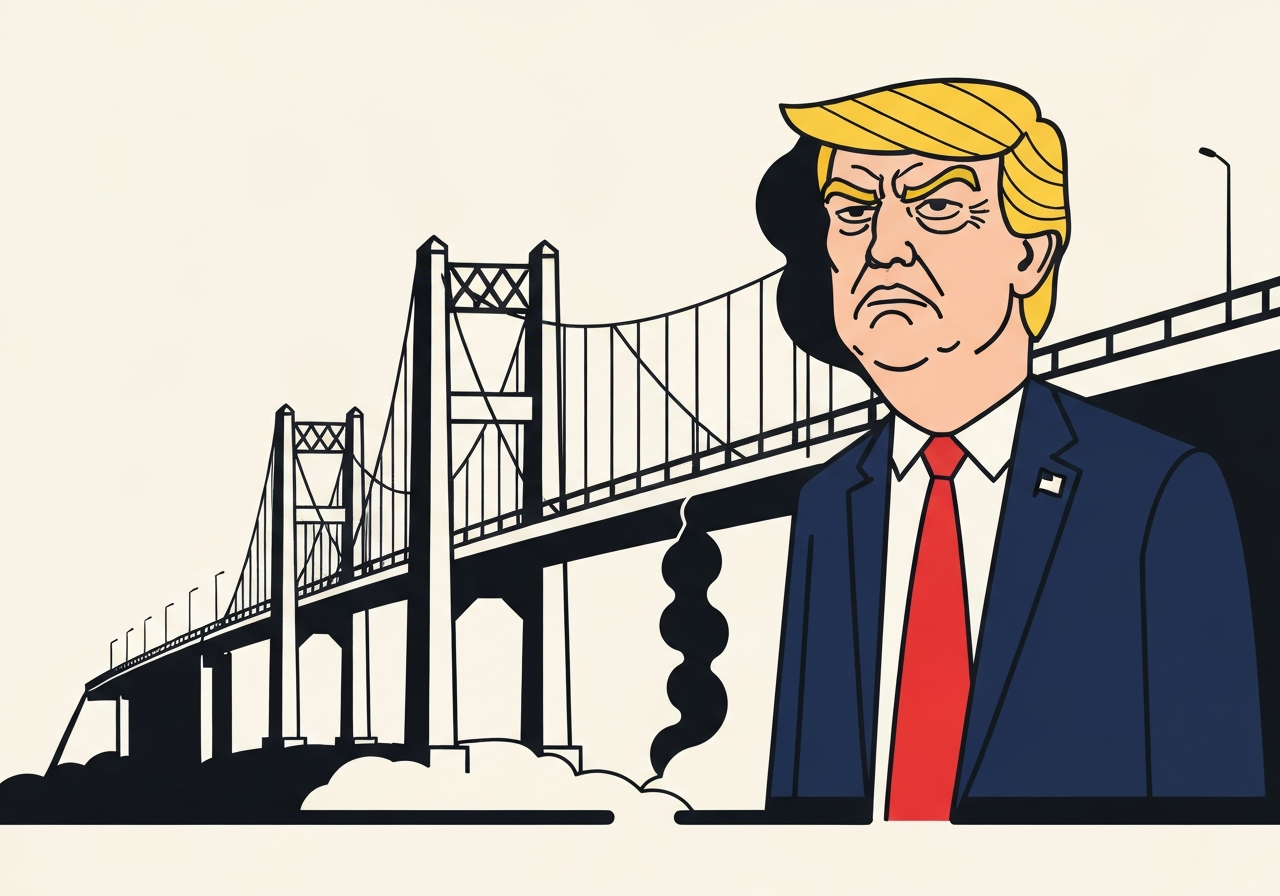
President Donald Trump said he would block the opening of the Gordie Howe International Bridge linking Detroit, Michigan, and Windsor, Ontario, until the United States is “fully compensated for everything” it has given to Canada. The bridge, whose construction began in 2018 and which Canada funded, is slated to open pending final tests and approvals in the early part of this year. Trump posted the threat on social media and said negotiations would begin immediately, without specifying the legal route to stop an opening. Michigan and Canadian officials warned the move could harm jobs, supply chains and cross-border commerce.
Key Takeaways
- The Gordie Howe International Bridge, connecting Windsor and Detroit, began construction in 2018 and is expected to open early this year after formal testing and approvals.
- Canada financed the project; public ownership is described on project pages as being shared between Canada and Michigan institutions, while the Windsor-Detroit Bridge Authority is wholly owned by the Canadian government.
- Project cost is estimated at C$6.4bn, a figure reported by Canadian broadcasters and cited in coverage of the dispute.
- President Trump said the U.S. must be “fully compensated” and suggested the U.S. should own at least half the asset, but he did not detail a legal mechanism to stop the opening.
- Michigan officials including Senator Elissa Slotkin and Governor Gretchen Whitmer warned of economic damage: higher costs for businesses, weaker supply chains and potential job losses.
- The privately owned Ambassador Bridge, controlled by the Moroun family, has been a longstanding rival interest in the region and opposed the new crossing.
- Local Canadian officials, including Windsor Mayor Drew Dilkens, rejected some of Trump’s factual claims about ownership and construction inputs.
Background
The Gordie Howe International Bridge has been a bilateral project and a point of contention for over a decade, involving federal, provincial/state and private stakeholders. Canada committed to funding the crossing and set up the Windsor-Detroit Bridge Authority to develop and oversee the project; the authority is a Canadian federal Crown corporation. Construction began in 2018 amid legal and commercial disputes with the owners of the neighboring Ambassador Bridge, who argued the new crossing would undercut their toll revenue.
The bridge is intended to strengthen an already busy trade corridor linking the U.S. Midwest and Ontario, a critical route for auto manufacturing, agriculture and other supply chains. Cost estimates reported publicly place the project at about C$6.4bn. The governments involved have framed the crossing as a long-term infrastructure investment to support cross-border commerce and regional jobs.
Main Event
On social media, President Trump said he would prevent the Gordie Howe bridge from opening until the United States was “fully compensated for everything we have given them.” He added that the U.S. should own “at least one half of this asset,” and claimed, without presenting supporting documentation, that Canada controlled both sides of the bridge. The post did not identify the legal authority or federal process by which a president could bar an international crossing that has been built under Canadian financing and management.
Michigan Democrats reacted quickly. Senator Elissa Slotkin warned the move would be “awful for our state’s economy,” citing risks of higher costs for Michigan businesses, weaker supply chains and fewer jobs. Governor Gretchen Whitmer’s office reiterated that the project was an example of bipartisan and international cooperation and defended its job benefits for the state.
Ontario and Windsor officials contested some of Trump’s claims. Windsor Mayor Drew Dilkens called the suggestion that Canada had improperly taken advantage of the U.S. “just insane,” and said the bridge was a necessary economic link. The Windsor-Detroit Bridge Authority and Canadian provincial offices did not immediately provide detailed responses to the presidential post, and officials signaled they would seek clarification.
Analysis & Implications
Legally, the president’s ability to block the opening of an international bridge built in Canada but connecting to U.S. territory is uncertain. Physical control of the crossing and its ownership are governed by international agreements, Canadian federal authorities and state-level permitting, and the claim that a unilateral presidential order could simply keep the bridge closed lacks an obvious statutory basis. Any U.S. action to impede operations would likely involve customs and border control procedures, regulatory holds, or diplomatic negotiation rather than a simple executive proclamation.
Economically, delay or obstruction could impose costs on auto manufacturers, parts suppliers and other businesses that rely on timely cross-border shipments. Michigan officials highlighted potential job losses and higher operating costs. Because the corridor handles high-value and time-sensitive freight, even intermittent disruptions can ripple through supply chains and raise consumer prices and production lead times.
Politically, the dispute underscores persistent tensions in U.S.-Canada trade relations. Trump tied his objection to long-standing complaints about Canadian dairy tariffs and other trade frictions; defenders of the bridge framed it as a nonpartisan infrastructure achievement. The episode could complicate bilateral talks on tariffs and market access if it becomes a bargaining chip, and it could shift public opinion in both countries about cross-border cooperation.
Comparison & Data
| Bridge | Ownership | Construction start | Reported cost |
|---|---|---|---|
| Gordie Howe International Bridge | Developed by Windsor-Detroit Bridge Authority (Canadian federal entity) | 2018 | C$6.4bn (reported) |
| Ambassador Bridge | Privately owned (Moroun family) | Original span historically owned privately | Toll revenue asset (private) |
The table summarizes public reporting: Gordie Howe is a Canadian-funded publicly developed project with a reported cost of approximately C$6.4bn; the Ambassador Bridge is privately owned and has a commercial incentive to oppose a competing crossing. The economic stakes include construction investment, future toll revenues and regional trade capacity.
Reactions & Quotes
“I will not allow this bridge to open until the United States is fully compensated for everything we have given them.”
President Donald Trump (social media post)
Trump framed the dispute in terms of compensation and fairness; his statement included assertions about ownership and past U.S. policy that officials disputed.
“Closing this incredibly important infrastructure project would be awful for our state’s economy.”
Senator Elissa Slotkin (D-Michigan)
Slotkin emphasized the potential for higher costs to Michigan businesses, less secure supply chains and job losses if the opening were blocked.
“It’s just insane. I really can’t believe what I’m reading.”
Drew Dilkens, Mayor of Windsor, Ontario
Windsor’s mayor pushed back at claims about ownership and the narrative that Canada was taking unfair advantage of the United States.
Unconfirmed
- Claim that the United States must own “at least one half” of the bridge: asserted by President Trump but not supported by public ownership documents; the WDBA is described as wholly Canadian-owned.
- Assertion that Canada “owns both the Canadian and U.S. sides” of the bridge: this was claimed by the President; ownership and jurisdiction details involve bilateral arrangements and require official documentation to confirm.
- Claim that construction began without any U.S. steel due to prior administrations: cited by the President and attributed to former President Barack Obama; specific procurement records would be needed to verify the share of U.S. steel used.
Bottom Line
The president’s public threat to block the Gordie Howe bridge’s opening raises immediate political and economic questions but lacks an immediately apparent legal mechanism for unilateral closure of a Canada-funded international crossing. Practical blocking of operations would likely require coordination with federal and state agencies, border authorities and diplomatic channels, not simply a social-media declaration.
For businesses and communities on both sides of the Detroit River, the key risks are economic: slower shipments, higher costs and uncertainty for employers. Watch for formal communications from the Windsor-Detroit Bridge Authority, U.S. Customs and Border Protection, and federal departments in both countries for clarity on operational timelines and legal status.