
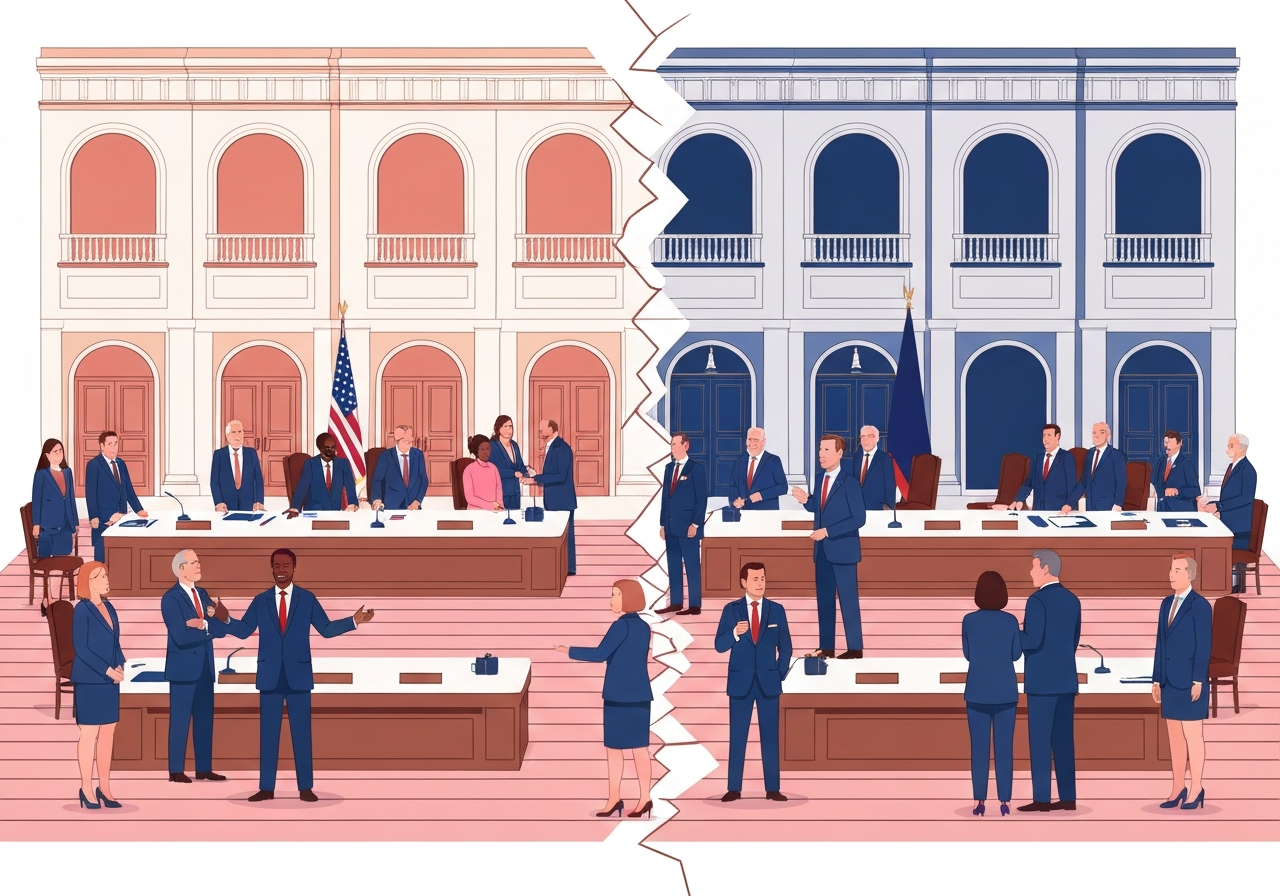
Lead: An annual gathering of the nation’s governors set for Feb. 19-21 in Washington is unraveling after the White House planned a Feb. 20 event that reportedly would invite only Republican governors. The National Governors Association (NGA), which represents all 55 governors, said it will no longer serve as the formal host for the White House session. Eighteen Democratic governors also announced they will boycott a traditional White House dinner in protest. The dispute has interrupted one of the few regular bipartisan forums where governors coordinate on national policy and emergency responses.
Key Takeaways
- The NGA represents 55 governors and will not facilitate the White House business meeting scheduled for Feb. 20, 2026, after reports the administration planned to invite only Republican governors.
- Eighteen Democratic governors publicly pledged to skip the customary White House dinner; their statement pledged continued unity on state-level priorities.
- Oklahoma Gov. Kevin Stitt, the Republican NGA chair, told governors in a Feb. 2026 letter that the White House intended to limit invitations to Republican governors for the Feb. 20 session.
- White House press secretary Karoline Leavitt defended the administration’s right to choose guests, saying the president has discretion over who is invited to the residence and events.
- NGA CEO Brandon Tatum called the White House meeting an “important tradition” and expressed disappointment that it would become partisan this year.
- Tensions between the White House and some Democratic governors date to last year, when an exchange between President Trump and Maine Gov. Janet Mills over transgender athlete policy became public and contentious.
- The decision removes a formal bipartisan convening point at a time when governors are coordinating on pandemic recovery, infrastructure funds, and disaster responses.
- Some Democratic governors reportedly withheld NGA dues last year amid earlier conflicts, a signal of fraying ties within the traditionally bipartisan group.
Background
The National Governors Association has for decades provided a nonpartisan forum where state executives from both parties discuss policy, federal-state relations and practical governance issues. The NGA’s membership includes governors from all 50 states plus territories and commonwealths, totaling 55 officials. Its annual winter meeting in Washington traditionally includes a White House business session and a dinner that serve as opportunities for policy coordination and relationship-building across party lines.
That bipartisan character has been strained in recent years by heightened national polarization and clashes over federal policy. Last year’s NGA events were marked by a public confrontation between President Trump and Maine Gov. Janet Mills, an episode that some governors have said changed the tone of the conference. The current dispute centers on the White House’s reported plan to restrict attendance at its Feb. 20 meeting to Republican governors, a break from past practice and from NGA’s role as a representative body for all governors.
Main Event
On Monday, Feb. 2026, Oklahoma Gov. Kevin Stitt — who chairs the NGA — circulated a letter to fellow governors saying the White House would limit invitations to the NGA’s scheduled Feb. 20 business meeting to Republican governors only. The letter, obtained by multiple news outlets, said the NGA would therefore not be the formal facilitator for the event or included in the NGA’s official program. Stitt urged governors to remain focused on shared duties despite the administration’s reported decision.
Following reports of a partisan guest list, 18 Democratic governors issued a joint statement saying they would not attend the White House dinner. The governors framed the boycott as a defense of the NGA’s bipartisan mission and a stand for their constituents rather than a partisan maneuver. Brandon Tatum, the NGA’s CEO, said the association was “disappointed in the administration’s decision to make it a partisan occasion this year.”
The White House press office, speaking through press secretary Karoline Leavitt, defended the president’s prerogative to select guests for events at the presidential residence. Leavitt said the White House is both “the people’s house” and the president’s home, and reiterated that the president may invite whomever he chooses to dinners and events. The administration did not immediately provide a public list of invitees when these reports first circulated.
The dispute has already altered the agenda and optics of the governors’ meeting. NGA officials and several governors expressed regret that a longstanding, practical convening has been disrupted at a time when state executives are confronting issues that typically require cross-party coordination, including disaster preparedness, federal funding distribution and public health responses.
Analysis & Implications
The White House decision to exclude Democratic governors from a formal session, if confirmed, represents a notable departure from recent practice and from the NGA’s role as an institution that convenes all governors. That shift risks eroding a useful channel for routine federal-state communication. Governors often rely on personal relationships formed at these gatherings to expedite disaster aid, align on regulatory issues and negotiate with federal agencies; a partisan break could slow those informal pathways.
Politically, the move may deepen partisan divisions between state and federal leaders. Democratic governors’ boycott signals a willingness to use institutional leverage — including public refusal to participate — to defend a nonpartisan forum. For Republican governors, attending a White House-only session could yield short-term political or policy advantages but risks isolating them from their Democratic counterparts on cross-cutting issues that require cooperation.
Policy consequences could surface quickly. Emergency response coordination, formula grant administration and pandemic-related programs often depend on collaborative federal-state work. If communication channels narrow, states could face delays in federal approvals or less clarity on evolving federal guidance. Conversely, the administration might use a Republican-only event to press a more unified federal-state agenda with aligned governors, heightening short-term policy momentum in areas where the parties agree.
Institutionally, the NGA’s choice to withdraw from facilitating the session reinforces its identity as a membership organization representing all governors. That posture preserves its nonpartisan mandate, but it also reduces the formal role the association plays in connecting governors to the White House. How the NGA balances advocacy and access in the months ahead will shape its effectiveness and membership cohesion.
Comparison & Data
| Item | Typical Practice | 2026 Reported Change |
|---|---|---|
| Governing body | NGA represents 55 governors (all states, territories) | NGA not facilitating Feb. 20 White House meeting |
| White House invitations | Historically bipartisan guest lists for NGA events | Reportedly restricted to Republican governors |
| Democratic governors’ response | Customary bipartisan attendance at dinners | 18 Democrats publicly announced a dinner boycott |
The table summarizes the departure from past practice: the NGA’s nonpartisan facilitation role, historically inclusive guest lists, and the scale of the Democratic governors’ boycott. These shifts are centered on the February 2026 meetings and reflect both procedural changes and political signaling.
Reactions & Quotes
Several actors framed the issue as a test of institutional norms. The Democratic governors’ joint message emphasized unity and advocacy for residents’ interests rather than partisan retaliation:
“If the reports are true that not all governors are invited to these events, which have historically been productive and bipartisan opportunities for collaboration, we will not be attending the White House dinner this year.”
Joint statement from 18 Democratic governors
“The president has discretion to invite anyone he wants to the White House. It’s the people’s house… he can invite whomever he wants to dinners and events here at the White House.”
White House press secretary Karoline Leavitt (official statement)
“The White House meeting is an important tradition… disappointed in the administration’s decision to make it a partisan occasion this year.”
Brandon Tatum, NGA CEO (organization statement)
Unconfirmed
- Complete guest list for the Feb. 20 White House session was not publicly released at the time of reporting, so the precise set of invitees remains unconfirmed.
- The White House’s internal rationale for limiting invitations (beyond cited presidential discretion) was not provided publicly and has not been independently verified.
- Whether individual Republican governors who are invited will participate in lieu of the NGA-facilitated session was unclear at the time of reporting.
Bottom Line
The reported decision to limit a White House session to Republican governors and the NGA’s withdrawal as facilitator mark a rupture in a longstanding bipartisan convening. That rupture has immediate symbolic significance and practical implications for routine federal-state coordination on areas such as disaster relief, health policy and federal funding administration.
How quickly the dispute affects outcomes will depend on whether informal lines of communication remain open and whether governors choose to use alternative forums to coordinate. For now, the episode underscores how polarized national politics can reshape institutions that once served as neutral platforms for cross-party governance.
Sources
- Associated Press (news report)
- National Governors Association (official organization) (official site)
- The White House Briefing Room (official statements and press briefings)