
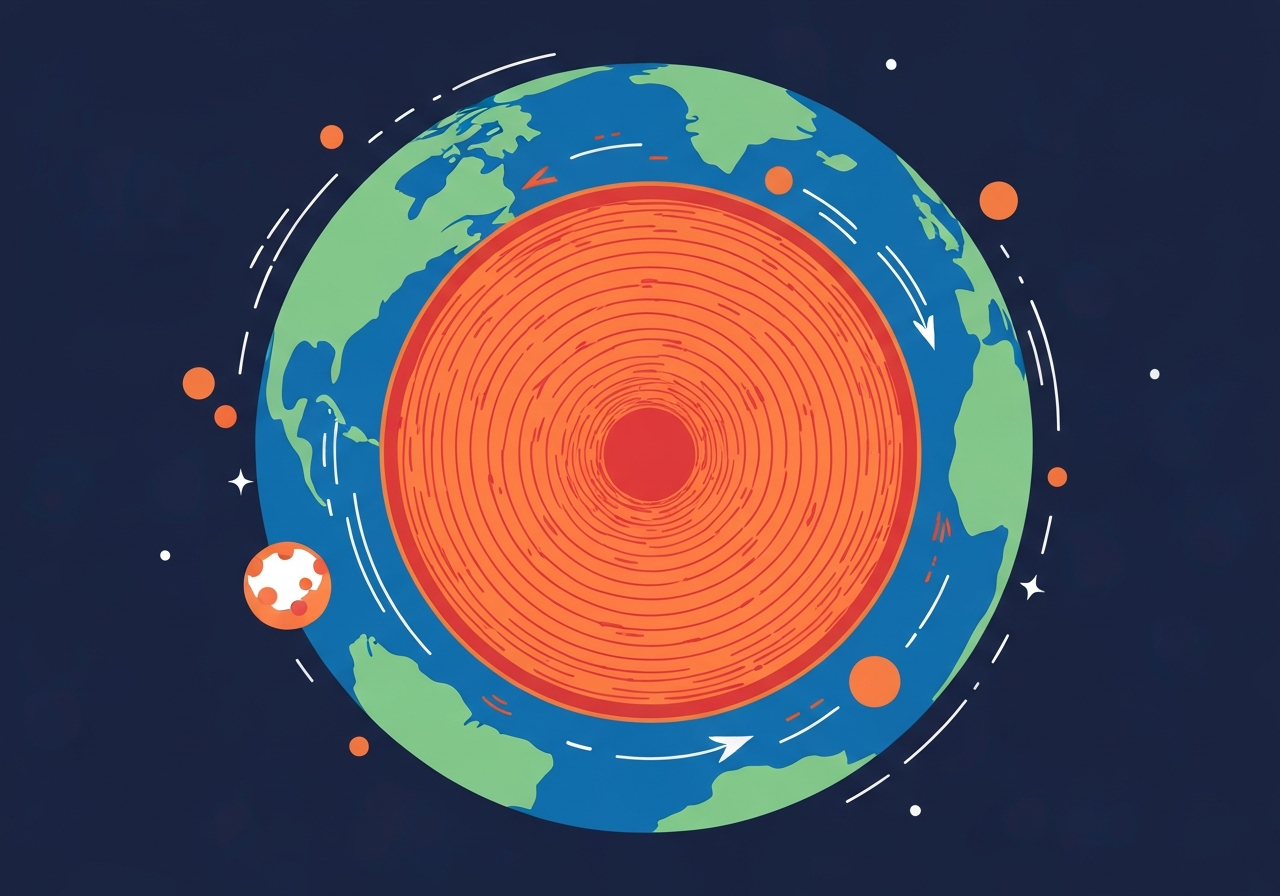
Researchers reported on 10 February 2026 that Earth’s metallic core may store a hydrogen mass equivalent to roughly nine to 45 modern oceans, a finding published in Nature Communications that shifts estimates of the planet’s internal volatile inventory. The team, led by Dongyang Huang of Peking University, used atom-scale measurements on laser-melted iron under high pressure to infer hydrogen concentrations that translate to 0.36%–0.7% of the core’s weight. If confirmed, the result implies much of Earth’s water-derived hydrogen was sequestered during the planet’s formation rather than delivered solely by late cometary impacts. That reallocation of hydrogen—core first, mantle and crust later—carries implications for early thermal evolution and the origin of Earth’s magnetic field.
Key Takeaways
- The new estimate: Earth’s core could contain hydrogen equal to about 9–45 oceans, corresponding to ~0.36%–0.7% of core mass, according to the 10 Feb 2026 paper in Nature Communications.
- Methodology: Researchers used diamond anvil cells, laser melting, and atom probe tomography to image and count atoms in iron samples at core-like conditions.
- Contrast with prior work: Earlier X-ray diffraction-based interpretations yielded a very wide range from ~10 ppm to 10,000 ppm (0.1 to >120 oceans).
- Timing implication: The data support hydrogen incorporation into the core during Earth’s main accretion phases, within the planet’s first million years.
- Uncertainties: The approach relies on assumptions about atomic partitioning and possible hydrogen loss during decompression; authors stress additional work is needed to refine the estimate.
- Broader significance: A hydrogen-rich core affects models of heat flow into the mantle and the early onset and power source of Earth’s magnetic field.
Background
The question of where Earth’s hydrogen and water originated—whether inherited during accretion or delivered later by comets and asteroids—remains central to planetary science and the emergence of habitable conditions. Earth formed more than 4.6 billion years ago from collisions of rocks, gas and dust in the protoplanetary disk; differentiation then separated metallic iron into a central core and silicate materials into mantle and crust. Under the extreme pressures and temperatures of core formation, light elements such as hydrogen can dissolve into molten iron, potentially becoming trapped at depth. Direct sampling of the core is impossible, so scientists infer composition from seismic observations, high-pressure experiments, and geochemical modeling, each with its own limitations.
Previous laboratory estimates of hydrogen in iron have varied widely. Techniques such as X-ray diffraction infer hydrogen indirectly by measuring expansion of iron lattices, producing estimates from parts per million to several percent by weight depending on experimental details and interpretation. Those wide ranges have left open competing scenarios for water delivery: an early, endogenous origin during accretion versus a late, exogenous delivery by volatile-rich bodies. The new study applies a different experimental route—atom probe tomography at high pressure—to provide a more direct atomic-scale count of hydrogen in iron synthesized under conditions intended to mimic core formation.
Main Event
The research team prepared iron samples and subjected them to core-like pressures in a diamond anvil cell, heating them with lasers to create a molten metallic phase representative of core-forming conditions. After rapid quenching and focused sharpening into needlelike specimens only ~20 nanometers in diameter, the samples were analyzed with atom probe tomography, which ionizes and sequentially counts individual atoms to build a three-dimensional chemical map. The experiments revealed how hydrogen associates with silicon and oxygen within iron nanostructures as the metal cooled, with observed H:Si ratios near 1:1 in those nanophases.
To translate these laboratory ratios into a global core hydrogen inventory, the authors combined their atom-probe observations with existing estimates of silicon content in the core derived from seismic and high-pressure studies. That coupling produced the headline estimate of 0.36%–0.7% hydrogen by core weight, which the team converted into an equivalent of about nine to 45 present-day oceans of hydrogen. The paper emphasizes that this estimate represents a lower bound under their experimental and interpretive assumptions.
The authors and independent reviewers note experimental caveats. Atom probe tomography requires decompressing and extracting samples for analysis, a step known to allow some volatile loss in other contexts; the new paper did not explicitly correct for hydrogen lost during decompression. The study also depends on how silicon, oxygen and hydrogen partition among phases at extreme conditions—a set of parameters that remain active topics of research. Because of these issues, the authors call for follow-up experiments and alternative approaches to verify and refine the magnitude of the core hydrogen reservoir.
Analysis & Implications
If the core contains hydrogen at the levels reported, that reorders the planet’s inventory of hydrogen and, by extension, water: the core would be the largest reservoir, the mantle and crust intermediate, and the surface the smallest. This internal reservoir could influence models of long-term volatile cycling, affecting how water is exchanged between deep Earth and the surface over geological time. A sequestered hydrogen pool also changes the thermal budget of the core: interactions among hydrogen, silicon and oxygen alter melting behavior and the way heat is released from the core to the mantle, with consequences for mantle convection and plate tectonics.
Another major implication concerns the magnetic field. The geodynamo that generates Earth’s magnetic field depends on energy and compositional buoyancy released from the core. If hydrogen and its interactions with other light elements affected early heat flow or compositional stratification, they may have helped initiate or sustain a magnetic field earlier than otherwise predicted—an important factor for surface habitability and atmosphere retention. The study links observed nanostructures to possible pathways for early heat release into the mantle.
For planetary formation theories, the findings favor significant incorporation of volatiles during accretion rather than exclusive late delivery. That does not exclude contributions from cometary or asteroidal impacts, but it strengthens models in which nebular gases and water-bearing solids present during the main growth phases participated in core formation. The result will prompt refinement of accretion models and reexamination of isotopic constraints used to trace water sources.
Comparison & Data
| Method | Estimate | Notes |
|---|---|---|
| X-ray diffraction (prior studies) | ~10 ppm – 10,000 ppm (~0.1 to >120 oceans) | Indirect lattice-expansion interpretation; wide range among experiments |
| Atom probe tomography (this study) | ~0.36%–0.7% (~9–45 oceans) | Direct atomic counts on laser-melted iron; depends on partitioning assumptions |
The table summarizes major numerical ranges from prior indirect methods and the new atom-scale approach. The prior X-ray diffraction-based studies produced highly variable outcomes because lattice expansion can reflect multiple light-element contributions and experimental conditions. The new technique aims to directly image and quantify individual atoms, reducing some interpretation steps but introducing other assumptions related to sample preparation, decompression losses, and how laboratory-scale nanostructures map onto planetary-scale phases. Reconciling these datasets will require interlaboratory replication and complementary methods such as high-pressure spectroscopy and improved seismic constraints on light-element composition.
Reactions & Quotes
Authors and independent experts welcomed the methodological advance while underlining remaining uncertainties. The lead author framed the result in terms of timing for when hydrogen joined core materials.
“Earth’s core would store most of the water in the first million years of Earth’s history.”
Dongyang Huang, Peking University
Huang’s statement summarizes the authors’ interpretation that hydrogen incorporation occurred during main accretion and core formation. The paper ties this sequestration to experimental observations of hydrogen-silicon relationships in iron nanostructures and to prior silicon estimates for the core.
Independent commentators noted the importance of hydrogen availability during growth phases and flagged methodological issues.
“Hydrogen can only enter the core-forming metallic liquid if it was available during Earth’s main growth phases and participated in core formation.”
Rajdeep Dasgupta, Rice University
Dasgupta, not part of the study, emphasized that the presence of hydrogen during accretion is a prerequisite for core storage and that this finding will feed into broader models for volatile behavior during planet assembly.
Another specialist pointed out potential upward revisions if hydrogen loss during decompression were accounted for.
“My previous work estimated 0.2% to 0.6% hydrogen—more than this new paper proposed—because decompression loss can increase uncertainty.”
Kei Hirose, University of Tokyo
Hirose’s comment highlights that independent methods have produced comparable or larger estimates and that experimental protocols around sample recovery remain an active source of uncertainty.
Unconfirmed
- The exact magnitude of hydrogen loss from samples during decompression remains unquantified for this dataset and could raise the true core hydrogen estimate.
- The translation from nanostructures in laboratory-quenched samples to equilibrium distributions in a planetary core relies on partitioning models that are not yet settled.
- Other light elements or chemical interactions not included in the study could alter inferred hydrogen concentrations when accounted for.
Bottom Line
The study introduces atom-scale measurements that push estimates of core hydrogen toward a substantial reservoir—perhaps holding the equivalent of nine to 45 oceans and accounting for roughly 0.36%–0.7% of core mass. This reorients thinking about where Earth’s water-derived hydrogen resided earliest in the planet’s history and supports scenarios in which significant volatile sequestration occurred during accretion rather than solely by late impacts.
However, the result is not definitive: methodological assumptions and potential hydrogen loss during recovery mean further experimental replication and complementary constraints are required. Follow-up work using alternative high-pressure techniques, improved partitioning data, and tighter seismic or cosmochemical constraints will determine whether the core truly is Earth’s dominant hydrogen reservoir and how that affects models of early thermal evolution, the geodynamo, and the planet’s volatile budget.