
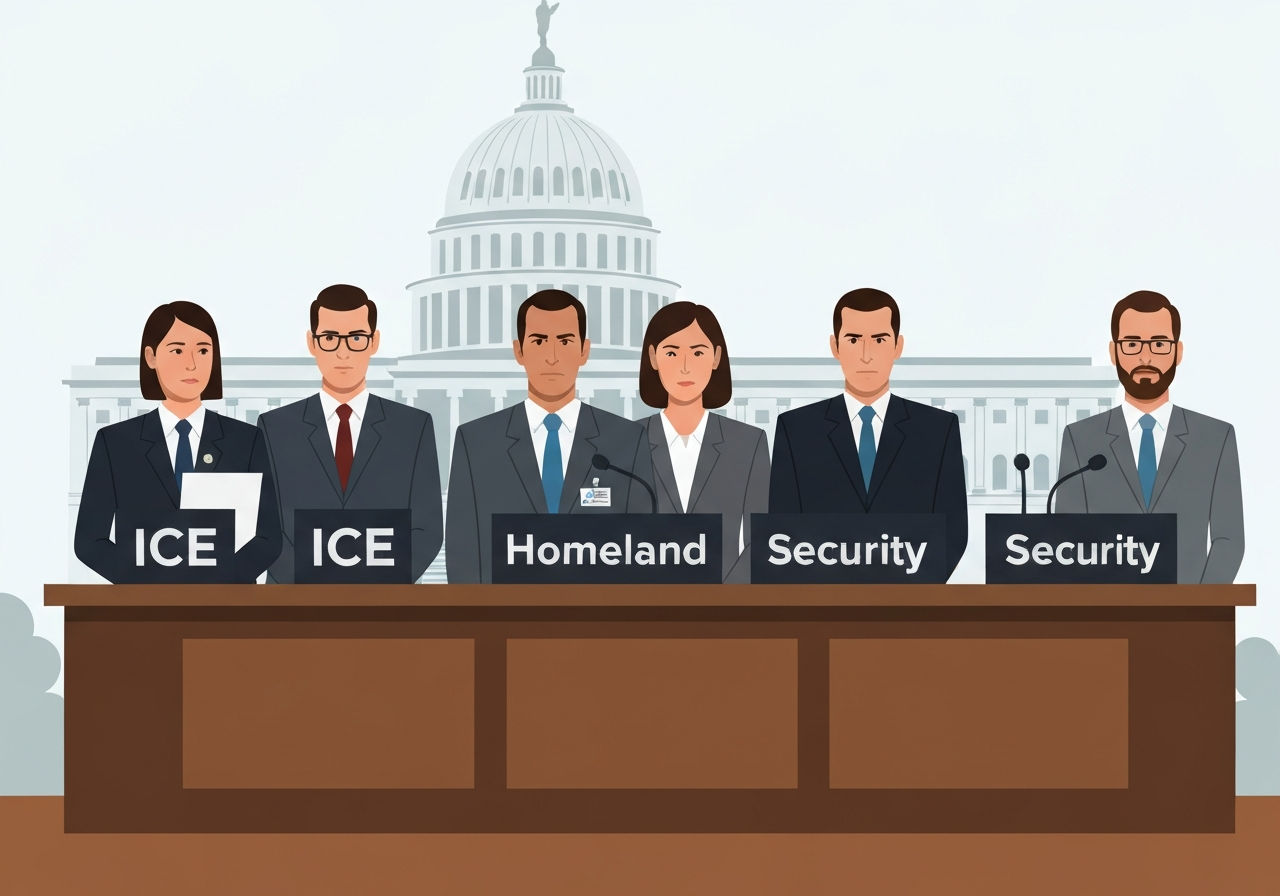
Lead: Senior immigration officials from ICE and Customs and Border Protection testified before the House Homeland Security Committee, facing sharply partisan questioning over enforcement tactics after recent clashes in Minneapolis and elsewhere. Witnesses included Todd Lyons, acting director of ICE, and Rodney Scott, commissioner of CBP; lawmakers pressed them about two recent deaths of U.S. citizens and videos showing aggressive tactics. Republicans defended agents and pointed to a surge in threats against personnel, while Democrats accused agencies of excessive force and demanded accountability. The session ended with no immediate policy change but heightened scrutiny and partisan division.
Key Takeaways
- Todd Lyons (acting ICE director) and Rodney Scott (CBP commissioner) testified before the House Homeland Security Committee about recent enforcement operations and confrontations with protesters.
- Committee exchanges highlighted two U.S. citizens killed in incidents tied to federal enforcement actions, identified in testimony as Pretti and Good.
- Lyons said roughly 3,000 of 13,000 ICE field agents have body cameras, while about 10,000 of 20,000 Border Patrol agents have them.
- Republican members cited a reported >16,000% rise in assault threats and an 8,000% rise in death threats to immigration officers between 2024 and 2025.
- ICE said training content remained intact amid a hiring surge, though timelines were condensed: inexperienced recruits undergo about three months of instruction; experienced hires may train in roughly 47 days; CBP academy training is 117 days.
- Contentious moments included a Democratic lawmaker calling agency tactics “fascist” and another demanding whether Lyons expected to “go to hell” over enforcement actions; Lyons declined to answer.
- Questions arose about the detention of a five-year-old, Liam Ramos, who was held with his father and released on 1 February after nearly two weeks in custody.
- Lawmakers debated whether federal enforcement will pause around the 2026 FIFA World Cup; Lyons said ICE is part of the event security apparatus and aims to keep visitors safe.
Background
Congressional scrutiny of immigration enforcement has intensified amid a wider national debate over border policy and tactics used by federal officers. Since the Trump administration stepped up deportation and interior enforcement, ICE and CBP have been central to a contentious political conversation: supporters emphasize public safety and rule of law, while critics point to civil-rights concerns and aggressive tactics. Recent high-profile confrontations in Minneapolis, and footage circulated by media outlets and activists, have driven renewed attention to how agents interact with protesters and civilians.
Oversight of DHS components like ICE and CBP often falls to the House Homeland Security Committee, where partisan divisions can shape the tenor and outcomes of hearings. Past investigations and reporting have already exposed weaknesses in training, internal investigations, and transparency—issues that lawmakers and civil-society groups continue to press. The agencies trace their modern roles to post-2002 reorganizations within DHS, but operational overlap and joint deployments have blurred distinctions between interior enforcement (ICE) and border policing (CBP).
Main Event
The hearing featured extended exchanges between Democrats pressing for accountability and Republicans defending agency conduct. Democrats repeatedly raised incidents captured on video—showing pepper spray deployed into vehicles and against restrained people—and sought confirmation about internal probes and personnel discipline. Lyons repeatedly declined to provide details about ongoing internal investigations or to confirm firings tied to misconduct, offering instead to follow up with committee requests.
Republican members framed the session around officer safety and rising threats to personnel. They presented statistics on threats against agents and emphasized crimes allegedly committed by noncitizens arrested by ICE in their districts. Lyons echoed those concerns, saying rhetoric against agents has risen to unprecedented levels and arguing that attacks on officers risk emboldening violence.
Several exchanges became heated. Representative Dan Goldman called agency tactics “un-American and outright fascist,” and challenged comparisons between ICE and historical police states; Lyons pushed back against that framing. New Jersey Democrat LaMonica McIver pressed Lyons with moral questions about responsibility for deaths linked to enforcement actions; the chair cut off the line of questioning after Lyons refused to respond. The committee also viewed footage of multiple incidents and asked whether procedures had been followed; CBP commissioner Scott said one pepper-spray clip shown was not proper procedure and pledged to report back on investigations.
Lawmakers also raised operational questions: how many officers wear body cameras, whether recruits receive consistent training amid a surge in hiring, and whether federal operations would be paused during major events like the 2026 FIFA World Cup. Lyons said body-camera coverage is incomplete but growing, that the “meat” of training remains intact even if schedules are shortened, and that ICE will coordinate as part of World Cup security planning.
Analysis & Implications
The hearing underscored the deep politicization of immigration enforcement oversight. With Congress divided, hearings like this often serve more to signal partisan priorities to constituencies than to produce immediate reforms. Democrats used the platform to document alleged abuses and press for accountability mechanisms; Republicans sought to shore up institutional legitimacy and highlight officer safety concerns. That dynamic makes bipartisan corrective action—such as uniform body-camera policies, standardized training reforms, or transparent disciplinary reporting—difficult but not impossible if bipartisan pressure coalesces.
Operationally, the testimony revealed persistent gaps in transparency: incomplete body-camera coverage, limited public information about internal investigations, and varying training timelines for new hires. Those gaps create both accountability deficits and legal risk for the agencies. If videos of questionable tactics proliferate without clear, timely investigations or disciplinary outcomes, public trust may erode further and spur state or federal action to impose oversight or procedural reforms.
Politically, the hearing will feed narratives on both sides ahead of 2026 events and future elections. Republicans can point to threats and arrests as evidence of necessity; Democrats can use videos and testimony to advocate for abolition, restriction, or reorganization—efforts already reflected in legislative proposals some members announced. International events such as the World Cup introduce practical stakes: large-scale gatherings could prompt temporary operational changes, public-relations challenges, and coordination questions between federal agencies and local authorities.
Comparison & Data
| Metric | ICE | Border Patrol (CBP) |
|---|---|---|
| Field agents (approx.) | 13,000 | 20,000 |
| Agents with body cameras | 3,000 | 10,000 |
| Typical recruit training | ~3 months (naïve recruit); 47 days (experienced) | 117-day academy |
| Reported rise in threats (2024→2025) | >16,000% assault threats; 8,000% death threats (as cited by committee Republicans) | |
The table shows the uneven deployment of body cameras and differing training regimes, which are central to oversight debates. Incomplete body-camera coverage complicates independent review of confrontations, and accelerated training timelines may raise questions about field readiness even if agencies assert curriculum consistency. The threat statistics cited by Republicans, if accurate, indicate a marked escalation in risks to personnel—and factor into arguments for bolstering officer protections and mental-health resources.
Reactions & Quotes
The hearing produced several forceful statements from lawmakers and officials. Below are representative excerpts with context.
“If you don’t want to be called a fascist regime or secret police, stop acting like one.”
Rep. Dan Goldman (Democrat)
Goldman pressed Lyons on documented instances where citizens were asked to prove their status, framing some tactics as comparable to historical authoritarian practices; Lyons rejected that line of questioning.
“I’m not going to entertain that question.”
Todd Lyons, Acting Director, ICE
Lyons refused to respond to a question about moral responsibility for deaths linked to enforcement actions and later declined to provide specifics about internal disciplinary actions pending investigations.
“There has never been anything like this under any other administration.”
Rep. Sheri Biggs (Republican) — paraphrased testimony emphasis on threats
Republicans cited dramatic percentage increases in threats against agents to argue that hostile rhetoric has consequences for officer safety and morale.
Unconfirmed
- The exact number of ICE agents fired for misconduct under current leadership was not confirmed during testimony; Lyons said he would follow up with data.
- Specific details of internal investigations into the pepper-spray and other force incidents shown to the committee were not finalized on the record; some cases remain under review.
- Allegations that a five-year-old (Liam Ramos) was used as “bait” were denied by Lyons; independent verification of all surrounding claims about that detention was not provided in the hearing.
Bottom Line
The hearing highlighted unresolved tensions between demands for robust immigration enforcement and calls for greater oversight and restraint. Key operational deficits—partial body-camera coverage, condensed training timelines, and limited public information on internal disciplinary actions—create persistent accountability gaps that fuel partisan conflict and public distrust.
Absent bipartisan agreement on transparency and procedural standards, hearings will likely continue to polarize rather than produce systemic reform. Watch for follow-up responses from DHS and for any committee requests or subpoenas that could compel disclosure of internal investigations, body-camera footage, and personnel records in the coming weeks.
Sources
- BBC — Live coverage of House Homeland Security hearing (news, live reporting)