
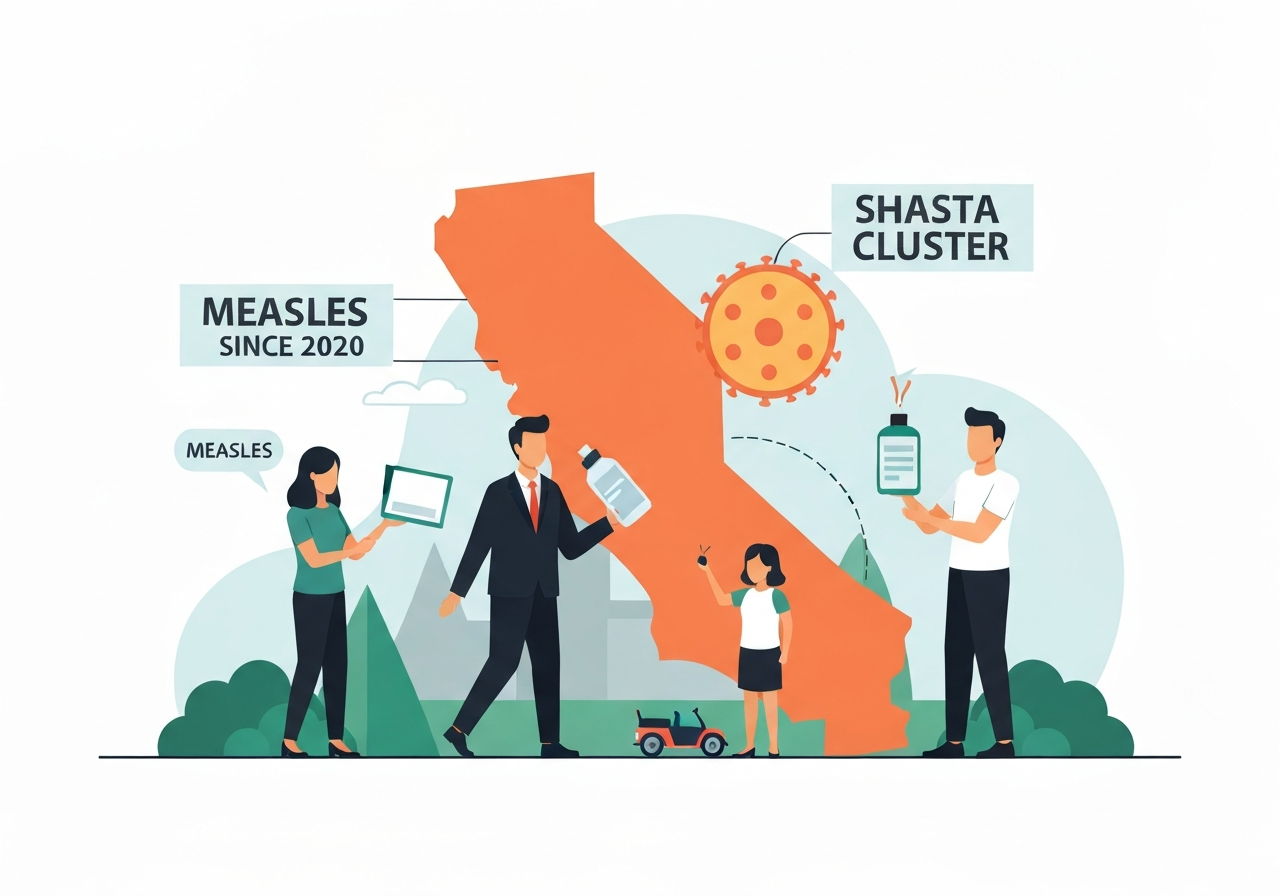
Lead: Seventeen measles cases have been reported across California since the start of 2026, marking the state’s first outbreak of the disease since 2020. The California Department of Public Health (CDPH) issued a health alert in early February after an eight-case cluster in Shasta County was identified as the largest grouping. Confirmed cases have also been recorded in Los Angeles, Orange, San Bernardino and Riverside counties, and investigators are examining additional suspected infections. Public health officials say most confirmed patients were unvaccinated or had unknown immunization histories, prompting renewed outreach and exposure notifications.
Key Takeaways
- Seventeen confirmed measles cases statewide since the start of 2026, with eight cases tied to a Shasta County cluster.
- CDPH issued a health alert in early February after cases emerged in multiple counties and investigators began contact tracing and notifications.
- All identified cases involved people who were unvaccinated or whose vaccination status was unknown, according to public health statements.
- Two infectious individuals visited Disneyland on Jan. 22 and Jan. 28, triggering targeted notifications for possible employee and guest exposures.
- Measles is highly contagious: CDPH notes roughly 90% of unvaccinated close contacts will become infected.
- California reported more than 95% MMR coverage among kindergarteners for 2024–2025, but local pockets with lower coverage can enable outbreaks.
- Infants as young as 6 months may receive an early MMR dose before travel to affected areas; the standard two-dose schedule remains the primary protection.
Background
Measles is an airborne viral illness that can linger in the air and on surfaces for hours after an infected person leaves a room, making it one of the most transmissible vaccine-preventable diseases. Widespread MMR vaccination established herd immunity in many parts of the U.S., and California’s public-school immunization rules have kept statewide kindergarten coverage above 95% for 2024–2025. However, statewide averages can mask communities or social networks where coverage is far lower, creating vulnerable pockets where the virus can spread quickly.
California’s last widely noted measles activity on record occurred in 2020; health officials now say the 2026 clusters represent the first notable surge since then. Public health response draws on contact tracing, exposure notifications, and rapid vaccination outreach to contain chains of transmission. Stakeholders include state and county public health departments, local healthcare providers, school systems, and large venues that can generate wide exposure, such as theme parks and mass gatherings.
Main Event
The CDPH health alert, issued in early February, came after local health departments reported a string of confirmed infections emerging across several counties. Shasta County investigators identified an eight-case cluster that appears linked by close contact among people who were not protected by vaccination. County and state teams began interviews, case finding and vaccination offers to close contacts.
As of Feb. 9, confirmed cases were reported in Los Angeles, Orange, San Bernardino and Riverside counties in addition to Shasta, and additional suspected cases remain under investigation. Two people known to have been infectious visited Disneyland on Jan. 22 and Jan. 28; state and local officials worked with the park to notify potentially exposed employees and visitors and to advise those who develop symptoms to contact a healthcare provider.
Public messaging emphasized classical measles symptoms — high fever, cough, runny nose, red eyes and a spreading rash — and warned of severe complications such as pneumonia and encephalitis, particularly among young children and unvaccinated individuals. Health authorities reiterated that two doses of MMR offer strong protection and that infants traveling to areas with active transmission can receive an early dose at six months, followed by the routine two-dose series.
Analysis & Implications
The current cluster highlights how high statewide coverage does not eliminate risk when immunity is unevenly distributed. Localized clusters of unvaccinated people can sustain transmission even when the broader population remains well immunized. Public-health experts warn that the incubation period of one to two weeks can conceal additional cases for several cycles of transmission, producing delayed secondary waves if exposures reach susceptible networks.
Operationally, the outbreak requires rapid, targeted responses: identifying contacts, verifying immunization records, offering vaccines, and communicating with institutions such as schools and employers. Large public venues that draw visitors from many regions pose particular challenges for timely exposure notification, as seen with the Disneyland visits. The need to reconcile guest privacy with public health outreach complicates notifications and may slow identification of subsequent cases.
On policy and community levels, the surge may prompt renewed emphasis on vaccination clinics, school-entry checks, and outreach to communities with lower coverage. Long-term implications include reassessing gaps in vaccine access or hesitancy, bolstering the digital vaccination record systems used by families and providers, and maintaining surge capacity for contact tracing during clustered outbreaks.
Comparison & Data
| Location | Confirmed Cases |
|---|---|
| Shasta County | 8 |
| Los Angeles, Orange, San Bernardino, Riverside (combined) | 9 |
| California total (since start of 2026) | 17 |
The table shows the current confirmed counts and highlights that the Shasta cluster accounts for nearly half of the statewide total. Public-health responders note that suspected cases under investigation could raise the total, and that the distribution across counties may change as investigations conclude and laboratory confirmations arrive.
Reactions & Quotes
“If it comes into a group of people who are not protected, then you’re at risk because it’s so easily transmitted,”
Dr. Yasuko Fukuda, pediatrician and immediate past chair, AAP California chapter
Dr. Fukuda emphasized the ease with which measles spreads among unvaccinated networks and warned that secondary waves often follow exposures in public settings. Her remarks reflect clinicians’ expectations that additional cases often appear after initial transmission chains seed susceptible households and communities.
“It absolutely could indicate that it’s an iceberg and there could be many more cases,”
Dr. Monica Gandhi, infectious disease expert, UCSF
Dr. Gandhi framed the cluster as a potential signal of wider, undetected transmission and urged vigilance in testing and vaccination. Public-health officials said rapid testing, prompt reporting and outreach to close contacts are central to determining the full scope.
“California reported more than 95% MMR coverage among kindergarteners for the 2024–2025 school year, but that statewide average can conceal pockets of lower coverage,”
California Department of Public Health (official statement)
CDPH used the statement to stress that high population-level rates do not eliminate the risk posed by local immunity gaps and reiterated guidance on early infant dosing and two-dose schedules for reliable protection.
Unconfirmed
- Additional suspected cases remain under investigation; the final case count could rise if laboratory confirmations or new reports are returned.
- The full transmission chains linked to the Disneyland exposures have not been publicly detailed; the extent of onward spread from those visits is still being established.
- Detailed vaccination histories for several confirmed patients are incomplete or recorded as unknown; specific reasons for vaccine gaps (access, hesitancy, exemptions) have not been confirmed publicly.
Bottom Line
This outbreak underscores that measles can re-emerge quickly when the virus reaches groups with low immunity, even in states with strong overall vaccination rates. The immediate priorities are rapid case finding, clear exposure notifications — particularly for large venues with wide visitor reach — and accessible vaccination services to close immunity gaps.
For most people, two doses of MMR provide strong protection; families planning travel or attending large gatherings should verify immunization records and consult health providers about early infant dosing or catch-up vaccination as needed. Public-health officials will continue contact tracing and laboratory confirmation; the situation will depend on how quickly at-risk contacts are identified and vaccinated.
Sources
- SFGATE — reporting on the Shasta County outbreak (local news)
- California Department of Public Health (CDPH) (official state public health guidance and alerts)
- Centers for Disease Control and Prevention — Measles (federal public health information on measles transmission and vaccination)