
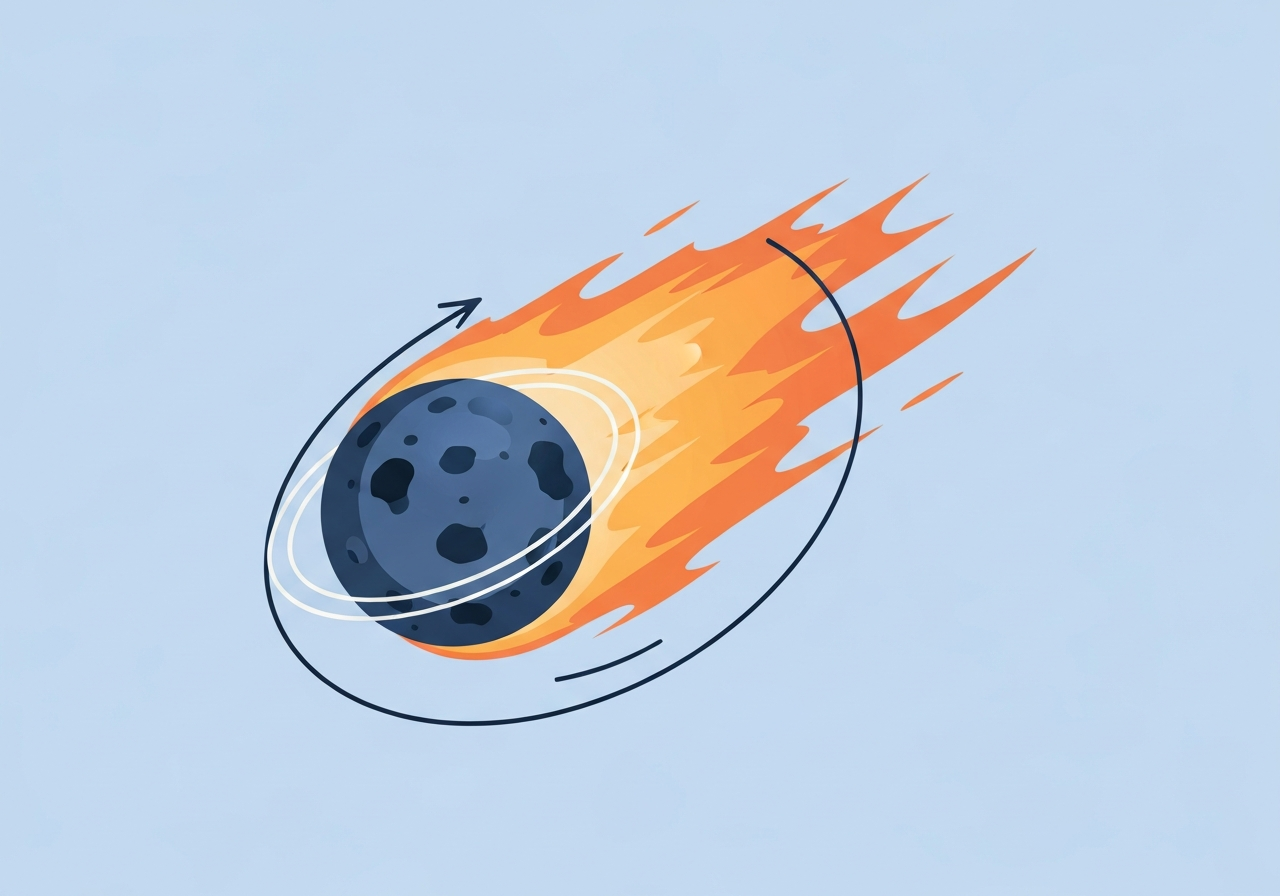
Lead: In 2017, as Comet 41P/Tuttle-Giacobini-Kresák neared the Sun, its rotation decelerated over weeks until the nucleus stopped spinning and then began rotating in the opposite direction. Astronomer David Jewitt (UCLA) analyzed Hubble Space Telescope images from that approach and reported the reversal in a recent arXiv preprint ahead of publication in The Astronomical Journal. The behavior is unprecedented in the record of small comets and points to powerful outgassing torques reshaping tiny bodies in the inner solar system.
Key Takeaways
- Object: Comet 41P/Tuttle-Giacobini-Kresák was observed by Hubble in 2017 as it moved inward toward the Sun; those images show a full reversal of its rotation.
- Discovery: David Jewitt (UCLA) published analysis on arXiv in early February 2026 reporting the spin flip; the paper is pending peer-reviewed publication in The Astronomical Journal.
- Timescale: The transition from a steadily shortening day to a stopped rotation and then to retrograde spin occurred over a matter of weeks during the 2017 perihelion approach.
- Mechanism: Researchers point to asymmetric jets of escaping gas and dust (outgassing) as the most plausible torque source altering the nucleus’ angular momentum.
- Significance: The magnitude and speed of the change exceed previously recorded comet spin variations and may indicate a pathway for small comets to fragment or be disrupted.
- Observational basis: The finding rests on time-series imaging from the Hubble Space Telescope complemented by ground-based photometry and rotational-state modeling.
Background
Comets are icy remnants from the solar system’s formation that originate in cold reservoirs beyond the giant planets. When gravitational perturbations drive some inward, solar heating causes volatile ices to sublimate, producing the coma and familiar tails. The same sublimation process can produce localized jets that act like small rocket engines, imparting torque to the solid nucleus.
Rotational changes driven by outgassing are a known phenomenon; spacecraft and telescopic campaigns have recorded measurable period shifts in several comets. However, prior cases involved gradual lengthening or shortening of the rotation period. A complete stop and reversal of spin, on the timescale and amplitude reported for 41P in 2017, has not previously been documented in the literature.
Main Event
Jewitt used Hubble images taken during 41P’s 2017 inner‑solar‑system passage to construct a time series of the comet’s rotational state. Observers noted that the interval between apparent surface features or brightness modulations shortened substantially, indicating a rapid spin‑up in one sense before the trend reversed. Over several weeks the apparent day length converged toward an effectively infinite rotation period as the spin approached zero.
Following the momentary halt, subsequent frames showed the nucleus rotating in the opposite (retrograde) direction. Jewitt’s analysis modeled the nucleus’ angular momentum and found that asymmetric mass loss from one or more active regions could supply the required torque to first decelerate and then reverse the spin axis direction. The Hubble imagery provided the spatial resolution needed to separate nucleus-driven changes from transient coma features.
Independent commentators noted that while rotational evolution through outgassing is plausible, the precise geometry and timing of the active jets on 41P remain under study. Ground-based photometry taken around the same interval supports the Hubble-derived trend but cannot, by itself, resolve the small nucleus shape or the exact placement of localized vents.
Analysis & Implications
The 41P spin reversal challenges current models of cometary rotational dynamics because it demonstrates that relatively small torques, applied persistently and from favorable lever arms, can produce large changes in angular momentum over short periods. If common, such events could accelerate the erosion and mechanical weakening of small comet nuclei, raising the likelihood of fragmentation during perihelion passages.
For solar‑system science, the case highlights the sensitivity of tiny bodies’ rotation states to outgassing geometry. Models that predict long‑term survival of small comets must account for episodic, high‑leverage jetting that can both reorient and destabilize nuclei. This has knock‑on effects for estimating the size distribution of near‑Sun comet remnants and for interpreting transient meteor streams fed by disrupted fragments.
Practically, the result underscores the value of high‑resolution, time‑resolved imaging (Hubble, large ground telescopes and future space observatories) during comet approaches. Frequent imaging across an apparition is necessary to capture rapid rotational transitions and to separate nucleus evolution from coma variability. In turn, better constraints on active region locations and strengths will improve torque‑driven evolution models.
Comparison & Data
| Comet | Observation Year | Reported Rotational Change |
|---|---|---|
| 41P/Tuttle-Giacobini-Kresák | 2017 | Rotation halted and reversed (Hubble imaging) |
| 67P/Churyumov–Gerasimenko | 2014–2016 | Measured spin-rate variations during Rosetta mission |
| Other small comets | Various | Modest period changes from outgassing |
The table summarizes the qualitative difference: 41P’s behavior is an order‑of‑magnitude larger in effect and faster in timescale than typical period shifts recorded to date. That contrast suggests either unusual jet geometry on 41P or that similar extreme events are rare but can be missed without dense temporal coverage.
Reactions & Quotes
We have seen comets change spin before, but not with such magnitude and so quickly.
David Jewitt, UCLA (astronomer)
Jewitt emphasized the uniqueness of the observation and the role Hubble’s resolution played in confirming a full reversal rather than a transient photometric artifact.
Outgassing jets can act like rocket motors; exactly how they conspire to flip a spin like this remains unclear.
Dennis Bodewits, Auburn University (astronomer)
Bodewits noted that jet physics and localized surface behavior on nuclei are still poorly constrained and that additional targeted monitoring is needed.
Unconfirmed
- The precise configuration and number of active jets on 41P during 2017 have not been definitively mapped and remain a modeling assumption.
- Whether the reversal was a single event or part of a longer sequence of torque reversals across multiple apparitions is not yet established.
- It is still uncertain if such reversals commonly lead to fragmentation in small comets or if 41P represents an atypical case.
Bottom Line
The Hubble-derived finding that Comet 41P stopped rotating and then spun backward in 2017 represents a novel and significant example of cometary rotational evolution driven by outgassing. The event pushes current theoretical models and shows that small bodies can undergo rapid angular‑momentum changes on observable timescales.
Follow‑up observations and targeted monitoring of comets during perihelion passages are now a priority to determine how frequent such reversals are and whether they presage breakup. Better constraints on jet location, nucleus shape and mass‑loss rates will be essential to predict the long‑term fates of small comet nuclei.