
Lead
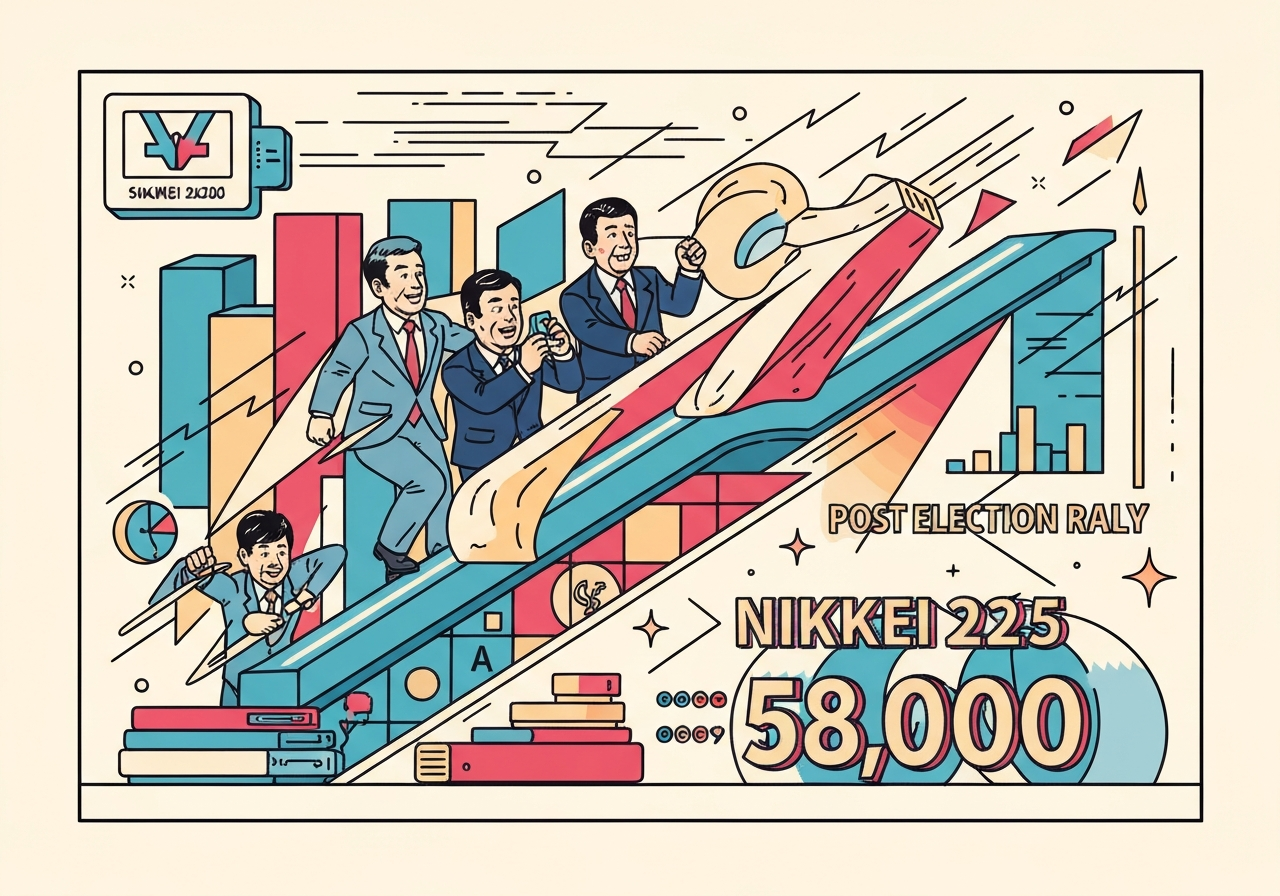
On Feb. 12, 2026, Japan’s Nikkei 225 climbed past 58,000 for the first time in history, extending a post‑election rally tied to Prime Minister Sanae Takaichi’s Lower House landslide. The index later pared gains to trade near 57,663, while the broader Topix rose 0.68%. Traders and strategists attributed the move to renewed confidence in Tokyo’s domestic politics and the ruling administration’s economic agenda, even as concerns about yen weakness and potential policy intervention linger. Regional markets largely followed suit, with several Asian benchmarks reaching new highs.
Key Takeaways
- The Nikkei 225 hit an all‑time intraday peak above 58,000 on Feb. 12, 2026, before settling around 57,663.
- Topix advanced 0.68% on the same session, reflecting gains across large‑cap Japanese stocks.
- Analysts attribute the surge to the so‑called “Takaichi trade” after Prime Minister Sanae Takaichi’s snap‑election landslide, seen as a multi‑year policy mandate by some investors.
- GMO Investment flagged a supportive outlook for domestic markets but warned yen intervention risk could rise if USD/JPY approaches 160.
- Across Asia, South Korea’s Kospi climbed to a record intraday 5,466.9 (up as much as 2.1%), Singapore’s benchmark crossed 5,000 for the first time, and Australia’s S&P/ASX 200 rose 0.42%.
- U.S. markets cooled after stronger‑than‑expected payrolls: January nonfarm payrolls rose 130,000 versus a Dow Jones estimate of 55,000, reducing odds of near‑term Fed cuts.
Background
Prime Minister Sanae Takaichi called a snap Lower House election in early 2026 and secured a decisive victory that market participants widely interpreted as a clear policy mandate. That outcome has sharpened investor focus on her administration’s economic priorities, including corporate‑friendly reforms and measures intended to boost domestic investment. Market participants soon labeled the reaction the “Takaichi trade,” a shorthand for positioning toward Japanese equities and cyclicals expected to benefit from pro‑growth policies.
Japan’s equity market has historically been sensitive to both domestic political shifts and exchange‑rate moves. A weaker yen tends to lift exporters’ revenue in yen terms and can boost headline index levels, but excessive currency weakness prompts talk of official intervention; the threshold often cited by market participants is around 160 yen to the dollar. After years of low volatility, the current combination of political clarity and favorable earnings revisions has drawn fresh flows into Japanese shares.
Main Event
On Feb. 12, the Nikkei 225 pierced the 58,000 mark intraday, a milestone many investors had not expected this early in the rally. By mid‑session the index had retraced some gains and was trading near 57,663, while Topix advanced 0.68%, signaling broad participation beyond a few headline names. Market commentary tied the move directly to investor reaction to Takaichi’s victory and the anticipated policy continuity and potency it implies.
The rally in Tokyo echoed across Asia. South Korea’s Kospi surged as much as 2.1% to a record 5,466.9 before easing back to trade roughly 1.82% higher. Singapore’s main index climbed above the 5,000 threshold for the first time, and Australia’s S&P/ASX 200 rose about 0.42% in early trade. Hong Kong’s Hang Seng fell 0.23% while mainland China’s CSI 300 added 0.12%—mixed moves reflecting local drivers and differing exposures to global monetary cues.
Overnight in the U.S., stronger labor market data undercut expectations for near‑term Federal Reserve easing: the Dow Jones Industrial Average closed at 50,121.40, down 66.74 points (-0.13%), the S&P 500 was roughly flat at 6,941.47, and the Nasdaq Composite fell 0.16% to 23,066.47. The January nonfarm payrolls report—130,000 jobs added versus a consensus of 55,000—appeared to temper the bullish case for faster rate cuts, influencing cross‑border risk sentiment.
Analysis & Implications
The immediate market response shows how political clarity can accelerate asset reallocation. A convincing electoral victory for Takaichi reduces policy uncertainty and raises the probability of fiscal or structural initiatives that benefit corporate profits and investor confidence. Portfolio flows into Japan may persist if investors expect multi‑year policy continuity and improved corporate governance or shareholder returns.
However, gains driven in part by a depreciating yen carry tradeoffs. While a weaker currency lifts reported earnings of exporters, it also raises the specter of official intervention to prevent disorderly moves. GMO and other market strategists caution that intervention risk rises as USD/JPY approaches 160—an implicit limit that could trigger market‑moving actions by authorities.
Global monetary conditions complicate the outlook. Strong U.S. payrolls reduced the odds of swift Fed easing, which can support the dollar and pressure other currencies, thereby amplifying the yen move. If U.S. rates remain higher for longer, the yen may feel sustained downward pressure, forcing Japanese policymakers to respond, which would alter the market calculus for equities and bonds.
Comparison & Data
| Index | Session Move | Notable Level |
|---|---|---|
| Nikkei 225 | Intraday peak above 58,000; traded ~57,663 | 58,000 (first time) |
| Topix | +0.68% | Broad large‑cap gains |
| Kospi | Up as much as 2.1%; settled ~+1.82% | 5,466.9 (intraday record) |
| S&P/ASX 200 | +0.42% | Early session gains |
| Hang Seng | -0.23% | Relative weakness in HK |
The table summarizes session moves across major Asia‑Pacific indices on Feb. 12, 2026 and places the Nikkei’s milestone in regional context. While Tokyo led with a headline record, momentum varied by market depending on local economic data, sector composition and currency exposure.
Reactions & Quotes
“Takaichi’s snap‑election landslide gives her an unusually strong, multi‑year mandate to execute policy, which we view as broadly supportive for Japan’s markets and corporate sector.”
GMO (investment firm commentary)
GMO’s public commentary framed the election outcome as a structural tailwind for equities, while simultaneously flagging FX risk if the yen weakens further. That dual message—supportive for stocks but cautious on currency—has become a recurring theme among institutional strategists.
“Nonfarm payroll employment increased by 130,000 in January, reflecting continuing job growth.”
Bureau of Labor Statistics (Jan 2026 report)
The BLS numbers reinforced a stronger U.S. labor market narrative, which in turn reduced immediate expectations for Federal Reserve easing and influenced global cross‑asset flows. Market participants noted the contrast between resilient U.S. jobs and mixed consumer spending data.
“The recent rally shows investors are pricing in political certainty and a tilt toward growth‑oriented policies in Tokyo.”
Market analysts (aggregated commentary reported by major outlets)
Analysts quoted by financial news services described the rally as politically driven, with traders positioning for policy actions that could boost profitability for domestically exposed sectors as well as exporters benefiting from a weaker yen.
Unconfirmed
- Specific timing and scale of any official yen intervention remain unannounced; market commentary has signaled only increased risk as USD/JPY nears 160.
- Exact policy measures Takaichi will deploy that might materially boost corporate earnings over a multi‑year horizon are not yet detailed in enacted legislation.
- Whether foreign portfolio inflows into Japan will sustain the Nikkei’s advance beyond near‑term political optimism is uncertain and depends on global rate and FX dynamics.
Bottom Line
The Nikkei’s breach of 58,000 on Feb. 12, 2026 underscores how decisive political outcomes can rapidly reshape market expectations. Investors rewarded perceived policy certainty, driving broad gains across Japan and parts of Asia even as U.S. macrodata introduced headwinds for risk assets elsewhere.
Looking ahead, the durability of this rally hinges on three linked variables: the trajectory of Japan’s policy implementation under Prime Minister Takaichi, currency moves—especially USD/JPY around the 160 level—and the global interest rate backdrop shaped by U.S. labor market strength. Traders and policymakers will be watching all three closely; any sign of disorderly FX moves or unexpected policy shifts could prompt rapid reassessment.