
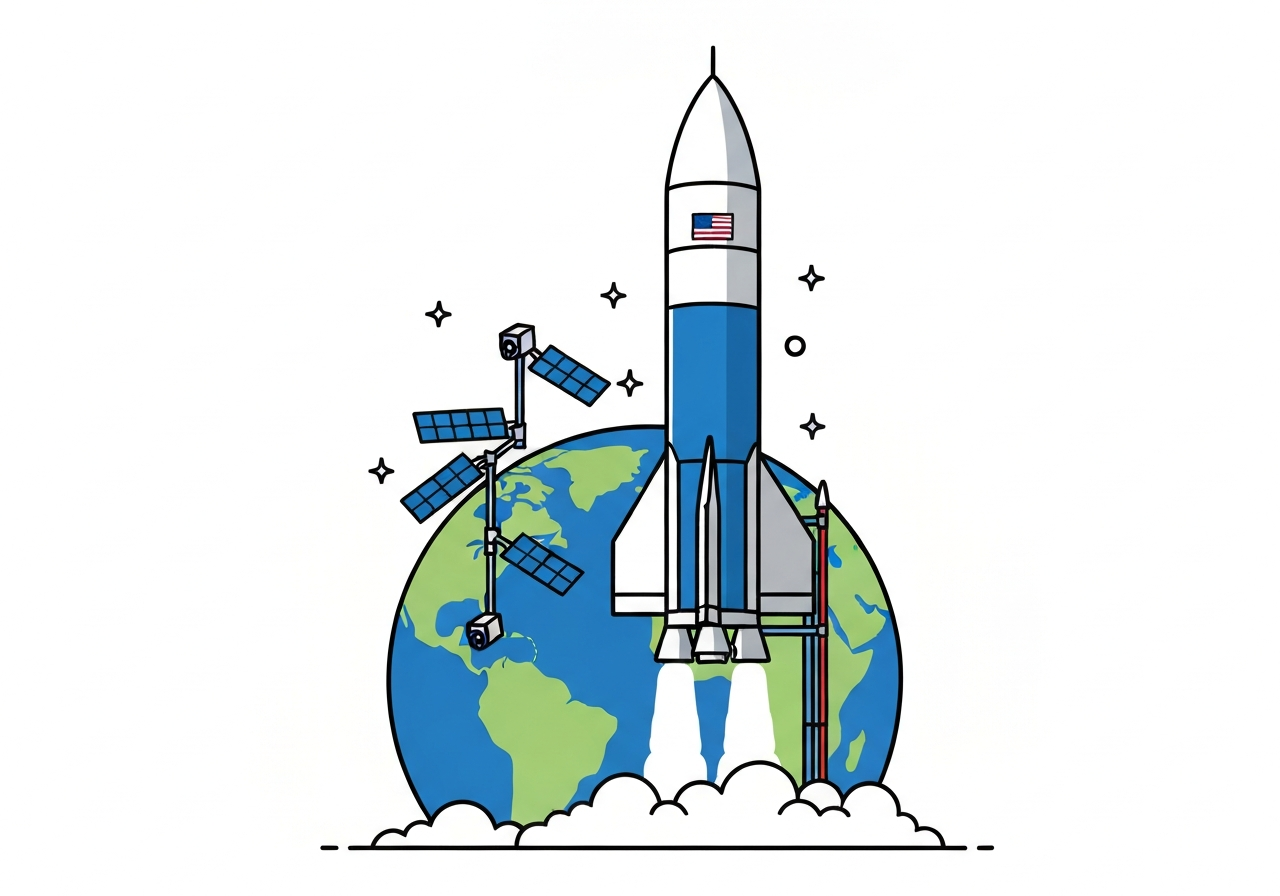
At 4:22 a.m. ET (0922 GMT) on Feb. 12, a United Launch Alliance Vulcan Centaur rocket lifted off from Cape Canaveral Space Force Station carrying the USSF-87 mission for the U.S. Space Force. The flight delivered two Northrop Grumman-built satellites for the Geosynchronous Space Situational Awareness Program (GSSAP) into trajectories bound for geostationary orbit. The payloads and several research-and-development experiments aim to improve tracking and maneuvering precision for U.S. assets in GEO and to provide enhanced collision-warning capability for operators in that crowded orbital regime.
Key takeaways
- The Vulcan Centaur launched USSF-87 on Feb. 12 at 4:22 a.m. ET from Cape Canaveral Space Force Station, Florida.
- Primary payloads were two GSSAP satellites built by Northrop Grumman to monitor activity in geostationary orbit (GEO), 22,236 miles (35,785 km) above Earth.
- GSSAP now has eight spacecraft produced in pairs across launches in July 2014, August 2016, January 2022, and Feb. 2026 for a total of two on this mission.
- USSF-87 also carried experimental R&D payloads intended to refine orbital maneuver precision and resilience of GEO assets.
- This was the fourth Vulcan Centaur flight overall and the rocket’s third national-security-capable mission variant (VC4S) using four solid rocket boosters.
- Following earlier test flights, the Space Force certified Vulcan Centaur for national security launches; ULA is now one of two certified providers alongside SpaceX.
- Vulcan Centaur is rated to fly from Cape Canaveral and Vandenberg and can be configured with up to six SRBs for higher performance.
Background
Geostationary orbit (GEO) sits roughly 22,236 miles (35,785 kilometers) above Earth’s equator where satellites match Earth’s rotation and appear fixed over a single longitude. Because weather, communications and many reconnaissance assets operate there, GEO is strategically valuable but increasingly congested as more nations and companies place busier constellations and larger platforms into that ring. Operators rely on surveillance sensors and tracking data to predict close approaches and to plan collision-avoidance maneuvers.
The Geosynchronous Space Situational Awareness Program (GSSAP) was created to give the U.S. a dedicated, high-performance sensor suite in GEO. Northrop Grumman has supplied GSSAP spacecraft in earlier batches, with two each launched in July 2014, August 2016 and January 2022, and the new pair extends that coverage. The Space Force has described GSSAP as a “neighborhood watch” capability in the GEO arena, a role that becomes more important as private and government actors increase traffic and operational complexity there.
Main event
The Vulcan Centaur climbed away on its VC4S configuration, meaning the core stage was augmented with four solid rocket boosters to provide the thrust required to reach the delivery trajectory. ULA reported a clean ascent profile and stage separations; the upper-stage Centaur performed the burns needed to dispatch the primary payloads toward geostationary transfer. Ground telemetry indicated nominal performance through the critical early phases of flight.
After separation, the two GSSAP satellites will use their own propulsion to reach final GEO positions where they will begin on-orbit checkout and calibration. Space Force officials said the satellites will join previously deployed GSSAP vehicles to improve positional awareness in GEO, enable more timely warnings of potential close approaches, and support collision-avoidance decision-making for U.S. and allied operators.
USSF-87 also included experimental R&D payloads intended to advance maneuvering precision and robustness of GEO platforms. These demonstrations are intended to feed engineering upgrades that can be applied to both civilian and military satellites to reduce risk from debris and conjunctions. ULA noted the mission was the company’s fourth Vulcan Centaur flight and part of a broader campaign of national-security launches the vehicle is slated to perform.
Analysis & implications
Adding another pair of GSSAP satellites strengthens the Space Force’s ability to monitor the GEO belt continuously and to produce higher-fidelity orbital predictions. Better tracking reduces uncertainty in conjunction assessments and shortens the decision window for satellite operators, which can lower the operational cost and risk of avoidance maneuvers. For the civil and commercial community, improved public or shared data streams could translate into safer operations for all actors in GEO.
The certification of Vulcan Centaur for national-security missions marks an important diversification of U.S. launch options. With ULA certified alongside SpaceX, the U.S. now has two qualified providers for military and intelligence payloads, reducing schedule risk and dependence on a single supplier. Over two dozen national-security missions have been planned for Vulcan, a pipeline that could change competitive dynamics and pricing in the national-security launch market.
Strategically, persistent surveillance in GEO has both cooperative and competitive consequences. While collision-warning and spaceflight-safety functions benefit all operators, detailed monitoring of other nations’ satellites can be perceived as intrusive, and transparency around mission intent and data-sharing will influence international reception. Longer term, nations will need updated norms and potentially formal agreements to manage congestion and mitigate misperceptions about maneuvering and inspection activities.
Comparison & data
| Item | Date | Notes |
|---|---|---|
| GSSAP launch pair 1 | July 2014 | Two satellites |
| GSSAP launch pair 2 | August 2016 | Two satellites |
| GSSAP launch pair 3 | January 2022 | Two satellites |
| GSSAP launch pair 4 (USSF-87) | Feb. 12, 2026 | Two satellites |
The table above shows GSSAP deployments to date, each delivered in two-satellite batches. That incremental approach lets operators expand coverage while spacing procurements and launches across years to incorporate upgrades; the Feb. 12 addition brings the fleet’s total to eight craft. On the launcher side, Vulcan’s VC4S variant used four SRBs on this mission; Vulcan can be outfitted with up to six SRBs for heavier or higher-energy payloads.
Reactions & quotes
Space Force officials framed the mission as a boost to GEO safety and situational awareness, emphasizing the program’s contribution to collision avoidance for all operators. The statement highlighted the role of GSSAP data in producing timely orbital predictions that support safer operations in geostationary space.
They provide ‘neighborhood watch’ services in the geostationary Earth arena, improving flight safety for all spacefaring nations operating in that orbit.
U.S. Space Force (official statement)
United Launch Alliance characterized the flight as another step in maturing the Vulcan Centaur family for national-security customers after earlier test flights and return-to-flight efforts. ULA noted the VC4S configuration is now a proven option for missions that require extra lift to reach GEO transfer orbits.
The successful USSF-87 mission demonstrates Vulcan’s capability to deliver critical national-security payloads to GEO trajectories.
United Launch Alliance (press release)
Industry analysts welcomed the additional surveillance capability but cautioned that increased monitoring can raise diplomatic questions if not paired with transparency. Analysts expect continued debate about data-sharing, norms of behavior in GEO and how to balance national security objectives with cooperative spaceflight safety.
Enhanced GEO surveillance improves operational safety, but it also requires international dialogue to avoid misperception.
Independent space analyst
Unconfirmed
- Specific classified capabilities or sensor performance metrics of the new GSSAP pair have not been publicly disclosed and remain unconfirmed.
- Detailed timelines for when each GSSAP satellite will reach its permanent GEO slots and complete on-orbit commissioning were not published at the time of launch.
- The exact inventory and technical descriptions of all R&D experiments aboard USSF-87 were only broadly described by officials and lack full public documentation.
Bottom line
The Feb. 12 USSF-87 launch extends the U.S. Space Force’s dedicated GEO surveillance capability with two additional GSSAP satellites and several experimental payloads focused on maneuvering precision and resilience. The addition strengthens conjunction awareness and collision-warning functions that help protect both military and civil space assets in the increasingly busy geostationary belt.
For ULA, the mission reinforced Vulcan Centaur’s role as a certified national-security launcher and diversified U.S. access to GEO delivery services alongside SpaceX. Observers should watch how data-sharing, international transparency and technical standards evolve to translate improved surveillance into safer, more cooperative operations in GEO.
Sources
- Space.com — independent news coverage of the launch (media).
- United Launch Alliance — company press and mission details (commercial/official).
- U.S. Space Force — official statements and mission context (government/official).
- Northrop Grumman — manufacturer information for GSSAP spacecraft (industry/official).