
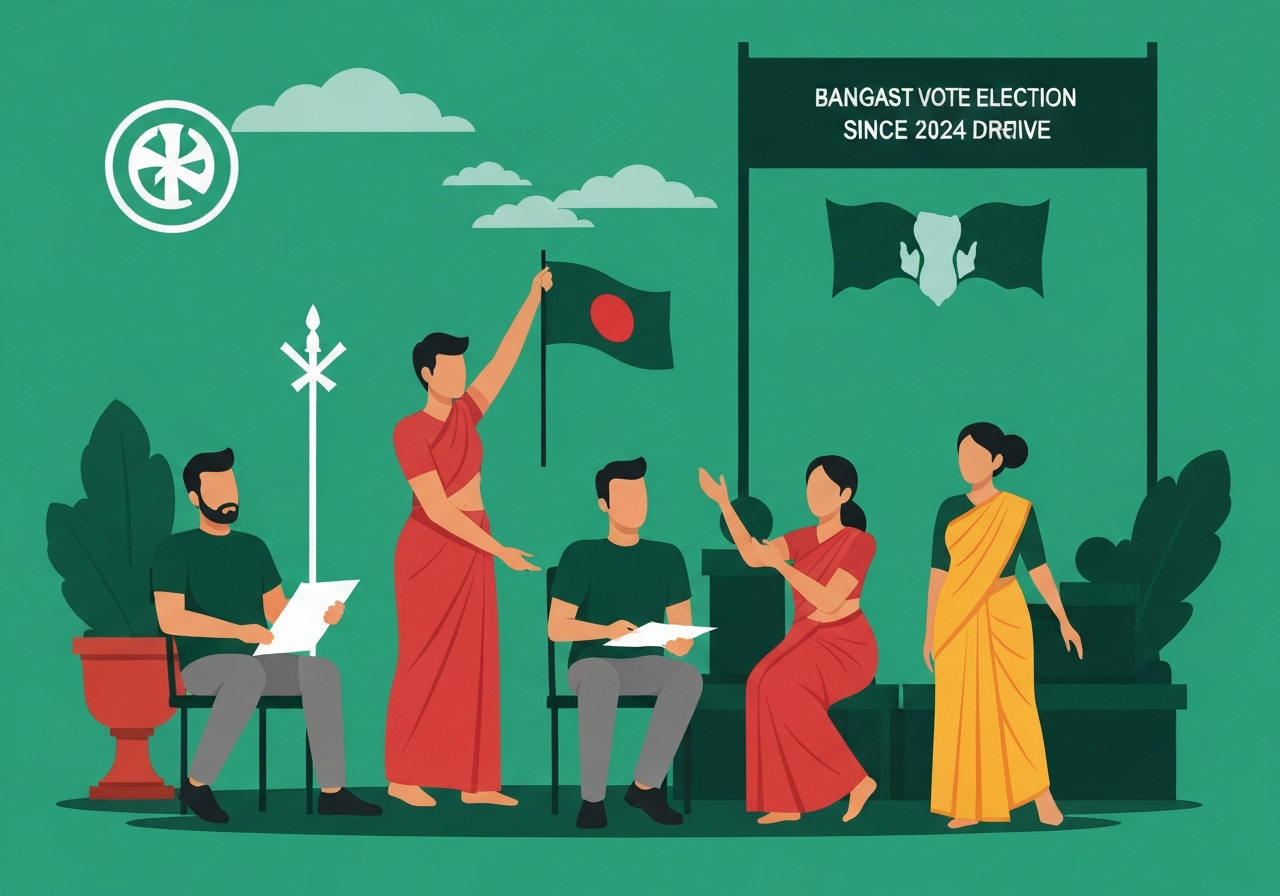
Lead: On Thursday, Bangladesh held its first parliamentary election since the mass protests of 2024 toppled Prime Minister Sheikh Hasina’s government. Voting across Dhaka and the rest of the country was largely peaceful after a slow start, with the Election Commission reporting more than 47% turnout by 2:00 p.m. Polls closed at 4:30 p.m. and counting began immediately; official results were expected the following day.
Key Takeaways
- More than 127 million people were eligible to vote in the election, the first after Hasina’s ouster following weeks of mass protests dubbed a Gen Z uprising.
- By 2:00 p.m. local time, the Election Commission reported turnout above 47%; polls closed at 4:30 p.m. and counting started the same evening.
- Bangladesh’s Parliament has 350 seats: 300 elected from single-member districts and 50 reserved seats for women; lawmakers serve five-year terms.
- Tarique Rahman of the Bangladesh Nationalist Party emerged as a leading contender; he returned to Bangladesh in December after 17 years in self-exile in London.
- An 11-party alliance led by Jamaat-e-Islami, the country’s largest Islamist party, contested the vote after gaining prominence following Hasina’s removal.
- About 5 million first-time voters were eligible, and international delegations — including observers from the EU and the Commonwealth — monitored the process.
- The interim government, led by Nobel laureate Muhammad Yunus, promoted a national referendum on constitutional reform alongside the parliamentary vote.
Background
The 2024 protests, driven in large part by young people and social-media organizing, culminated in the fall of Sheikh Hasina’s administration and her flight to India, where she now lives in exile. Hasina’s Awami League remains a major political force but was barred from contesting this election. Longstanding rivalries between entrenched parties, episodes of political violence and accusations of electoral manipulation have been recurring features of Bangladesh’s post-1971 politics.
The interim government installed after the protests has framed this vote as a reset for Bangladeshi democracy. Key actors include the Bangladesh Nationalist Party (BNP), led politically by Tarique Rahman — son of former prime minister Khaleda Zia — and an 11-party alliance spearheaded by Jamaat-e-Islami. Minority communities and women’s groups have expressed concern about the rising influence of Islamist parties since Hasina’s departure, given the country’s demographic profile of more than 90% Muslim and roughly 8% Hindu.
Main Event
Voting opened slowly in several districts before swelling later in the day as lines formed at polling stations in Dhaka and elsewhere. The Election Commission’s midday bulletin recorded turnout figures exceeding 47% by 2:00 p.m. Voting was conducted on paper ballot, with officials manually checking each black-and-white ballot for validity at many stations. At least one constituency’s polling was postponed after the death of a candidate, the commission said.
Security forces maintained a visible presence at many polling centers; political party agents were permitted to observe counts and verify tallies. Counting began immediately after polls closed at 4:30 p.m., with results slated for publication on Friday. Around 500 international observers and foreign journalists attended, including teams from the European Union and the Commonwealth, as part of efforts to bolster credibility.
Candidates and party representatives campaigned on sharply different agendas: the BNP emphasized restoring institutions and reviving the economy, while the Islamist-led alliance appealed to conservative and religious constituencies. Voter enthusiasm among younger cohorts and first-time participants was notable at many stations, but officials and observers reported isolated incidents of tension in some areas.
Analysis & Implications
The election is a pivotal test for Bangladesh’s democratic resilience after a period of intense street politics and institutional disruption. A successful, transparent count would help anchor the interim government’s claim that the country is returning to constitutional norms; conversely, credible allegations of irregularity could deepen polarization and undermine public trust. International observers’ assessments will therefore carry substantial weight in shaping diplomatic responses and donor confidence.
If Tarique Rahman or a BNP-led coalition secures a working majority, policy priorities are likely to include judicial and electoral reform, economic stabilization and reversing elements of the previous administration’s approach. Should the Jamaat-led bloc gain influence, there will be heightened scrutiny of civil liberties, especially regarding women’s rights and minority protections, given concerns voiced by rights groups.
The referendum packaged alongside the parliamentary contest adds a constitutional dimension with long-term consequences. If voters approve the reform package, the new Parliament could establish a constitutional reform council and pursue structural changes — including a proposed shift to a bicameral legislature — within 180 working days of the first parliamentary session. The referendum’s outcome will shape power balances and institutional design for years.
Comparison & Data
| Metric | Figure |
|---|---|
| Eligible voters | 127,000,000+ |
| First-time voters | ~5,000,000 |
| Turnout (reported by 2:00 p.m.) | >47% |
| Parliamentary seats | 350 (300 elected + 50 reserved) |
These figures show the scale of the vote and the demographic shifts — notably the pool of first-time and young voters — that helped drive the 2024 protests. Turnout patterns through the day suggested strong interest in urban centers like Dhaka; final turnout percentages and seat tallies will be essential to assess the election’s representativeness.
Reactions & Quotes
Key actors framed the day as either a rebirth or a turning point in national politics.
“This is a turning point. People demand change. They desire change.”
Shafiqur Rahman, Jamaat-e-Islami chief (statement after voting)
Shafiqur Rahman expressed optimism about his party’s prospects and cast the vote as a mandate for political redirection. His remarks underscored Jamaat’s growing public profile since Hasina’s removal.
“This is a day of great joy. Today is the birthday of a new Bangladesh.”
Muhammad Yunus, interim leader (after voting in Gulshan)
Interim leader Muhammad Yunus, a Nobel laureate, highlighted the referendum’s potential to transform governance and defended the administration’s efforts to run a credible election with international observers present.
“I think it is a very crucial election because this is the first time we can show our opinion with freedom.”
Ikram ul Haque, 28, voter
Voters such as Ikram emphasized the symbolic importance of the ballot for young citizens who played an active role in the 2024 uprising and who now represent a sizable share of the electorate.
Unconfirmed
- The final national turnout percentage and seat-by-seat results remained pending at the close of reporting and were to be confirmed by the Election Commission the next day.
- The degree to which the Jamaat-led alliance’s electoral gains — if any — will translate into policy shifts affecting civil liberties remains uncertain and depends on coalition dynamics.
- Claims about isolated election-day irregularities were reported anecdotally in some localities; comprehensive verification by observers and the Election Commission was outstanding.
Bottom Line
Thursday’s vote marks a critical juncture for Bangladesh: it is the first nationwide test of public trust in institutions after the 2024 uprising and Hasina’s exit. The presence of international observers and visible security measures aimed to lend credibility, but final assessments will hinge on transparent publication of results and independent observer reports.
The referendum attached to the election elevates the stakes beyond party politics to structural constitutional change. Whether the outcome produces a stable governing majority capable of implementing reforms — and whether those reforms protect pluralism and minority rights — will determine whether the election is remembered as a genuine democratic reset or merely a realignment of entrenched political forces.
Sources
- The Associated Press (news agency) — original reporting and data on the election, turnout and statements from key figures.