
Lead
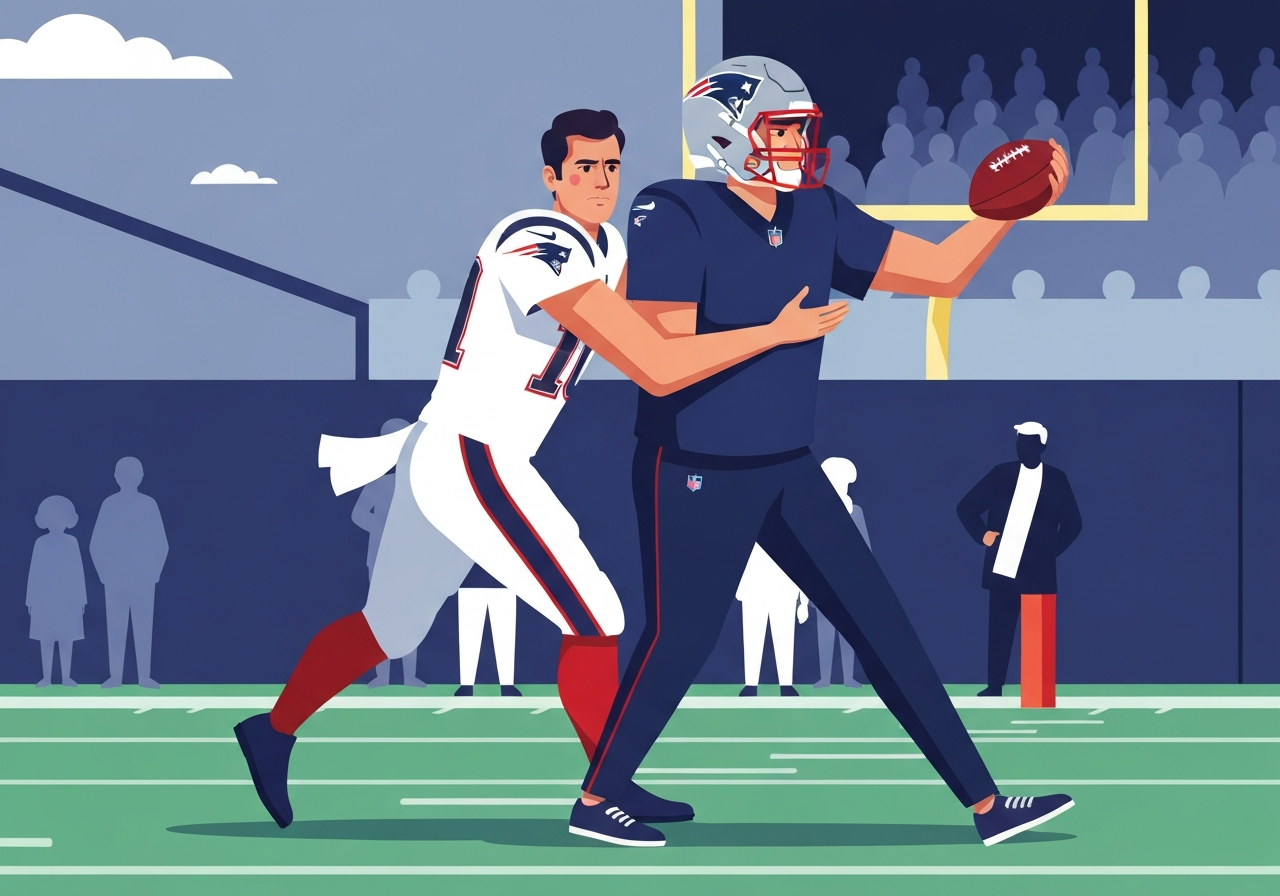
In the fourth quarter of Super Bowl LX, New England Patriots coach Mike Vrabel elected to kick the extra point after the team’s first touchdown instead of attempting a two-point conversion. The play reduced the deficit but left the Patriots trailing by 12 points rather than 11 after kicker Borregales converted the PAT. NBC broadcast commentator Mike Tirico immediately noted that a successful two-point try would have made the gap 11 points — a materially different math for a late comeback. The choice has drawn scrutiny because the score margin altered the practical path to a tie or overtime.
Key Takeaways
- The Patriots scored their first touchdown of Super Bowl LX in the fourth quarter, temporarily cutting the score to 19-6 before the extra point.
- Coach Mike Vrabel sent the PAT unit onto the field; kicker Borregales converted the kick to make the score 19-7.
- Commentator Mike Tirico observed that going for two would have produced a 19-8 score, an 11-point deficit, which changes comeback calculations.
- An 11-point deficit allows the trailing team to tie with a touchdown plus a two-point conversion and a field goal; a 12-point deficit typically requires two touchdowns.
- Vrabel was named the NFL’s 2025 Coach of the Year; he has not publicly answered questions about this fourth-quarter decision.
- Analysts and fans flagged the call as significant because the late-game scoring differential materially affects strategic options.
Background
Super Bowl LX unfolded as a game in which one side had established persistent control, and the Patriots had struggled to generate touchdowns until the fourth quarter. In lopsided contests, individual decisions rarely change the final outcome; nevertheless, late-game choices that alter the scoring margin can shape comeback possibilities and the narrative after the fact. The two-point conversion has been part of NFL strategy considerations since its 1994 reintroduction, and coaches weigh the immediate risk of failure against downstream mathematical advantages.
Coaching decisions in playoff and championship settings are evaluated not only on immediate success but on how they change the opponent’s required responses. Modern analytics often provide probabilities for succeeding on two-point attempts and for expected outcomes of alternative sequences (e.g., kick PAT then force turnover). Yet coaches also factor in personnel, play-call confidence and game flow. Vrabel, who won the league’s 2025 Coach of the Year honor, was operating in that complex calculus when he opted to have the placekicker on the field.
Main Event
Late in the fourth quarter, the Patriots recorded their first touchdown of the game, prompting a decision point at the goal line. Rather than keeping the offense on the field for a two-point try, Vrabel sent out the extra-point unit. The kick was successful, and the scoreboard moved to 19-7. The live broadcast immediately highlighted the alternative: a two-point conversion would have reduced the gap to 11 points (19-8), changing the scoring scenarios required to tie.
The immediate consequence was straightforward: Trailing by 12 points after the PAT, the Patriots would typically need two touchdowns to take the lead, or a touchdown plus a two-point conversion and another score to force a tie. If they had gone for two and succeeded, the team could have tied the game with a touchdown and two-point conversion plus a field goal, per on-air math cited by commentators. The decision therefore narrowed strategic flexibility late in the game.
There was no public postgame explanation from Vrabel about the choice; as of this writing he has not been asked about it. That absence of a coach’s rationale has intensified speculation and critique from viewers and some analysts, who point to the simple scoring math as a central reason to have attempted the two-point play.
Analysis & Implications
At stake in this decision is the difference between a one-score required comeback (under some sequences) and a two-score requirement. A successful two-point conversion reduces the margin to 11, which in practical terms allows a trailing team to recover with a touchdown plus a two-point try and a field goal; that multiplicative sequence matters in late-game clock and possession management. By taking the single point, the Patriots conceded the need for an additional touchdown unless other unusual scoring sequences occurred.
Coaches balance probability and context: a two-point try converts at league-average rates that vary by personnel and play choice, typically below the PAT success rate. The conventional PAT is the higher-probability play, but the higher probability does not account for the downstream leverage of the extra point on required scoring sequences. Analytical models often favor going for two in late situations where the arithmetic benefits outweigh the conversion probability gap.
Vrabel’s reputation as a successful head coach — the NFL’s 2025 Coach of the Year — complicates the critique. Singling out one call in a game described as a rout overlooks the many factors that led to the loss, including earlier offensive performance, defensive breakdowns and special-teams plays. Still, high-leverage decisions in championship games attract scrutiny because they are discrete, explainable choices that can be contrasted with alternative strategies using simple scoring math.
For the Patriots organization, the episode is likely to prompt internal review of late-game decision protocols and whether analytics or situational guidelines should be more prescriptive in similar scenarios. For fans and commentators, the call will remain a concrete example used when debating the role of analytics versus intuition in modern coaching.
Comparison & Data
| Deficit | Score Needed to Tie | Typical Comeback Sequence |
|---|---|---|
| 11 points | Touchdown + 2-point conversion + Field goal | TD (6) + 2-pt (2) + FG (3) = 11 |
| 12 points | Two touchdowns (or other multi-score sequence) | TD + TD (12) or TD + TD + PAT combinations |
The table illustrates the practical distinction between an 11- and 12-point deficit: 11 points can be erased with a TD, a two-point conversion and a field goal; 12 requires two scoring drives of at least a touchdown each. In late-game contexts where possessions and clock are limited, the fewer discrete scores required, the higher the theoretical chance of a comeback. That advantage is why some coaches opt for the higher-variance two-point try at key moments.
Reactions & Quotes
On the NBC broadcast, play-by-play commentator Mike Tirico highlighted the alternative math at the moment the special-teams unit came onto the field.
“He’s gonna go for one here… Go for two and make it 19-8, an 11-point game.”
Mike Tirico / NBC broadcast
The broadcast then noted the immediate result after the kick.
“Instead they try the extra point, Borregales knocks it in to make it a 19-7 game.”
NBC broadcast play-caller
Observers on social media and some analysts framed the decision as a clear-cut mathematical miss; others urged context, noting that overall game performance and time remaining also determine the right call. Without a postgame explanation from Vrabel, differing interpretations have persisted in public discussion.
Unconfirmed
- Whether Vrabel consulted in-game analytics or staff recommendations before sending out the PAT unit is not publicly confirmed.
- There is no public record yet of Vrabel explaining the decision or of the team releasing internal reasoning for the choice.
- Any numbers about two-point conversion success specific to the Patriots’ playbook at that moment remain private and unverified.
Bottom Line
While the Patriots’ broader struggles in Super Bowl LX made the outcome unlikely to hinge on a single decision, Vrabel’s choice to kick the extra point rather than attempt a two-point conversion materially altered the arithmetic of a possible comeback. The shift from an 11-point to a 12-point deficit changed the theoretical paths to a tie or overtime, and that simple math is why commentators and many viewers flagged the call.
Absent a coach’s explanation, the play will be evaluated in coaching circles and by fans as an instructive late-game decision. For the Patriots, the episode may prompt internal review of situational protocols; for observers, it underscores how small, explicit choices can become focal points in postseason narratives even when a game’s broader arc already favored the opponent.