
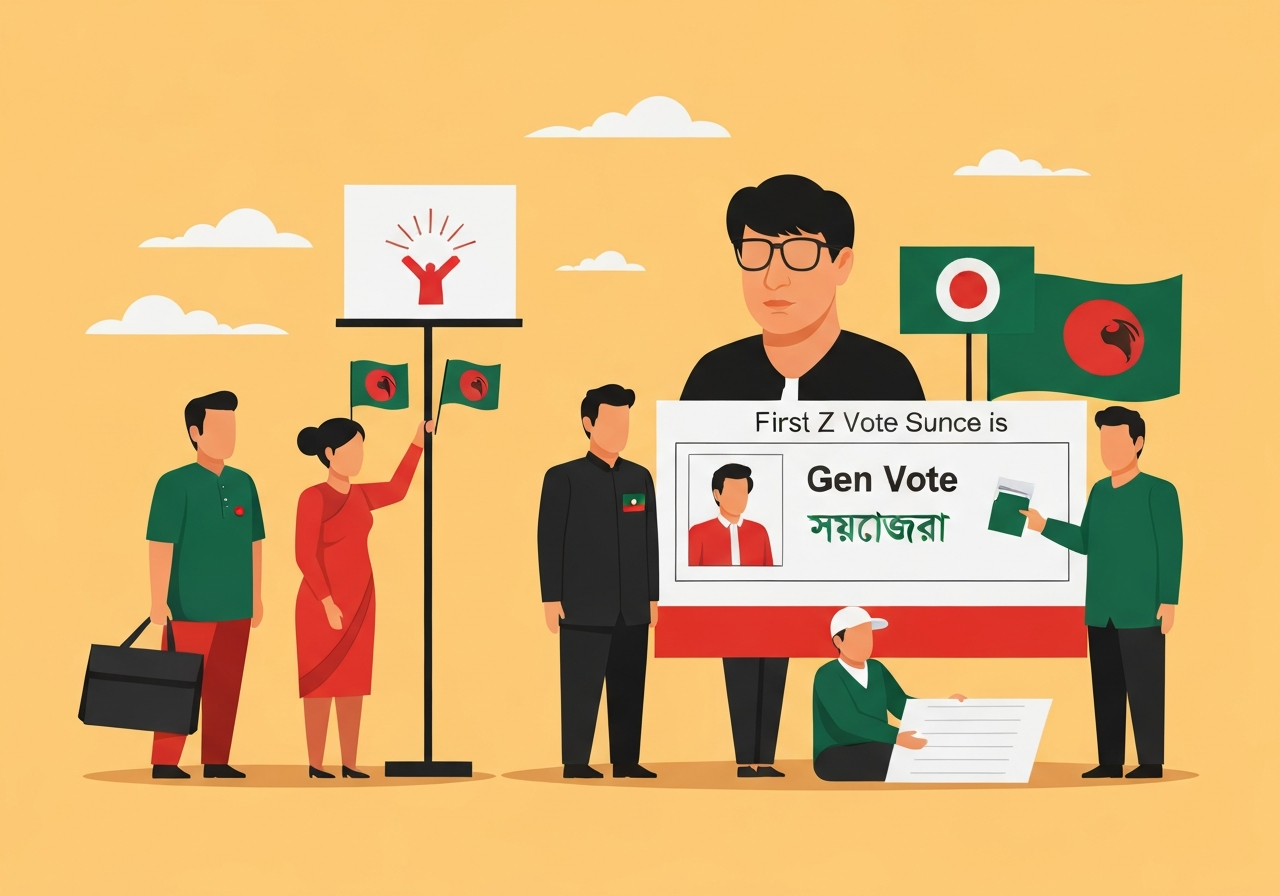
Bangladesh held its first national election since the 2024 student-led uprising that forced former prime minister Sheikh Hasina into exile; ballots closed and counting began with results expected on Friday. More than 2,000 candidates contested 350 parliamentary seats, while the Awami League — Hasina’s party — was barred from running. Voters, including a large cohort under 37, cast ballots amid a heavy security deployment as the interim government simultaneously put a constitutional reform to referendum. Early official tallies showed turnout near 49% by 14:00 local time, and the vote has been described by some participants as a potential reset for the country’s politics.
Key takeaways
- Election date: first national vote after the 2024 Gen Z protests that led to Sheikh Hasina’s exile; results due Friday.
- Scale: over 2,000 candidates competing for 350 parliamentary seats; more than 120 million people were eligible to vote, about 40% under age 37.
- Major parties: the centre-right Bangladesh Nationalist Party (BNP) led by Tarique Rahman and a coalition headed by Jamaat-e-Islami are principal contenders; the Awami League was banned from contesting.
- Security and turnout: nearly 1 million police and soldiers deployed; official turnout reached 49% by 14:00 local time (08:00 GMT) per the Ministry of Information and Broadcasting.
- Gender and representation: BNP fielded over 250 candidates including 10 women; Jamaat fielded more than 200 candidates, all men; the student-born National Citizen Party (NCP) ran 30 candidates, two of them women.
- Interim leadership: Nobel Peace Prize laureate Muhammad Yunus, serving as interim head, voted in Dhaka and said the vote marked an end to a difficult period.
- Uncertain integrity: the absence of the Awami League and Hasina’s exile to India — where she rejects the charges against her — raise unresolved questions about the election’s fairness.
Background
The contest follows a wave of student-led street protests in 2024 that escalated into a nationwide movement and preceded a security crackdown in which hundreds of demonstrators were killed. Those events precipitated the removal and eventual exile of Sheikh Hasina, who had governed Bangladesh for 15 years and whose party, the Awami League, was subsequently barred from this ballot. For years before 2024, several elections were widely criticized by observers and opposition figures as manipulated in favour of Hasina and her allies, leaving deep skepticism about electoral integrity.
The interim government that replaced Hasina has framed the vote and a parallel constitutional referendum as corrective measures to repair what it calls a broken political system. That framing appeals to many voters who say they want a return to competitive politics; it also alarms others who worry that exclusions and political bans will undercut the legitimacy of the outcome. Longstanding political cleavages — including rival dynastic networks, Islamist parties, and civil-society actors — shape campaign choices and the post-election bargaining landscape.
Main event
Polling stations across Bangladesh closed and counting began under intensive security, with nearly a million police and military personnel on duty to deter violence and protect ballots. Voting took place in a charged atmosphere: some precincts reported steady queues and engaged voters, while others — notably in former Awami League strongholds such as Gopalganj — saw sparse turnout. Election administrators reported turnout at about 49% by mid-afternoon local time; final national figures will be released when counting advances.
Two figures dominated the campaign: Tarique Rahman, 60, is the BNP’s principal candidate and a scion of Khaleda Zia’s political family; he has been openly critical of alliances that leverage religion and has promised economic and democratic reforms. The Jamaat-e-Islami coalition, led by Shafiqur Rahman, 67, ran an organized grassroots effort emphasizing justice and anti-corruption and has for the first time emerged as a major electoral player since the Awami League’s exclusion.
Campaign dynamics were shaped by contrasts in candidate selection and messaging. BNP entered with more than 250 candidates but only a small number of women (10), while Jamaat fielded over 200 male candidates and allowed the student-born National Citizen Party to put forward 30 nominees, two of them women. Observers noted both the absence of a major incumbent party and the presence of newly energized youth voters as unusual features that make the result less predictable than recent polls.
Analysis & implications
Domestically, the vote marks a pivotal moment for Bangladesh’s political trajectory. If the election is broadly accepted as competitive, it could open space for reconstituted party competition, judicial reforms and new mechanisms for accountability. However, the exclusion of the Awami League and the exile of its leader risk leaving a sizeable swath of voters feeling disenfranchised, which could fuel political polarization and street-level mobilization after the results are announced.
Regionally, developments in Dhaka will be watched closely by neighbouring capitals and international partners concerned with stability, migration, and trade. Hasina’s presence in exile in India and her public rejection of the charges against her complicate bilateral dynamics and could become a sustained diplomatic issue, particularly if political tensions escalate after the vote. International observers, aid donors and investors will likely use the election’s perceived legitimacy as a barometer for future engagement.
Economically, a credible transfer or consolidation of power could restore investor confidence that was dented during years of contested governance; conversely, a disputed outcome could delay investment and disrupt development projects. The referendum on constitutional changes adds another layer: its passage or rejection will influence institutional reforms and the rules that govern future elections, potentially shaping party behaviour for years to come.
Comparison & data
| Party/Group | Approx. candidates | Women candidates | Notable detail |
|---|---|---|---|
| BNP | More than 250 | 10 | Led by Tarique Rahman; dynastic link to Khaleda Zia |
| Jamaat-e-Islami | More than 200 | 0 | Organized grassroots campaign; first major role since Awami League ban |
| National Citizen Party (NCP) | 30 | 2 | Born from the 2024 student movement |
| Awami League | 0 (banned) | — | Former ruling party; Sheikh Hasina in exile |
These figures underscore shifts in candidate composition and gender balance compared with past elections. The near absence of female candidates among the principal contenders stands out, especially given women’s prominent role in the 2024 uprising. Analysts will compare turnout and seat distribution to previous elections — particularly those of 2008 and the contested polls of the 2010s — to assess whether competitive pluralism has been restored.
Reactions & quotes
Interim leader Muhammad Yunus framed the vote as a turning point and urged patience as results are tallied; his public remarks reflect the interim government’s narrative that the country is beginning a new political chapter. Observers note that Yunus’s stature as a Nobel laureate gives his statements symbolic weight, but acceptance by opposition supporters remains uncertain.
“We have ended the nightmare and begun a new dream,”
Muhammad Yunus (interim leader)
BNP leader Tarique Rahman, who voted in Dhaka, expressed optimism about his party’s prospects after years in exile and internal exile for some leaders. His comments emphasize restoration of what he calls democratic choice, while criticizing Islamist partners for relying on religious sentiment — a tension that could shape coalition bargaining if the BNP gains seats.
“I am feeling confident… I have waited more than a decade for this day,”
Tarique Rahman (BNP)
Voters interviewed by reporters described a sense of possibility at the ballot box, telling journalists that for the first time in years they felt they genuinely had options. Those sentiments coexist with doubts among some citizens about whether bans and legal actions against major figures will limit the vote’s legitimacy.
“For the first time in years we feel like we have a choice,”
Voters interviewed by media
Unconfirmed
- Whether the exclusion of the Awami League will permanently prevent its return to mainstream politics; long-term effects on voter loyalty remain unclear.
- Claims that Jamaat-e-Islami has fully modernized and shed past controversies are not independently verified and remain contested.
- Allegations that any large-scale rigging will occur during counting are not substantiated at this stage; observers and monitors have not yet issued final judgments.
Bottom line
The election is a consequential test of whether Bangladesh can move beyond years of disputed ballots and polarized governance. The combination of a banned former ruling party, the rise of a student-born formation, and strong showings by the BNP and Jamaat creates an unpredictable outcome that could either restore competitive politics or deepen divisions if parts of the electorate reject the process.
Key indicators to watch in the coming days are the official seat tallies, the referendum result, statements by international observers, and whether losing camps accept the outcome. Those signals will determine whether the vote is seen as a credible reset or the start of a new, contested chapter in Bangladesh’s political life.
Sources
- BBC News — media reporting on election and field interviews.