
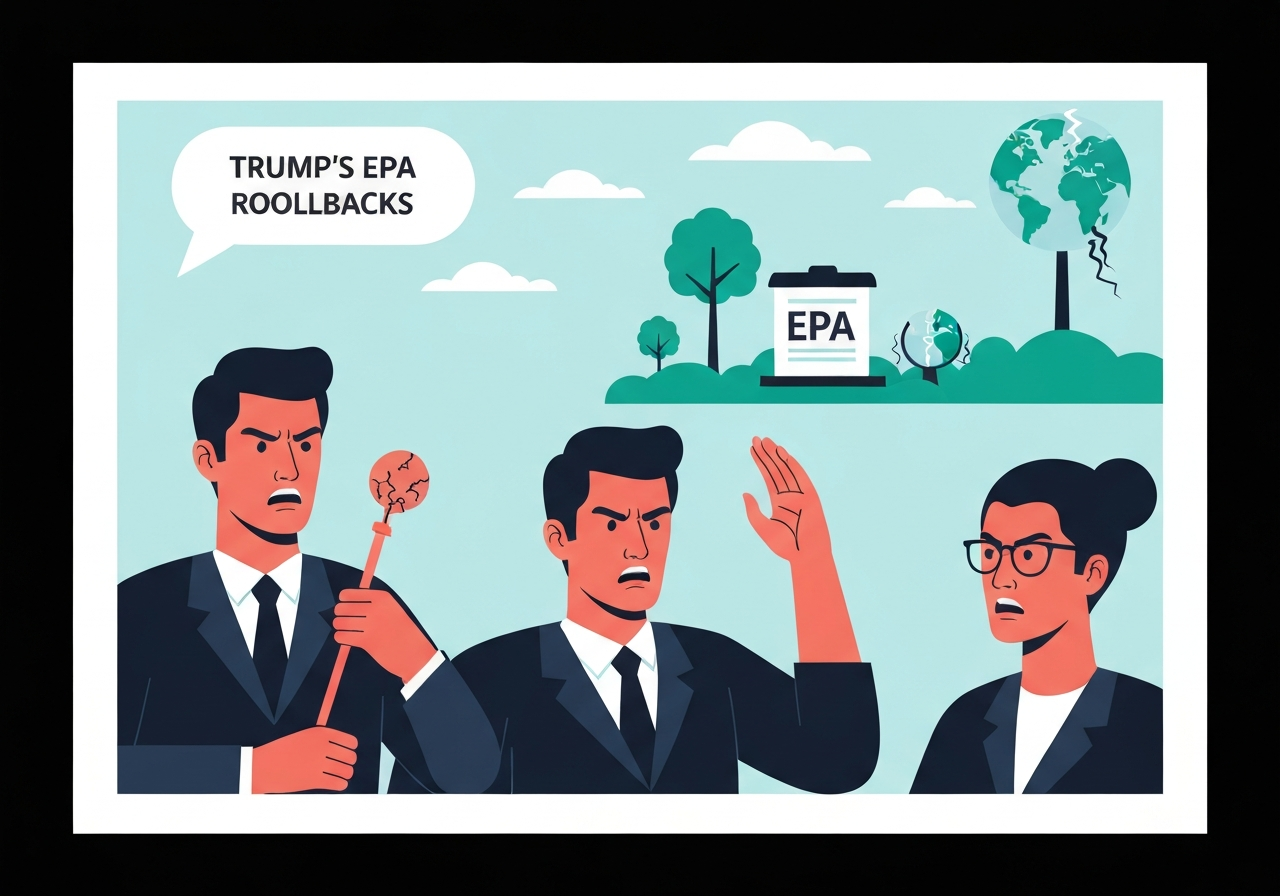
— Climate advocates, lawmakers and public-health activists gathered outside the Environmental Protection Agency headquarters in Washington on Wednesday to condemn the Trump administration’s plan to rescind the 2009 endangerment finding that underpins federal greenhouse gas regulations. Organizers said the move, announced by the White House press secretary and scheduled to be finalized the following day, would strip the legal basis for regulating planet-warming emissions under the Clean Air Act and trigger court battles. Speakers from nonprofit groups and several Democratic lawmakers pledged immediate litigation and intensified oversight in Congress. Protesters warned the rollback would increase climate damages and health costs even as the administration framed it as a major deregulatory, pro‑growth action.
Key takeaways
- The Trump administration announced it will finalize the repeal of the 2009 greenhouse gas endangerment finding on , removing the statutory basis for many federal climate rules.
- The White House and EPA called the action the “largest deregulatory action in American history,” claiming it will save Americans about $1.3 trillion, a figure officials have not publicly substantiated.
- Environmental groups including the Natural Resources Defense Council, Earthjustice and the Sierra Club pledged to file legal challenges immediately after the repeal is published.
- Senators Sheldon Whitehouse and Ed Markey and Representative Paul Tonko said they will use congressional tools to spotlight and oppose the rollback.
- Speakers at the rally warned of long-term economic and health costs, citing expert estimates that stronger climate impacts and related healthcare burdens could reach into the trillions over coming decades.
- The administration also signed an executive order pushing the Defense Department to procure more electricity from coal and received a pro‑coal industry award the same week; industry reports show coal interests donated $3.5 million to support the 2024 presidential campaign.
- Children and frontline community leaders featured at the event emphasized disproportionate impacts on vulnerable populations and environmental justice concerns.
Background
The 2009 endangerment finding concluded that greenhouse gases threaten public health and welfare and provided the statutory authority for the EPA to regulate emissions under the Clean Air Act. It followed a comprehensive review of peer‑reviewed science and has been cited in subsequent rulemakings on vehicle standards, power‑plant emissions and other pollution controls. Federal courts have repeatedly upheld the finding and its use as a regulatory foundation, and the scientific evidence linking human‑caused greenhouse gas emissions to climate risk has strengthened since 2009.
For more than a decade the endangerment finding has anchored federal climate policy, shaping regulations across administrations. The current administration frames deregulatory moves as reforms that reduce regulatory burdens and energy costs, invoking economic benefits as justification. Opponents argue that eliminating the finding would remove the legal mechanism that courts and agencies rely on to protect air quality and public health, making future regulation far more difficult.
Main event
On Wednesday outside the EPA headquarters, speakers ranged from senior senators to child activists and leaders of major environmental organizations. Senator Sheldon Whitehouse described the action as political corruption and accused fossil fuel interests of having excessive influence over new EPA leadership. Environmental nonprofits announced coordinated litigation plans and called on Congress to hold hearings.
The White House press secretary, Karoline Leavitt, told reporters earlier in the week that the repeal would be finalized on Thursday and defended the administration’s deregulatory agenda as pro‑economy and pro‑consumer. EPA officials echoed that position, arguing the endangerment finding had been used to justify what they described as heavy regulatory costs on vehicles, engines and other sectors.
At the same time, the president signed an executive order encouraging the Department of Defense to buy more electricity from coal-fired generation, and he received an endorsement-style award from a pro‑coal industry group. Rally speakers tied those moves to broader policy priorities labeled by critics as a return to aggressive fossil fuel expansion.
Community leaders at the event stressed that the immediate harms of weakened climate protections would fall on frontline communities and children. A 10‑year-old Maryland resident, Talia Brandt, told the crowd she should not have to plead for protections for her future. Organizers said the repeal will spur legal and legislative countermeasures aimed at preserving existing safeguards.
Analysis & implications
Legally, rescinding the endangerment finding is a significant and unusual step: it seeks to remove a foundational legal determination that has been repeatedly relied upon by regulators and courts. Courts will likely scrutinize whether the administration’s administrative record satisfies the Administrative Procedure Act’s standards for reasoned decision‑making. Given the finding’s scientific basis and judicial history, litigation challenging the repeal is expected to be fast‑moving and high‑stakes.
Economically, the administration’s $1.3 trillion savings claim is central to its argument but lacks a publicly disclosed methodological breakdown. Independent analysts note that short‑term reductions in regulatory compliance costs can be offset by larger, longer‑term economic damages from more severe climate impacts, including disaster losses, infrastructure damage and health expenditures. Several studies estimate those cumulative costs could reach into the trillions over coming decades if emissions continue unchecked.
Politically, the repeal is likely to sharpen climate as a salient issue in national debates. Democrats at the rally and in Congress pledged to elevate the matter, framing it as an example of industry influence over policy. Republicans defending the move argue that it will lower energy costs and reduce regulatory burdens for manufacturers and utilities, a message designed to resonate in regions dependent on fossil fuels.
Internationally, the U.S. action could weaken global climate diplomacy by removing a major domestic policy lever for emissions control. Other countries and subnational U.S. actors—states, cities and businesses—may respond by strengthening their own rules, but the federal change complicates national commitments and could slow coordinated global mitigation efforts.
Comparison & data
| Item | Estimate / value | Context |
|---|---|---|
| Administration’s claimed savings | $1.3 trillion | Administration estimate; methodology not released publicly |
| Coal industry political donations (2024) | $3.5 million | Reported industry contributions to campaigns in 2024 |
| Potential climate & health damages (est.) | Trillions (multi‑decade) | Independent analyses project large cumulative costs from unmitigated warming |
The table compares the administration’s headline savings figure with publicly reported industry political donations and independent assessments of cumulative climate and health costs. The contrast highlights a common policy debate: immediate regulatory cost reductions vs. long‑term societal costs. Because the administration has not published a detailed accounting for the $1.3 trillion figure, independent analysts must rely on model projections to estimate avoided or increased costs under different regulatory scenarios.
Reactions & quotes
Organizers and officials responded in sharply different terms. Environmental leaders framed the repeal as a profound legal and moral reversal; the administration characterized it as regulatory relief that will benefit consumers.
“This is corruption, plain and simple. Old‑fashioned, dirty political corruption,”
Senator Sheldon Whitehouse
Whitehouse spoke at the rally and later told reporters he viewed the repeal as the result of close ties between new EPA leadership and fossil fuel interests. His remarks were part of a broader strategy by Senate Democrats to spotlight industry influence on policy decisions.
“We’re going to be taking this fight to the courts, and we are going to win,”
Manish Bapna, Natural Resources Defense Council
Bapna, whose organization is coordinating litigation plans with other nonprofits, emphasized the NRDC’s intent to pursue expedited judicial relief and to challenge the repeal on administrative‑law grounds.
“Science did not change when Donald Trump was inaugurated,”
Joseph Goffman, former EPA official
Goffman, who worked on the original endangerment finding, said the action reflects a management choice rather than new scientific evidence, and warned that rolling back the finding would undermine long‑standing public health protections.
Unconfirmed
- The administration’s $1.3 trillion savings estimate has not been accompanied by a published methodology or detailed accounting, so the precise calculation and time frame remain unconfirmed.
- Reports that the president requested $1 billion from oil industry executives while campaigning are cited in media reporting but have not been independently verified in this article; those claims are noted but remain unconfirmed.
- The direct causal link between recent pro‑coal donations and specific policy decisions by individual officials is asserted by critics but has not been demonstrated through disclosed communications or transactional evidence.
Bottom line
The administration’s planned rescission of the 2009 endangerment finding represents a high‑stakes legal and political gamble: it aims to remove a core legal basis for federal greenhouse gas regulation while exposing the action to rapid legal challenge. Litigation is likely to begin immediately, and courts will play a decisive role in determining whether the repeal can survive administrative‑law scrutiny.
For stakeholders and the public, the key near‑term developments to watch are the administration’s published rulemaking record and legal briefs, rapid filings by environmental groups, and any congressional inquiries or hearings. Longer term, the move will shape U.S. climate policy debates, influence subnational and private sector responses, and affect how the United States is perceived in international climate negotiations.
Sources
- The Guardian — news report covering the rally and administration announcements (news)
- U.S. Environmental Protection Agency — official background on the 2009 endangerment finding (official)
- Natural Resources Defense Council (NRDC) — advocacy organization; announced litigation plans (advocacy)
- Earthjustice — environmental legal nonprofit involved in litigation (advocacy)
- Sierra Club — environmental advocacy group active in policy and legal responses (advocacy)