
Lead
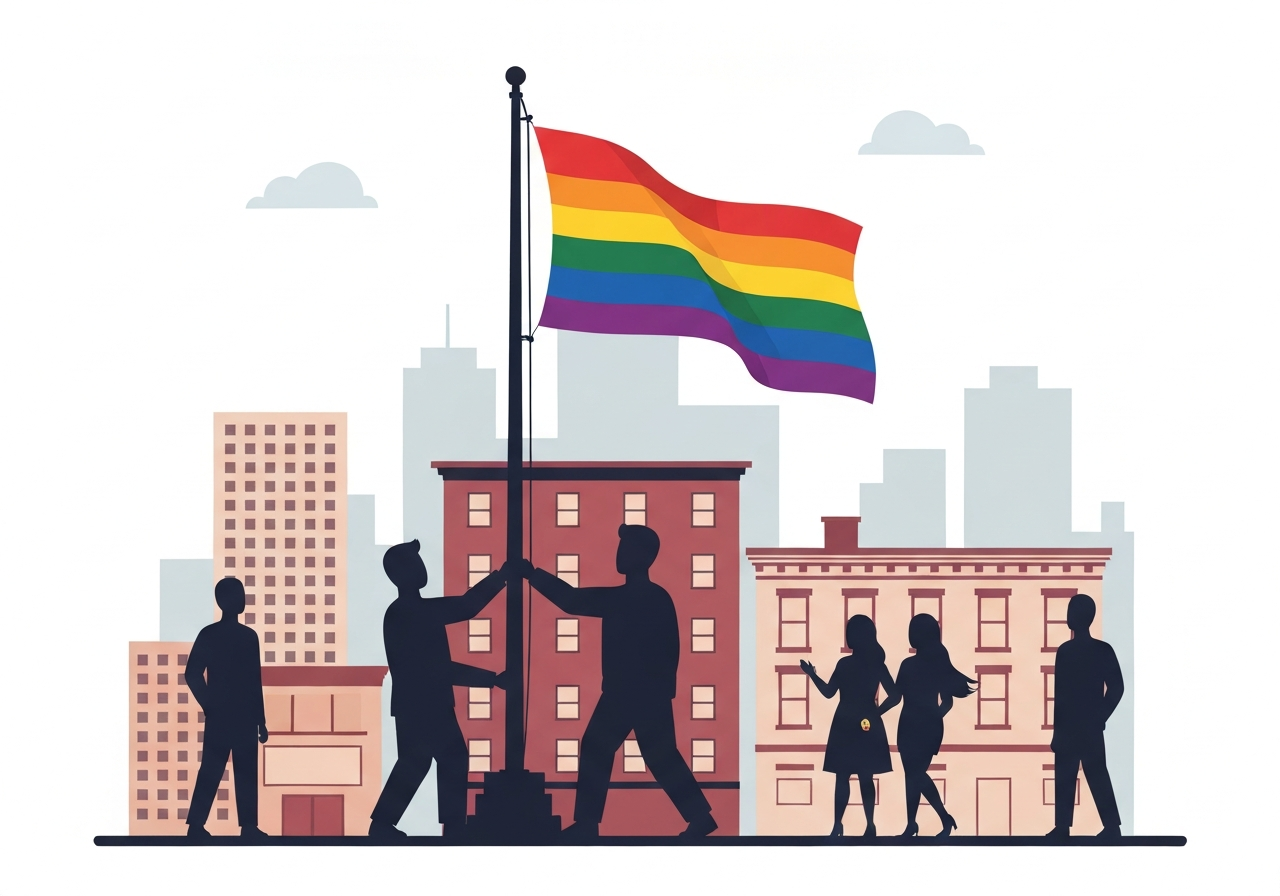
On Feb. 12, 2026, a group of New York City elected officials and several hundred supporters returned the Pride flag to the Stonewall National Monument in Manhattan after it had been removed earlier in the week by federal personnel. The removal followed Department of the Interior guidance on the display of “non-agency” flags at national park sites; federal employees raised an American flag on the same pole the day before. City leaders, including Manhattan Borough President Brad Hoylman-Sigal and Representative Jerrold Nadler, publicly re-hoisted the rainbow banner at a rally in Greenwich Village, and by Thursday evening both flags were flying side by side.
Key Takeaways
- On Feb. 12, 2026, NYC officials and several hundred supporters re-raised the Pride flag at Stonewall National Monument in Greenwich Village.
- The flag had been removed earlier that week after Department of the Interior guidance about “non-agency” flags in the national park system.
- Federal employees raised an American flag on the pole on Wednesday; by Thursday evening both the American and Pride flags were displayed simultaneously.
- Brad Hoylman-Sigal and Representative Jerrold Nadler participated in the re-raising; Stonewall Inn staff reported noticing the Pride flag was missing on Monday morning.
- The event drew a large public turnout and was widely promoted on social media in advance, signaling local officials’ intent to contest federal flag policy at a site central to L.G.B.T.Q. history.
Background
The Stonewall National Monument commemorates the June 1969 uprising against police raids at the Stonewall Inn, widely regarded as a spark for the modern L.G.B.T.Q. rights movement. The site, located in Greenwich Village in Manhattan, has become a focal point for both local activism and national debates over civil rights and historic recognition. Since its designation, Stonewall has hosted commemorations and displays that underscore L.G.B.T.Q. visibility; the Pride flag had been a recurring symbol at that small park outside the Inn.
This week’s removal followed a Department of the Interior directive addressing the display of non-agency flags within the National Park System. The guidance sought to clarify which flags federal employees may display on official poles; it led to questions about how sites with strong community symbolism would be treated. Local officials said the decision to restore the Pride flag was intended to push back against what they described as an administrative tightening that could diminish the monument’s commemorative role.
Main Event
The sequence began when staff at the Stonewall Inn noticed the Pride flag was gone on Monday morning. Federal workers subsequently placed a U.S. flag on the pole on Wednesday afternoon, citing the Interior Department guidance. That action was visible to residents and visitors in Greenwich Village and quickly became a subject of social media discussion and local organizing.
On Thursday evening, hundreds of people gathered after elected officials publicly announced plans to return the Pride flag to the site. The crowd assembled under overcast winter skies as organizers hoisted the rainbow banner beneath the American flag; at times the Pride flag rested close to the pole and fluttered against it. Speakers at the rally framed the move as a defense of Stonewall’s symbolic status and of L.G.B.T.Q. visibility in public spaces.
Officials emphasized that the event was peaceful but intentionally oppositional to federal policy. Participants included municipal leaders, local advocates and residents; the presence of Representative Jerrold Nadler and Borough President Brad Hoylman-Sigal underscored the political stakes. By sunset both flags were waving side by side, an image that organizers and onlookers said conveyed both respect for national symbols and a refusal to erase the site’s association with Pride.
Analysis & Implications
The dispute at Stonewall reflects a broader tension between federal rules governing national park displays and local communities’ efforts to preserve sites as living memorials. National park policies are designed to ensure uniformity and avoid endorsements, but monuments like Stonewall carry layered civic meanings that many residents and activists view as inseparable from community identity. The federal guidance on “non-agency” flags could create recurring conflicts at other sites where local symbolism is strong.
Politically, the episode highlights how cultural-symbol disputes can become proximate arenas for partisan contention. Local officials framed the re-raising as a defense of diversity initiatives and of the monument’s commemorative purpose; federal authorities, by contrast, have emphasized adherence to standardized flag protocols. That divergence risks escalating similar confrontations in other jurisdictions where elected officials and constituents seek to preserve visual markers tied to social movements.
Practically, the incident raises questions about management of small, high-profile federal properties in dense urban areas. Stonewall is both a federal monument and a community landmark embedded in everyday neighborhood life; reconciling agency regulations with local expectations will require clearer guidance and sustained dialogue. Without that, temporary removals and re-raisings could become recurrent flashpoints, with legal and operational implications for park staff and municipal partners.
Comparison & Data
| Before Feb. 2026 | Week of Feb. 9–12, 2026 | After Feb. 12, 2026 |
|---|---|---|
| Regular display of Pride flag at Stonewall during commemorations and community events | Pride flag removed; American flag raised by federal employees (reported Wed.) | Pride flag re-hoisted by NYC officials; American flag remains on pole (both flags displayed) |
The table summarizes the immediate status change at the Stonewall pole over the week in question. That change illustrates how a single administrative clarification can alter on-the-ground displays and prompt rapid political response. While the incident involved a single pole and small park, its symbolic reach extends far beyond Greenwich Village, fueling debates about how federal stewardship interacts with local memory and activism.
Reactions & Quotes
Organizers and local officials framed the return of the Pride flag as both a restoration of visibility and a public statement against the policy change. Supporters emphasized the monument’s role in civil-rights history and the need to maintain open acknowledgment of that legacy at federal sites.
“We have brought the flag back to a sacred site.”
Brad Hoylman-Sigal, Manhattan Borough President
Hoylman-Sigal used the rally to cast the action as a restoration of a symbol tied to the community’s history. His brief statement was delivered to the assembled crowd via bullhorn and was widely shared online by attendees.
“This is about safeguarding the visibility of L.G.B.T.Q. history at a place that helped shape a national movement.”
Representative Jerrold Nadler (paraphrased)
Representative Nadler joined the public action in solidarity; his remarks framed the re-raising as part of a broader effort to protect historical recognition. Local activists similarly described the move as a defense of civic memory rather than an attack on national symbols.
Unconfirmed
- The precise timing and internal authorization chain for the flag’s initial removal has not been publicly documented; who ordered the action is unconfirmed.
- No public statement from a Department of the Interior spokesperson detailing operational reasons for the removal was available at the time of reporting.
- Whether similar removals will occur at other memorials covered by the guidance remains uncertain pending further agency interpretation or local challenges.
Bottom Line
The Feb. 12 action at Stonewall transformed a technical policy shift into a visible, politicized moment that underscores how national rules interact with local memory and activism. While the immediate outcome left both the American and Pride flags flying together, the episode signals potential for future clashes over symbolic displays at federal sites.
Resolving such disputes will likely require clearer, site-sensitive guidance from federal agencies and proactive engagement with local stakeholders so that operational rules do not unintentionally erase community commemorations. For now, Stonewall remains a potent test case in how cities and the federal government negotiate the public expression of historic and civil-rights identities.
Sources
- The New York Times — news report on the Feb. 12 event and local officials (news media)
- U.S. Department of the Interior — federal guidance referenced regarding display of “non-agency” flags (official guidance)
- National Park Service — Stonewall National Monument — site information and designation background (federal agency)