
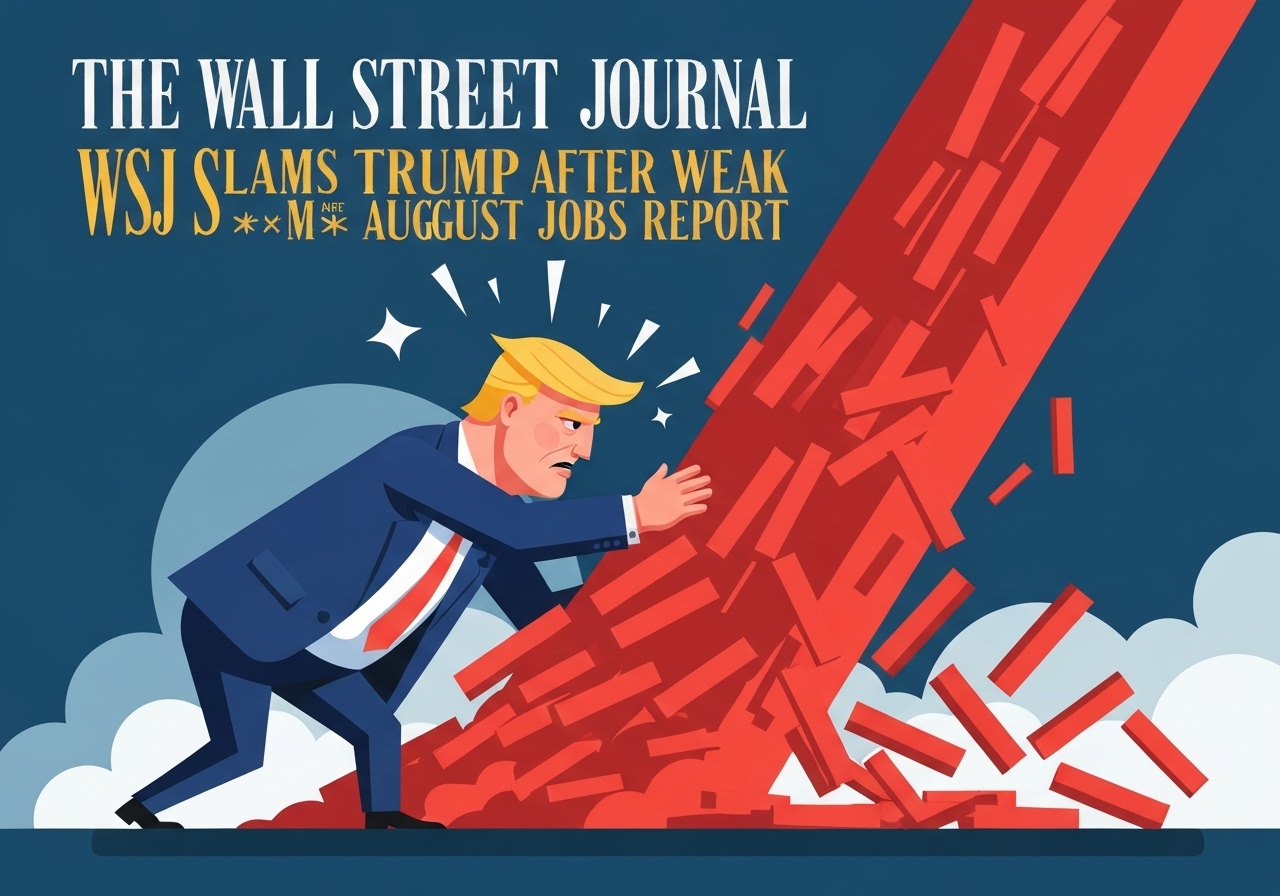
Lead: On Sep. 6, 2025, The Wall Street Journal editorial board sharply criticized President Donald Trump after August’s jobs report showed a slowdown in hiring, including losses in manufacturing, and linked the weakness in part to the administration’s recent tariffs.
Key Takeaways
- The Wall Street Journal editorial faulted Trump’s tariff policy for dragging on job growth.
- Manufacturing lost 12,000 jobs in August and 38,000 so far in 2025.
- Healthcare and social assistance added 46,800 jobs in August, driven largely by public spending.
- Average monthly job gains fell from 167,000 last year to about 27,000 since tariffs began on April 2.
- A federal appeals court ruled the administration’s import duties unlawful under the IEEPA; the White House has asked the Supreme Court to hear the case quickly.
Verified Facts
August’s payroll data showed a marked slowdown in headline job creation. The manufacturing sector shed 12,000 positions in August, bringing total manufacturing losses to roughly 38,000 in 2025, according to published labor statistics.
Most of August’s reported job gains were concentrated in social assistance and healthcare, which together added about 46,800 jobs. Analysts and the Journal noted that these categories are more reliant on public and state-level budgets than on export-exposed industries.
Comparative averages underline the shift: during 2024 the economy averaged about 167,000 new jobs per month, while the period following the administration’s tariff measures (after April 2) has seen an average near 27,000 per month.
Legal developments have compounded the policy debate. A federal appeals court recently found the administration’s import duties—imposed under the International Emergency Economic Powers Act (IEEPA)—to be unlawful. The White House has requested fast-track review by the U.S. Supreme Court.
Separately, President Trump relieved the Bureau of Labor Statistics commissioner after the previous month’s disappointing employment figures; the agency continued to publish the August numbers that show the ongoing slowdown.
Context & Impact
The WSJ editorial framed tariffs as a drag on confidence and investment, arguing that higher import duties act like taxes that can slow overall economic growth. Manufacturing and mining sectors, which are more exposed to input-cost increases and global supply chains, have shown the earliest job impacts.
Policymakers now face a mix of legal, economic, and political pressures: courts are weighing the legality of the tariff authority, businesses are adjusting to higher costs, and the administration is balancing a protectionist agenda against signs of slower employment growth.
Potential near-term effects include slower hiring in trade-exposed industries, higher input costs for manufacturers, and increased political scrutiny of tariff policy ahead of forthcoming campaign seasons.
Official Statements
“Tariffs are taxes, and taxes hurt economic growth,” the editorial board wrote, calling for a revival in business confidence.
The Wall Street Journal editorial board
Unconfirmed
- Whether tariffs are the sole or primary cause of the overall slowdown in hiring; multiple factors may contribute to employment trends.
- The timing and outcome of any Supreme Court review of the tariff ruling remain unresolved.
Bottom Line
The Wall Street Journal’s editorial frames August’s weak jobs numbers as linked to the administration’s tariff strategy, highlighting losses in manufacturing and a drop in average monthly job gains. With a federal appeals court deeming the import duties unlawful and the White House seeking Supreme Court review, the tariffs issue could shape both near-term economic conditions and broader policy debates.