
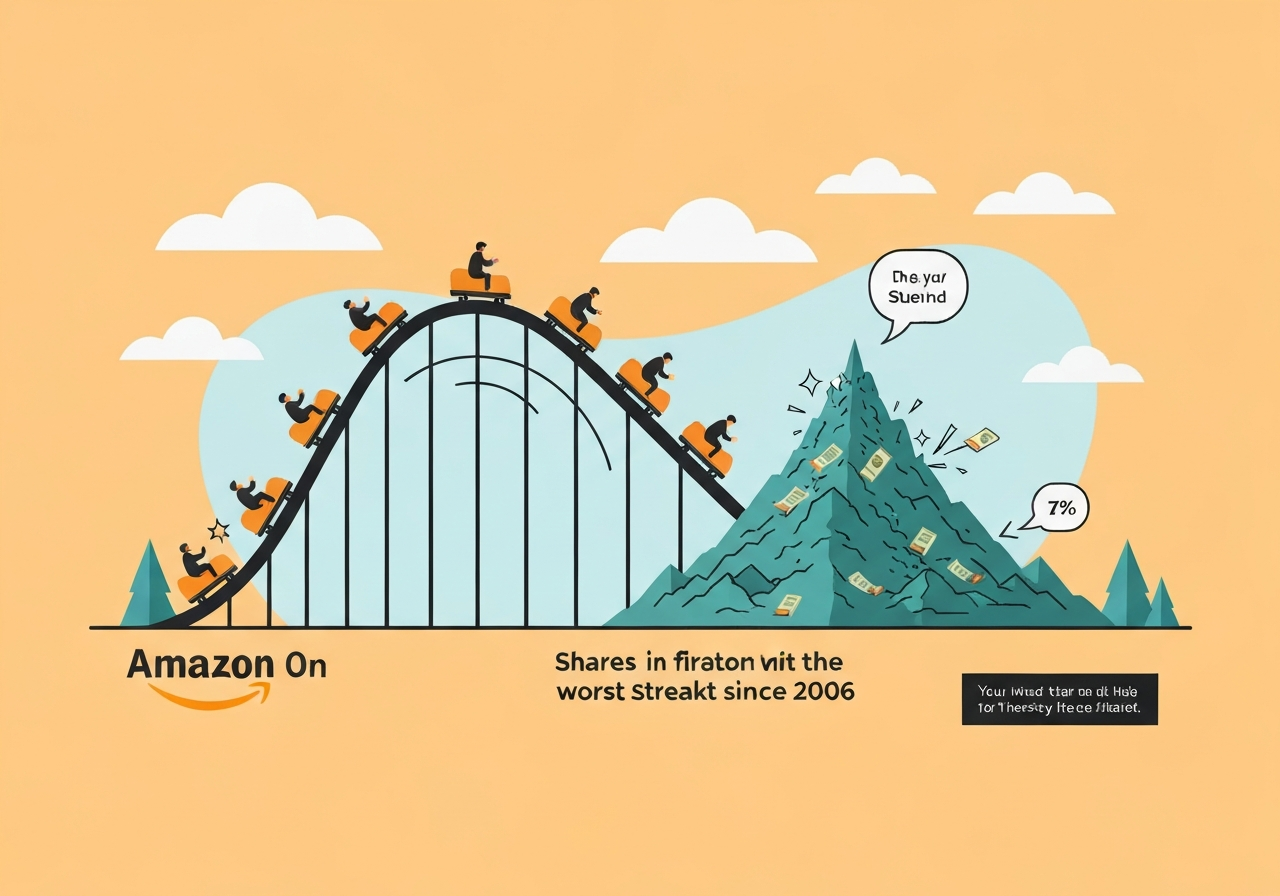
Lead: On Feb. 13, 2026, Amazon.com Inc. (AMZN) closed at $198.79 after recording a ninth straight trading-day loss, marking the company’s longest losing streak since July 2006. The stock fell 18.2% over the nine-session run, pushing shares deeper into bear-market territory and prompting renewed investor scrutiny of Amazon’s spending and AWS growth trajectory. Market participants are weighing whether the company’s heavy investment posture will deliver the revenue and profit outcomes investors expect.
Key takeaways
- Amazon closed at $198.79 on Feb. 13, 2026, after a ninth consecutive trading-day decline.
- The nine-day slide represents an 18.2% drop in AMZN over that span, the longest losing streak since July 2006.
- Data on the streak length is sourced from Dow Jones Market Data and reported by MarketWatch, highlighting market-data confirmation.
- Investor concern centers on whether Amazon’s continued investment — particularly in AWS and logistics — will translate to near-term margin improvement.
- The selloff pushed Amazon further into a bear market classification for many institutional frameworks, intensifying short-term volatility.
- Analysts are divided: some view the selloff as an opportunity tied to long-term AWS strength, others flag execution and cost-risk in a slowing macrocycle.
Background
Amazon has transformed from an online bookseller into a diversified technology and commerce conglomerate with major businesses in e-commerce, cloud computing (AWS), advertising and logistics. Over the last decade AWS has been the primary profit engine, funding investments across Amazon’s retail network and newer initiatives. That dynamic—high-margin cloud profits subsidizing capital-intensive retail and fulfillment investment—has shaped investor expectations about where and when returns will appear.
Periods of heavy spending have periodically rattled investors, especially when revenue growth slows or macroeconomic headwinds build. Market sensitivity to capital allocation decisions increased after the 2020–2022 expansion phase, and since then investors have closely tracked AWS margins, capital expenditures, and guidance for signs that investment will pay off. The current market move occurs against that longer backdrop of scrutiny.
Main event
On Feb. 13, 2026, trading ended with Amazon shares at $198.79, completing a nine-session losing streak and an 18.2% cumulative decline over those days. Financial-data provider Dow Jones Market Data flagged the sequence as the company’s longest run of consecutive losses since July 2006. The move was broad-based: volume surged on down days as institutional and retail participants adjusted exposure.
Market commentary accompanying the drop emphasized investor debate over Amazon’s capital allocation — balancing continued AWS expansion with heavy spending on logistics, inventory and new product areas. Some portfolio managers cited uncertainty over near-term margin improvement as a driver of the liquidation, while others pointed to rotation into more defensive or value-oriented names amid a risk-off tone.
Sentiment at the trading desks reflected amplified volatility: stop-triggering orders and options-related flows increased realized moves, and intraday price swings were larger than typical. While the share price decline was notable, company fundamentals such as AWS market share and multi-year growth prospects were still being weighed by the buy-side.
Analysis & implications
The immediate implication is elevated market anxiety about Amazon’s capacity to convert AWS momentum into predictable, rising consolidated margins. If AWS growth slows materially or pricing pressure accelerates, Amazon’s ability to absorb heavy retail and fulfillment spending could be impaired, compressing operating margins. That scenario would force a reassessment of near-term earnings models and capital-allocation timelines by analysts and investors.
Conversely, if AWS maintains its growth trajectory and operating leverage, the current price action could present a buying opportunity for long-term investors focused on free-cash-flow potential beyond near-term noise. Historical episodes show Amazon often experiences periods of investor skepticism before results reassert longer-term narratives, but timing and magnitude are uncertain.
Macro factors matter: higher interest rates and slower consumer spending can amplify downside pressure on e-commerce revenue, increasing reliance on AWS to carry profitability. Companies with high fixed-cost footprints are especially sensitive to demand shocks; Amazon’s logistics and fulfillment network is capital-intensive and can pressure cash flow if volumes sag. Investors will watch upcoming earnings, AWS revenue and margin trends, and any guidance changes closely.
Comparison & data
| Metric | Current run (Feb 2026) | Prior reference (July 2006) |
|---|---|---|
| Consecutive losing days | 9 | Longest prior comparable streak noted since July 2006 |
| Cumulative decline | -18.2% | Not specified in public report |
| Closing price (most recent) | $198.79 | Historical closing levels differ by era |
The table summarizes the confirmed metrics for the Feb. 2026 streak and the historical reference point. Public reporting confirms the nine-day sequence and the 18.2% fall; exact comparable percentage moves from 2006 are not provided in the primary market-data note. Readers should view the 2006 reference as a historical benchmark for streak length rather than a like-for-like market-cap or valuation comparison, since Amazon’s business composition and scale have changed substantially since 2006.
Reactions & quotes
Market coverage and data vendors emphasized the rarity of a run this long for Amazon, framing the event as a trigger for renewed debate about capital allocation and AWS’s role in the company’s profit mix.
Investors are once again questioning whether Amazon’s heavy spending plans will deliver the returns they need.
MarketWatch (financial news)
Data-provider confirmation of the streak length was cited widely by desks and news outlets as the factual anchor for the reporting.
The sequence marks Amazon’s longest consecutive losing stretch since July 2006, according to Dow Jones Market Data.
Dow Jones Market Data (market-data provider)
Some market analysts framed the episode as a technical correction layered on top of fundamental questions about near-term margins; others urged a focus on multi-year cash-flow potential tied to AWS and advertising.
For long-term investors, the core question remains whether AWS can sustain margin expansion to offset heavy reinvestment in retail and logistics.
Market analysts (industry commentary)
Unconfirmed
- Whether the current streak will prompt accelerated cost cuts or a strategic pivot at Amazon remains unconfirmed; no company action on that front was reported as of Feb. 13, 2026.
- Claims that the selloff is driven primarily by a specific large institutional exit have not been independently verified.
- Any immediate change to AWS pricing or contractual terms that would materially alter margins has not been announced and remains unconfirmed.
Bottom line
The nine-day slide that ended Feb. 13, 2026, and the associated 18.2% decline over that run are significant in that they represent the longest losing stretch for Amazon since July 2006. The episode has refocused investor attention on whether AWS’s profit engine can continue to fund Amazon’s broad investment agenda without compressing near-term margins.
For investors, the key near-term signals will be upcoming earnings, management commentary on capital allocation and any clear read on AWS revenue and margin trajectory. In the medium term, the balance between sustained cloud profitability and the drag from capital-intensive retail operations will determine whether the current price weakness is a tactical entry point or an early warning of deeper revaluation risk.
Sources
- MarketWatch (financial news report on Feb. 13, 2026)
- Dow Jones Market Data (market-data provider cited for streak confirmation)
- Amazon Investor Relations (official company filings and investor materials)