
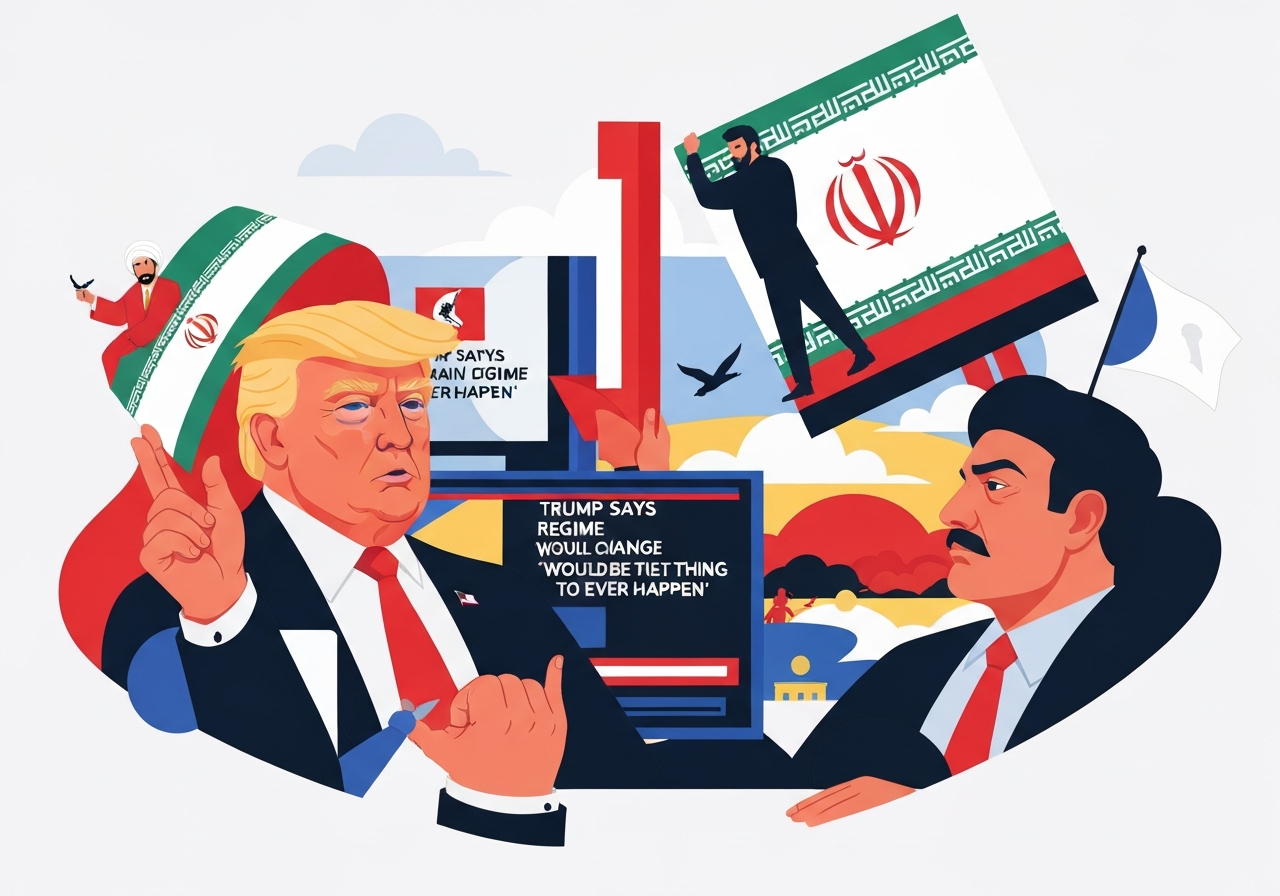
US President Donald Trump on Friday said regime change in Iran “would be the best thing that could happen,” marking one of his clearest public endorsements of replacing the clerical leadership that has governed since 1979. His comments came as the White House announced the USS Gerald R. Ford would relocate toward the Middle East to join the USS Abraham Lincoln, part of an effort to increase pressure on Tehran during stalled nuclear talks. Trump spoke broadly about Iran’s political future without naming potential successors, and Iran’s supreme leader, Ayatollah Ali Khamenei, had not responded publicly as of this report. The statement echoes long-standing US demands on Iran’s nuclear program and comes amid renewed diplomatic and military signaling in the region.
Key takeaways
- Donald Trump said regime change in Iran “would be the best thing that could happen,” framing it as a solution after “47 years” under the clerical system.
- The US is moving a second aircraft carrier, the USS Gerald R. Ford, to the Middle East to join the USS Abraham Lincoln as part of increased pressure on Tehran.
- Trump declined to name an alternative Iranian leadership but asserted “there are people” who could take over; that claim remains unspecified.
- The administration has pressed Iran to halt uranium enrichment; Israel has insisted Tehran curb ballistic missiles and cut support for proxy groups such as Hamas and Hezbollah.
- Iranian President Masoud Pezeshkian warned Tehran would “not yield to their excessive demands,” signaling limited willingness to accept outside conditions.
- Trump withdrew the US from the 2015 nuclear deal during his first term and reimposed sanctions; US officials restarted talks last year to seek a new agreement.
Background
Iran’s current system of clerical rule dates to the 1979 Islamic Revolution, which installed a Supreme Leader and a theocratic structure that has endured for 47 years. The international community has long contested elements of Iran’s nuclear program; the 2015 Joint Comprehensive Plan of Action (JCPOA) curtailed enrichment in return for sanctions relief but the United States withdrew from that deal under Trump in his first term. Economic pressure from sanctions and ongoing tensions with regional rivals have shaped both Tehran’s domestic politics and its foreign policy posture. In recent years mass protests and internal unrest have intensified scrutiny of the clerical establishment, and security crackdowns have at times produced heavy casualties and international condemnation.
Military deployments and public diplomacy have repeatedly been used by Washington and its allies to influence Tehran’s calculations. Aircraft carrier strike groups function as visible instruments of deterrence and coercive diplomacy in the region, and moving a second carrier to the Gulf raises the stakes in a volatile environment. Israel, which regards Iran’s missile and proxy capabilities as direct security threats, has pushed for tougher terms than those raised in early nuclear diplomacy. Meanwhile, Iranian leaders have signaled willingness to discuss nuclear limits in exchange for sanctions relief, even as they reject what they describe as disproportionate demands on their sovereignty and defense programs.
Main event
On Friday, Mr. Trump made a forceful statement endorsing regime change in Iran and framed it as corrective for four decades of clerical rule. He told listeners that after “47 years, they’ve been talking and talking and talking” and blamed the status quo for loss of life. When pressed about who should replace Iran’s leadership, he declined to provide names but asserted there were individuals capable of taking charge. The remark represents one of his clearest public endorsements for altering Iran’s internal power structure.
At the same time, the White House and Pentagon disclosed movement of the USS Gerald R. Ford, the US Navy’s newest aircraft carrier, from the Caribbean toward the Middle East to join the USS Abraham Lincoln, which is already deployed there. Trump posted an aerial image of the carrier on his platform, describing an imminent transit. The deployment follows earlier Pentagon steps in January after Washington warned it could take military action in response to Tehran’s domestic crackdown on protests that resulted in large numbers of deaths.
Trump reiterated pressure on Tehran to return to negotiations under terms the US deems acceptable, telling an audience at Fort Bragg that Iran should “give us a deal that they should have given us the first time.” US demands prioritize curbs on uranium enrichment, while Israeli officials have added requirements concerning ballistic missiles and support for proxy groups. Iranian President Masoud Pezeshkian publicly rejected what he called “excessive demands,” signaling a diplomatic gap between the parties.
Analysis & implications
Politically, the president’s open endorsement of regime change signals a hardening rhetorical stance that can constrain diplomatic flexibility. Public calls for regime replacement raise risks of escalation by narrowing off-ramps for de-escalation: Tehran may interpret such rhetoric as a direct threat to its survival and respond by accelerating sensitive programs or by asymmetric actions through proxies. Conversely, supporters of a tougher approach argue that strategic pressure can compel concessions; whether that calculus holds depends on Tehran’s domestic cohesion and elite resolve.
Militarily, the addition of a second carrier to the region is primarily a coercive signaling measure intended to deter Iranian aggression and reassure partners; carrier strike groups provide options for presence, surveillance, and strike if ordered. However, carrier movements also increase the risk of miscalculation in a crowded maritime environment, especially if naval escorts or aircraft encounter Iranian forces. The credibility of US deterrence depends on both capacity and political will to act, and public statements that link military deployments to political objectives can complicate decision-making in crisis moments.
For nuclear diplomacy, the backdrop is mixed. Iran has at times indicated willingness to limit aspects of its nuclear program in return for sanctions relief, but leaders in Tehran have rejected broad third-party demands on missiles and regional policy. Israel’s insistence on tougher terms narrows the negotiating bandwidth. Any renewed agreement will require bridging not only technical limits on enrichment but also broader security assurances that satisfy regional actors and Iran’s domestic constituencies.
Comparison & data
| Vessel | Current role |
|---|---|
| USS Gerald R. Ford | Newest US carrier; transiting from the Caribbean toward the Middle East |
| USS Abraham Lincoln | Already stationed in the Middle East as part of US naval presence |
The two carriers together represent a stepped-up US naval posture but do not by themselves indicate imminent kinetic action; carrier strike groups typically perform deterrence, patrol, and strike-conditioning roles. Their presence is costly and logistically complex, and the political message matters as much as the hardware. Analysts will watch escort composition, rules of engagement, and diplomatic channels to judge whether deployments aim primarily at deterrence or signal preparation for further measures.
Reactions & quotes
Official and public reactions were immediate and varied. Supporters of a hard line praised strong rhetoric and enhanced military presence as necessary to counter Tehran. Critics warned the language risks inflaming tensions and undermining diplomacy. Below are direct short quotations reported in connection to the events, with context.
“For 47 years, they’ve been talking and talking and talking. In the meantime, we’ve lost a lot of lives.”
Donald Trump, US President — remark summarizing his critique of Iran’s clerical rule
Trump used this line to justify his broader claim that regime change would be beneficial, framing decades of clerical governance as a source of regional instability and human cost.
“Give us a deal that they should have given us the first time.”
Donald Trump, US President — comment on Iran nuclear negotiations
At Fort Bragg, Trump invoked the 2015 agreement’s aftermath to press for what he called a firmer deal, reiterating US demands on enrichment and signalling continued readiness to use military pressure if negotiations fail.
“[Iran] will not yield to their excessive demands.”
Masoud Pezeshkian, President of Iran — response to external pressure
President Pezeshkian’s remark indicates Tehran’s public posture of resistance to demands it deems to compromise national defense or sovereignty; that stance complicates immediate bargaining prospects.
Unconfirmed
- Who would lead Iran if the clerical system were replaced: Trump suggested “there are people” but no names or credible succession plan have been identified publicly.
- Immediate linkage between the carrier movement and a specific military timetable: official statements frame the deployment as deterrence, not a confirmed precursor to strikes.
- The precise terms Tehran might accept in a new agreement remain unclear; Iranian offers to limit parts of its nuclear program have not been published with verifiable details.
Bottom line
President Trump’s public endorsement of regime change in Iran and the concurrent movement of a second aircraft carrier to the Middle East intensify pressure on Tehran at a moment of fragile diplomacy. The rhetoric tightens political constraints on negotiations by framing outcomes in existential terms for Iran’s leadership, diminishing plausible areas for compromise. Militarily, carrier deployments reinforce deterrence but raise risks of miscalculation; their presence alone does not determine diplomatic outcomes.
For policymakers and observers, the coming days will be decisive: diplomatic channels, public statements from Tehran and its partners, and the posture of US and allied forces will collectively shape whether the situation de-escalates into renewed talks or escalates into further confrontation. Close attention to verified statements and independent sourcing will be essential as events develop.
Sources
- BBC News (news) — original reporting on the president’s remarks and carrier movement