
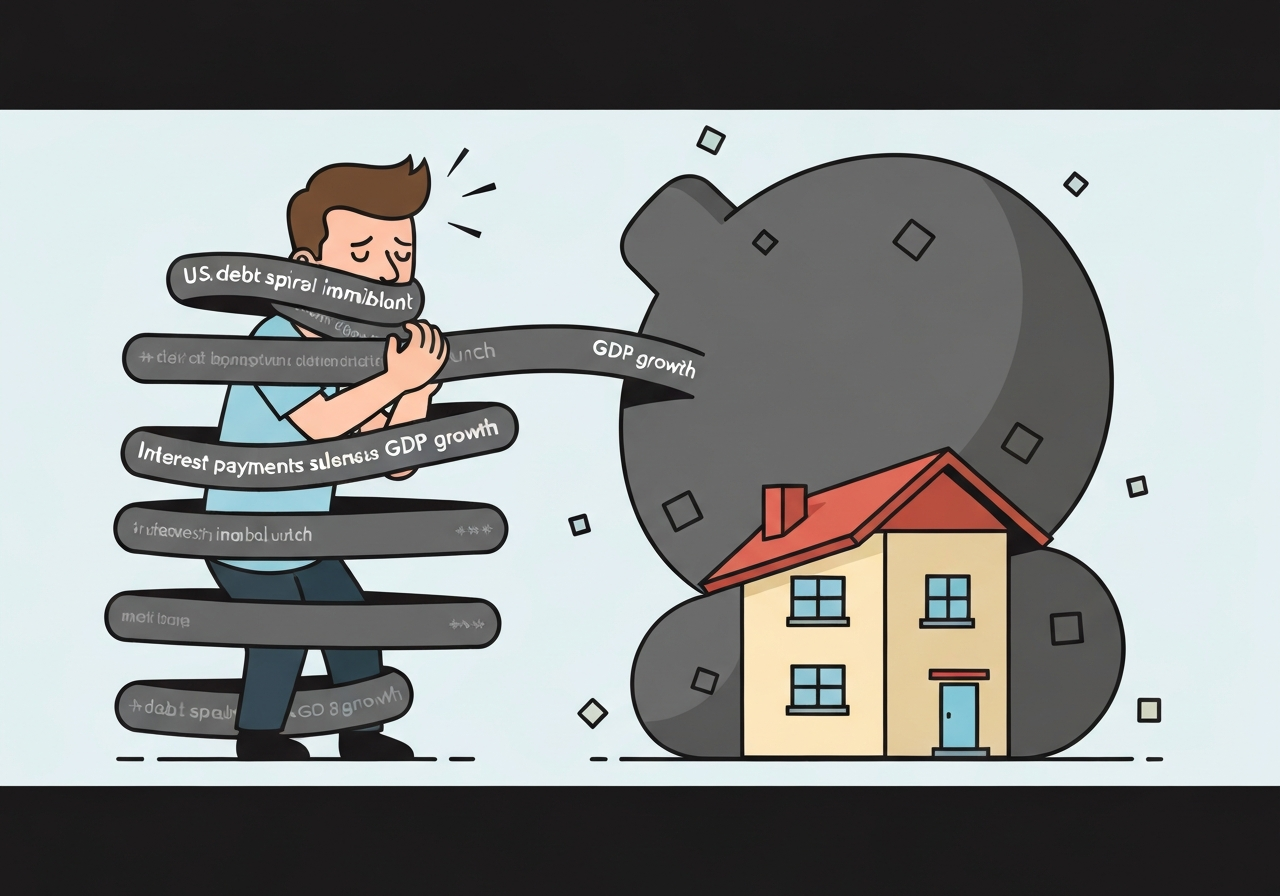
Lead: The U.S. federal debt trajectory is approaching a potentially dangerous turning point as borrowing costs begin to outpace nominal GDP growth. The Congressional Budget Office says publicly held debt sits near $31 trillion, about 100% of GDP today, and is projected to climb past the postwar 106% mark by fiscal 2030 and to roughly 120% by 2036. Rising interest expenses — forecast to more than double to about $2.1 trillion by 2036 — are a central factor that may force deficits higher and change policymakers’ choices. If the average interest rate on federal debt exceeds nominal growth later this decade, analysts warn, the budget could enter a self-reinforcing debt spiral.
Key Takeaways
- Publicly held federal debt is about $31 trillion, roughly 100% of GDP in the latest CBO baseline.
- The CBO projects debt will exceed 106% of GDP by fiscal 2030 and reach about 120% of GDP by 2036 under its baseline.
- Federal net interest outlays are expected to rise to approximately $2.1 trillion by 2036, more than double today’s level.
- The Treasury’s average interest rate on outstanding debt is 3.316% now; CBO projects it will rise toward roughly 3.9% in the late projection years.
- CBO’s nominal GDP growth forecast eases from 4.1% in 2025 to 3.9% in 2026 and 3.8% in 2027, reducing the economy’s capacity to absorb higher interest costs.
- If tariff revenues are struck down by courts and lawmakers extend expiring tax provisions, deficits could be materially larger, raising debt to about 131% of GDP by 2036 in one scenario.
Background
U.S. federal debt has climbed steadily for decades, accelerated by tax cuts, rising entitlement spending, and episodic fiscal stimulus. After the pandemic-era surge and subsequent policy choices, publicly held debt is now roughly equal to annual economic output, a rarity outside wartime conditions. Historically, periods when debt approached or exceeded output prompted debates over austerity, tax changes, or spending restraint; today those debates are resurfacing in a more complex global financial environment.
Two forces shape the near-term fiscal picture: the cost of servicing outstanding Treasury debt and the pace of nominal GDP growth. For years, ultra-low global interest rates kept interest costs manageable even as debt rose. That dynamic has shifted as market yields and policy rates climbed, lifting average borrowing costs. At the same time, CBO now projects a somewhat slower nominal growth path than earlier projections, narrowing the margin between what the government pays and what the economy earns.
Main Event
The CBO’s most recent baseline projects publicly held debt at about 100% of GDP today and rising to roughly 120% by 2036. That picture is driven in part by rising average interest rates on Treasury securities; the CBO assumes the average rate paid on all federal debt will climb from 3.316% toward roughly 3.9% late in its projection window. Because the Treasury issues securities across maturities, a shift in market yields gradually reweights the portfolio’s average cost, increasing annual interest outlays.
Interest costs are forecast to more than double over the coming decade, reaching approximately $2.1 trillion by 2036 and consuming a larger share of the federal budget. The CBO estimates that the increase in the average interest rate will explain about half of the projected growth in interest spending over the next ten years, with the remainder driven by the larger stock of debt itself.
Political dynamics complicate responses. Some lawmakers resist cuts to spending or tax increases due to voter backlash, instead pointing to the hope that faster economic growth will shrink debt ratios over time. The CBO’s baseline already includes a modest upward contribution from AI-related productivity—about 0.1 percentage point per year in total factor productivity and roughly a 1 percentage point cumulative boost to output by 2036—but that alone is insufficient to offset the rising cost of debt in the projection.
Analysis & Implications
If the average interest rate on federal debt surpasses nominal GDP growth on a sustained basis, debt dynamics become more precarious because interest expense grows faster than the economy’s capacity to pay. In that regime, deficits feed debt growth, and higher debt begets larger interest bills, creating a feedback loop that economists describe as a debt spiral. CBO’s baseline suggests the U.S. could approach that regime later this decade if current trends continue.
Higher interest spending has distributional and policy consequences. As interest costs claim a larger share of federal outlays, discretionary programs, infrastructure investment, and tax policy options face tighter constraints. That tradeoff raises questions about long-run investments and social programs, and it can shift the fiscal burden across generations if deficits remain elevated.
Financial markets monitor these dynamics closely. If investors believe the U.S. fiscal path is unsustainable, they may demand higher yields to hold government debt, which in turn raises interest costs and can tighten domestic credit conditions. So far the Treasury market remains deep and liquid, but the prospect of court rulings that would curtail tariff revenues or legal challenges that force reimbursements could produce abrupt changes in issuance needs and market pricing.
Comparison & Data
| Metric | Now | 2030 (CBO) | 2036 (CBO baseline) | 2036 (Adverse scenario) |
|---|---|---|---|---|
| Publicly held debt (% of GDP) | ~100% | >106% | ~120% | ~131% |
| Federal net interest outlays | Lower (current levels) | Rising | ~$2.1 trillion | Higher than $2.1 trillion |
| Average interest rate on debt | 3.316% | ~3.4% (this year) | ~3.9% | Similar or higher |
The table contrasts CBO’s baseline path with an adverse scenario explored by budget analysts. The alternative assumes tariff revenues could fall if courts disallow some duties and if policymakers extend expiring provisions; that scenario raises projected deficits and pushes debt even higher by 2036. While CBO uses conservative productivity gains from AI, its central estimates still show the fiscal pressures arising primarily from interest and demographic-driven spending.
Reactions & Quotes
“CBO’s latest baseline shows an unsustainable fiscal outlook, with debt approaching record levels and interest costs exploding,”
Committee for a Responsible Federal Budget (budget watchdog)
“Widespread adoption of current generative AI applications is expected to lift productivity modestly and add only about 1 percentage point to output by 2036,”
Congressional Budget Office (official projection)
Budget analysts warn that a Supreme Court decision striking down large portions of tariff revenue could sharply reduce receipts, force reimbursement claims, and increase near-term Treasury issuance, creating market disruption. Policymakers have signaled contingency plans but rebuilding alternative revenue streams or legal authorities would likely take months and complicate fiscal planning.
Unconfirmed
- The precise timing and scope of any Supreme Court ruling on the President’s tariffs remain uncertain and could materially change projected revenues.
- How quickly the administration could replace struck-down tariff authorities with alternate legal bases is unclear and may vary by product and statute.
- The magnitude of AI-driven productivity gains is highly uncertain and could be larger or smaller than CBO’s modest assumption.
Bottom Line
The CBO baseline paints a sobering picture in which rising interest costs and a growing debt stock place sustained pressure on the federal budget, with the average interest rate on debt projected to approach or exceed nominal GDP growth later this decade. That turning point matters because it can change debt dynamics from manageable to self-reinforcing, forcing sharper fiscal choices or risking market stress if investor confidence falters.
Policymakers face tradeoffs: cut spending, raise revenues, or accept higher debt ratios with attendant risks. Courts and legal decisions over tariff revenue add a short-term source of fiscal uncertainty that could worsen the outlook if revenues drop and reimbursements are required. Close monitoring, realistic growth assumptions, and transparent contingency planning will be essential to prevent a downward spiral in public finances.
Sources
- Fortune — (news coverage)
- Congressional Budget Office — (official federal budget projections)
- Committee for a Responsible Federal Budget — (budget watchdog/think tank)
- U.S. Department of the Treasury — (official issuer of federal debt)