
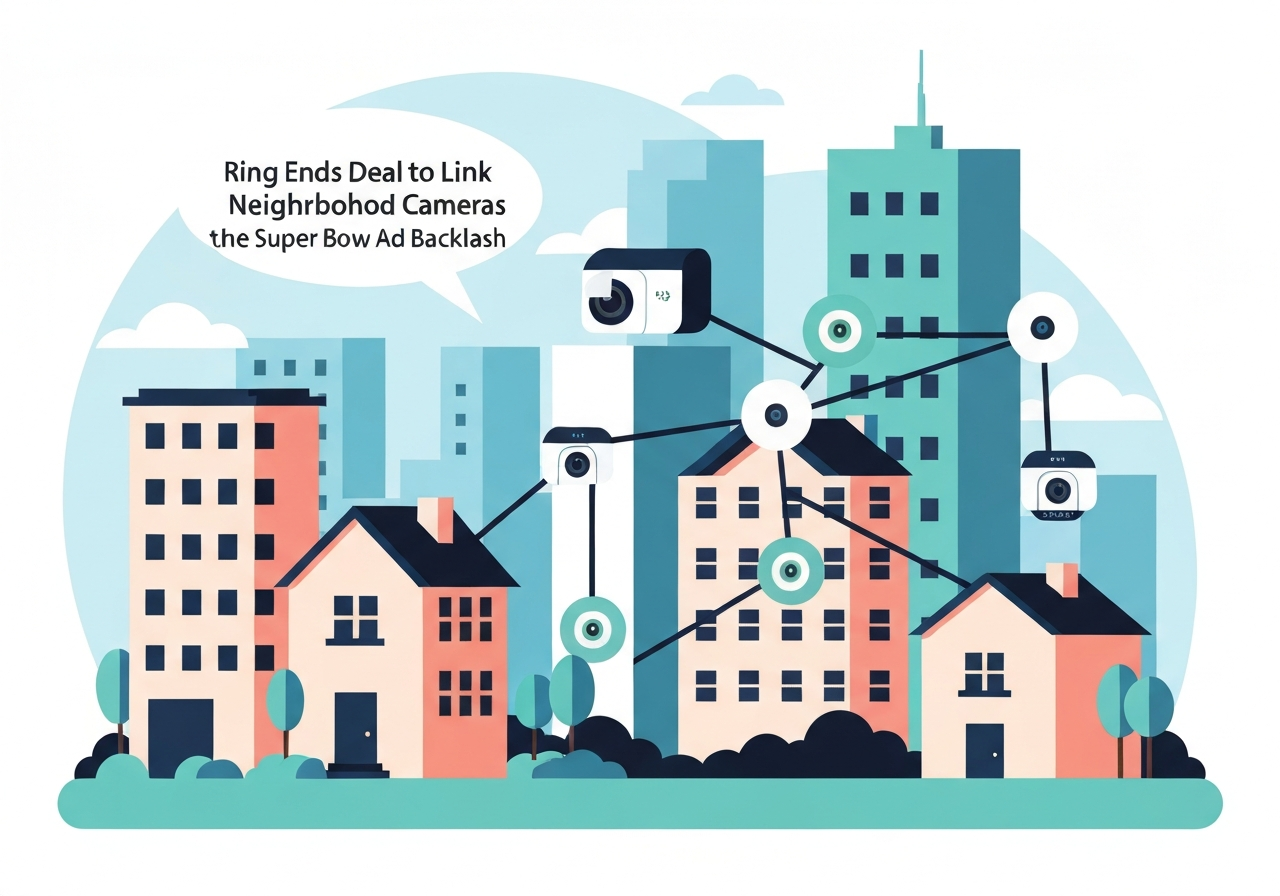
On Feb. 14, 2026, Amazon-owned Ring announced it was ending a recent partnership with Flock Safety after a Super Bowl commercial about a lost dog drew widespread criticism for appearing to normalize neighborhood surveillance. The 30-second ad illustrated a feature Ring described as “Search Party,” which would use footage from neighboring doorbell cameras to trace a pet across porches. Critics said the spot made private video networks and law-enforcement access feel intrusive rather than reassuring. Ring said it would no longer pursue the planned integration and emphasized a continued commitment to privacy and transparency.
Key Takeaways
- Ring, owned by Amazon, announced on Feb. 14, 2026, that it is ending a collaboration with Flock Safety, a company that supplies camera systems and license-plate readers used by law enforcement.
- The decision followed backlash to a 30-second Super Bowl commercial that showcased a feature called “Search Party,” which used footage from multiple doorbell cameras to find a lost dog.
- The two firms had planned a function named “Community Requests” to let homeowners choose whether to share Ring footage with local police during investigations.
- Ring framed the change as a response to user concerns and said it will focus on building neighborhood tools with privacy safeguards and transparency.
- Flock Safety is known for deploying license-plate readers and fixed cameras for municipal and law-enforcement use, which had been a point of scrutiny in the partnership.
Background
Ring, acquired by Amazon in 2018, has expanded from doorbell cameras into a platform of neighborhood-facing services that aim to connect homeowners and local authorities. Over the past several years, the company has introduced features that allow sharing of recorded video with neighbors and, in some cases, with law enforcement—moves that have repeatedly drawn attention from privacy advocates and civil liberties groups. Flock Safety, founded to sell camera and license-plate recognition systems to municipalities and police departments, markets its tools as crime-reduction technology; those same capabilities have also attracted debate about surveillance and civil liberties.
The proposed technical integration would have combined Ring’s residential doorbell-video network with Flock’s fixed cameras and license-plate readers to power cross-device searches and streamline evidence requests from police. That plan followed a broader industry trend of interoperable surveillance tools, which vendors argue improves investigations while critics warn about mission creep and expanded data sharing. The timing of the announcement—in the immediate aftermath of a high-profile Super Bowl ad—brought heightened scrutiny and fast public response.
Main Event
The 30-second commercial, broadcast during the Super Bowl, told the emotional story of a lost dog reunited with its family by tracing the animal from porch to porch using a feature Ring labeled “Search Party.” Viewers saw an implication that images from multiple doorbell cameras could be searched across a neighborhood to locate the pet. Within days, social media and privacy commentators characterized the ad as unsettling, arguing it normalizes a networked, searchable public-private camera system.
Responding to the criticism, Ring published a statement saying it would discontinue work with Flock Safety. The partnership had envisioned a feature called “Community Requests,” through which homeowners could opt to share Ring footage with local police as part of investigations. Ring emphasized that the feature would have required users’ consent, but acknowledged the public discomfort the ad had amplified and chose to step back from the partnership.
Flock Safety did not immediately announce a matching change to its broader business; the company continues to deploy license-plate readers and fixed cameras for municipal customers and law enforcement agencies. The announced split appears limited to the planned integration with Ring rather than a broader dissolution of either company’s product lines. Industry observers noted the speed and intensity of backlash—fueled by the Super Bowl platform—likely influenced Ring’s decision-making timeline.
Analysis & Implications
The episode highlights a persistent tension in security technology between convenience, community policing and individual privacy. Companies selling interconnected camera networks argue that shared footage can accelerate recoveries and investigations; critics point out that lowering barriers to searchable, cross-device video risks normalizing surveillance and expands the potential for misuse. Ring’s retreat may signal increased corporate sensitivity to reputational risk when privacy concerns gain rapid public traction.
Regulators and lawmakers have been watching the surveillance-technology market more closely in recent years, and this incident could accelerate legislative interest in transparency rules, data-retention limits and law-enforcement access protocols for private video networks. If policymakers respond with clearer legal constraints, vendors would need to redesign product features and consent flows to comply. That shift could raise costs for companies that rely on cross-device integrations and for municipalities seeking quick investigative tools.
For Ring and Amazon, the episode poses a brand and trust challenge: users who value privacy may see this as another example of tech firms testing the boundaries of consumer surveillance, while law enforcement partners and some neighborhood users may lament lost interoperability that could aid investigations. The commercial’s emotional framing—reuniting a family with a pet—underscored how marketing narratives can obscure technical and civil-liberties trade-offs, prompting intensified scrutiny of how such features are described to the public.
Comparison & Data
| Feature | Ring Alone | Ring + Flock (Planned) |
|---|---|---|
| Doorbell video sharing | Neighbor-to-neighbor sharing (user choice) | Neighbor sharing plus cross-device search across neighborhood cameras |
| Law-enforcement interface | Direct requests to homeowners (consent-driven) | Streamlined “Community Requests” pathway to request footage from multiple devices |
| License-plate reading | Not native to Ring doorbells | Integrated via Flock’s LPR systems |
The table summarizes intended functional differences: the integration would have added cross-device searchability and license-plate data linkage to Ring’s existing user-consent sharing model. While vendors describe these capabilities as efficiency gains for investigations, privacy groups warn they broaden the scope of searchable personal data and raise questions about retention, oversight and mission creep. Without publicly released deployment metrics for the integration, the assessment remains qualitative.
Reactions & Quotes
“We remain focused on building tools that empower neighbors to help one another while maintaining strong privacy protections and transparency about how our features work,”
Ring (company statement)
“The ad crystallized concerns about turning private-doorbell networks into searchable public surveillance grids, a worry long voiced by privacy advocates,”
Privacy advocates (summary)
“Technology that links residential cameras and license-plate readers creates powerful investigative tools, but also demands strict rules on access and retention,”
Independent policy analyst (summary)
Unconfirmed
- Whether the planned integration had advanced to any pilot deployments in U.S. neighborhoods is not publicly confirmed.
- The extent to which law-enforcement agencies had negotiated operational access to combined Ring–Flock data prior to the announcement is not independently verified.
- Reports vary on whether the decision to end the partnership was driven primarily by internal product review, user complaints, or external pressure; the precise internal rationale has not been disclosed.
Bottom Line
Ring’s decision to break off the integration with Flock Safety after a Super Bowl commercial confrontation illustrates how quickly public reaction can reshape corporate plans for surveillance technology. The episode underscores that even well-intended features—framed as community safety tools—can trigger backlash when marketing highlights capabilities that feel invasive. For companies building interconnected camera ecosystems, transparent consent flows and clear limits on police access will be essential to maintain user trust.
Policymakers and privacy advocates are likely to use this moment to press for clearer rules about data sharing, retention and law-enforcement requests involving private camera networks. Absent regulatory clarity, vendors may retreat from aggressive integrations or invest more heavily in privacy-preserving design to avoid reputational risk and potential legal scrutiny.
Sources
- The New York Times (news report)
- Flock Safety (company website, product information)