
Lead
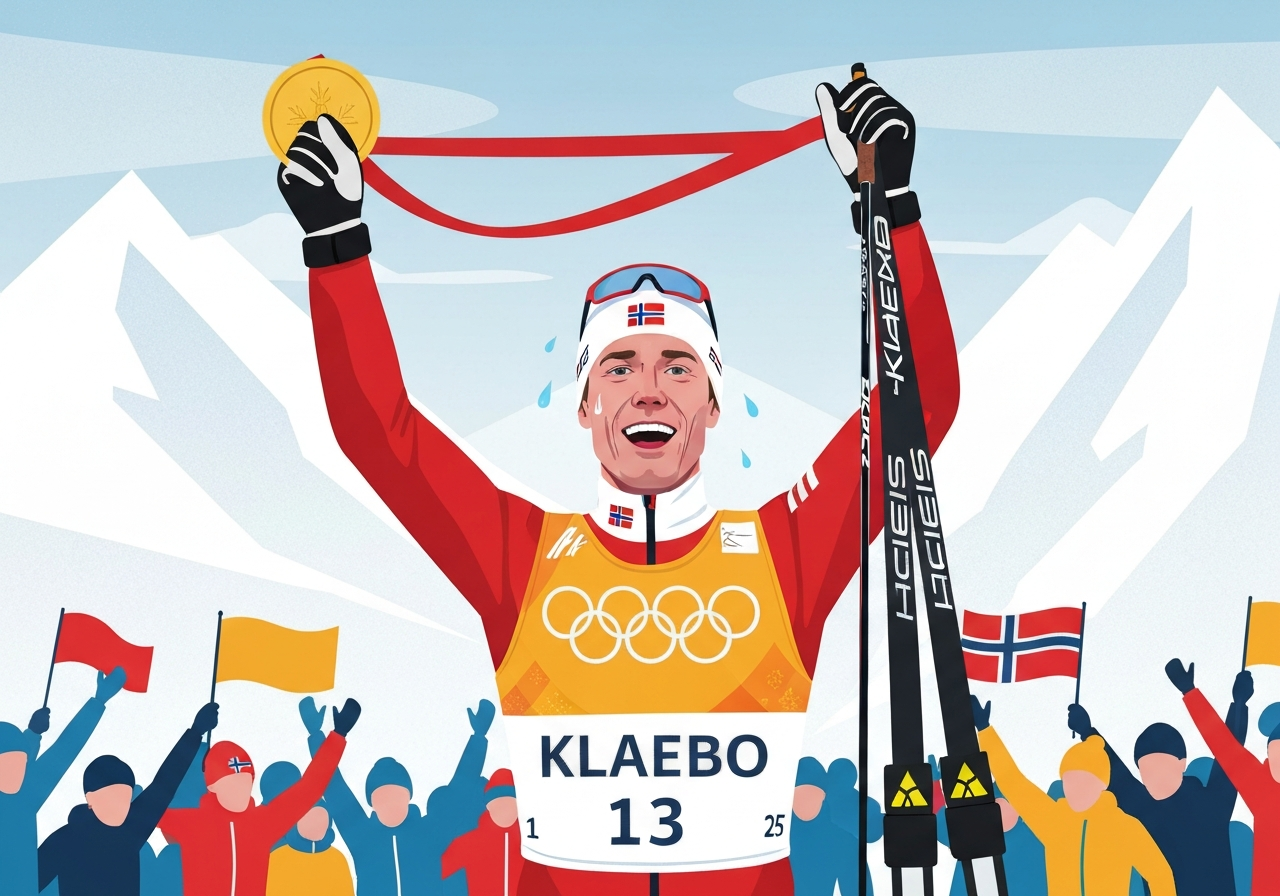
Johannes Høsflot Klæbo became the Winter Olympics’ most decorated athlete after claiming a record ninth Olympic gold on Sunday at the Milan–Cortina 2026 Games. The 29-year-old anchored Norway to victory in the men’s 4×7.5km relay, securing his fourth title of these Games alongside teammates Emil Iversen, Martin Løwstrøm Nyenget and Einar Hægegård. Norway finished 22.2 seconds ahead of France, with host nation Italy taking bronze. Klæbo’s haul now includes three golds from PyeongChang 2018 and two from Beijing 2022, and he still has two individual events left at this Olympics.
Key takeaways
- Johannes Høsflot Klæbo won his ninth Olympic gold in the men’s 4×7.5km relay at Milan–Cortina 2026, becoming the Winter Games’ outright most successful athlete.
- Klæbo is 29 years old and added his fourth gold of the 2026 Games to previous totals: three golds in PyeongChang 2018 and two in Beijing 2022.
- Norway’s relay team—Emil Iversen, Martin Løwstrøm Nyenget, Einar Hægegård and Klæbo—finished 22.2 seconds ahead of France; Italy earned bronze.
- Klæbo is a 15-time world champion; his Olympic medal count stands at nine golds and may rise with entries in the team sprint (Wednesday) and the 50km classic (Saturday).
- The relay victory underscores Norway’s depth in cross-country skiing and reinforces the nation’s early lead in the Milan–Cortina medal table for Nordic events.
Background
Klæbo emerged as an international force in the late 2010s, collecting multiple World Cup victories and world championship titles before his first Olympic breakthrough in PyeongChang 2018. His Olympic success continued in Beijing 2022, where he added two more golds to his résumé. Across world championships he has amassed 15 titles, a tally that has underpinned Norway’s long-running dominance in distance and sprint disciplines.
Norway has invested heavily in youth development, coaching and technology in cross-country skiing, creating a deep roster capable of podium finishes across formats. The relay event has historically been a showpiece for national depth: teams need four world-class legs, tactical substitution and strong waxing and support crews to prevail in variable alpine-to-mountain weather conditions typical of Milan–Cortina courses.
Main event
The men’s 4×7.5km relay unfolded as a test of consistency rather than a single spectacular surge. Norway produced reliable performances across all four legs, while France kept contact through the middle exchanges before fading in the anchor phase. Italy energised the home crowd with a podium push but could not match Norway’s finishing speed.
Klæbo completed the quartet’s work in the anchor leg to stretch the margin to 22.2 seconds at the finish, an advantage that reflected both his pace and Norway’s cumulative time gains earlier in the race. The win gave Klæbo his fourth gold of these Games and the ninth of his Olympic career, a new Winter Games benchmark.
The atmosphere around the course was electric: spectators and national teams recognised the historic moment as Norway crossed the line. Teammates Emil Iversen, Martin Løwstrøm Nyenget and Einar Hægegård were integral to the victory, supplying clean exchanges, efficient skiing and tactical cover when rivals threatened to reduce the gap.
Analysis & implications
Klæbo’s ninth gold reshapes the conversation about all-time Winter Olympic achievement. Surpassing prior totals, his record will recalibrate comparisons across eras: dominance in Nordic events now sits alongside historical marks set in figure skating, speed skating and alpine skiing. The milestone reinforces the modern trend of athletes extending Olympic careers through targeted event selection and careful season planning.
For Norway, the relay result is confirmation of systemic strength rather than reliance on a single superstar. Depth across sprint and distance squads, plus robust support teams for ski preparation, gives Norway a structural advantage in multi-leg events. Other nations will likely analyse Norway’s athlete rotation, waxing protocols and talent pipeline ahead of future world cups and world championships.
Economically and commercially, Klæbo’s status as the Winter Games’ most successful competitor could increase sponsor interest and media value for cross-country skiing, a discipline that typically receives less broadcast attention than alpine or skating events. National federations from other countries may respond with increased investment to remain competitive.
Comparison & data
| Olympic Games | Gold medals |
|---|---|
| PyeongChang 2018 | 3 |
| Beijing 2022 | 2 |
| Milan–Cortina 2026 (so far) | 4 |
| Total (to date) | 9 |
The table above shows Klæbo’s gold distribution across three Olympics. He also holds 15 world championship titles, illustrating dominance beyond the Olympic cycle. Comparing split-by-split data from the relay (race timing matrices) will clarify where Norway gained most time; public official split sheets are published by the event organisers and timing partners.
Reactions & quotes
“A historic performance and a proud day for Norwegian skiing,”
Norwegian Olympic Committee (official statement, reported)
“Klæbo’s consistency across four Games and multiple events is exceptional and elevates the sport’s profile,”
BBC (media report)
“The team executed a textbook relay: clean exchanges, steady pacing and a strong finish,”
Race analyst (expert commentary, reported)
Unconfirmed
- Whether Klæbo will enter both remaining events (team sprint and 50km classic) with full intention to race for gold is formally confirmed by entries but outcomes remain undecided.
- Specific split times and intermediate lead changes for each relay leg require the official timing sheet for full verification.
- Any immediate plans for retirement, long-term contracts or sponsorship changes following this milestone have not been officially announced.
Bottom line
Johannes Høsflot Klæbo’s ninth Olympic gold marks a new high-water mark in Winter Games history and highlights the effectiveness of Norway’s cross-country program. The milestone is both an individual achievement and a reflection of team depth, coaching, and logistical support that combine in relay success.
Klæbo still has two events left at Milan–Cortina 2026, so his Olympic story at these Games may not yet be complete. For competitors and federations worldwide, the result will be studied for technical, tactical and developmental lessons ahead of the 2027–2028 season and future championships.