
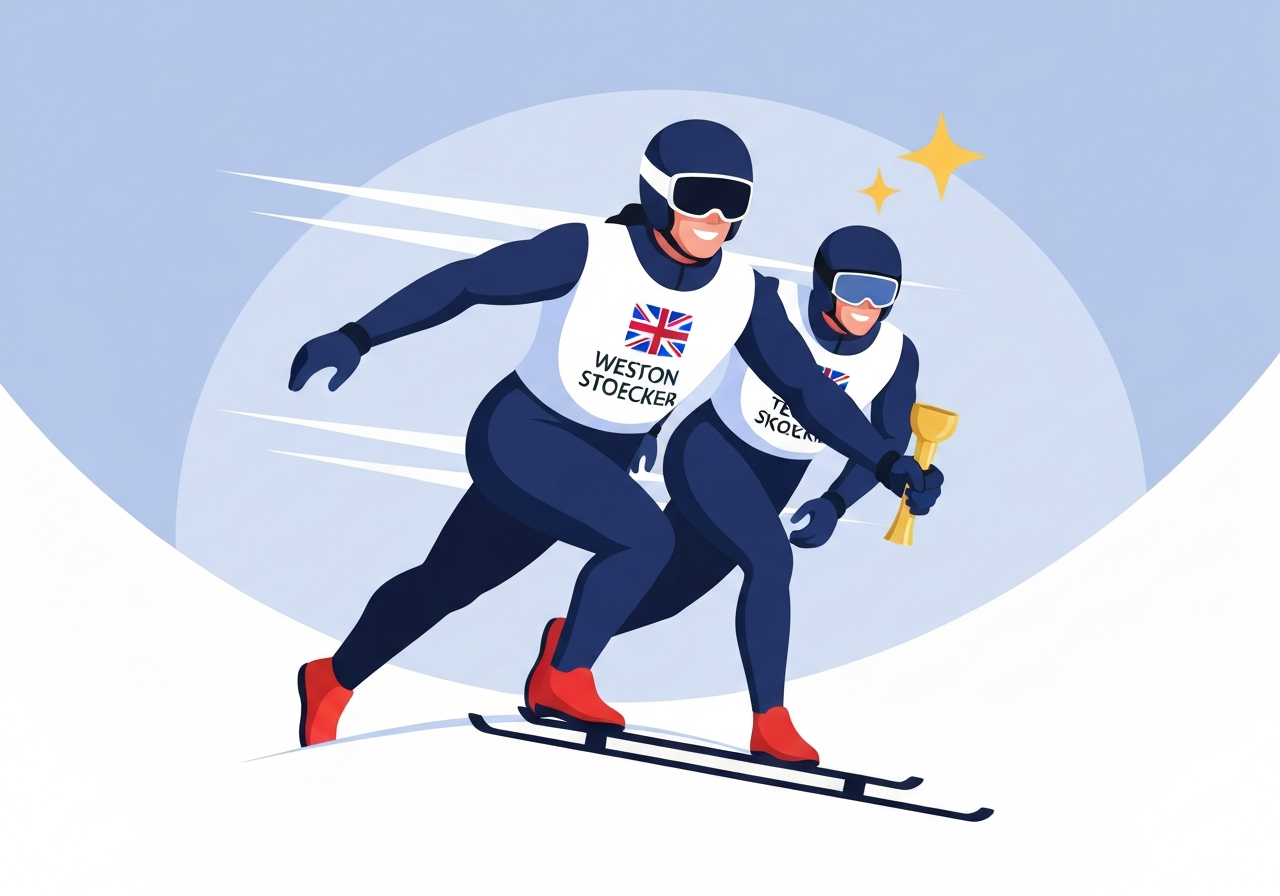
In Cortina d’Ampezzo on Sunday, Team GB claimed two Winter Olympic golds in one day as Matt Weston and Tabitha Stoecker won the mixed team skeleton event. The victory followed Charlotte Bankes and Huw Nightingale’s earlier snowboard cross mixed-team gold, making it a landmark day for British winter sport. Stoecker posted a 1:00.77 run that left Weston the last to race for the top spot, and the 28-year-old delivered a 58.59s sprint to give the pair a combined winning time recorded as 1:59:36. The result also marks the first time Great Britain has taken three golds at a single Winter Olympics.
Key Takeaways
- Matt Weston and Tabitha Stoecker won mixed team skeleton gold for Team GB in Cortina; Stoecker recorded 1:00.77 and Weston 58.59s, for a combined time of 1:59:36.
- Weston, 28, becomes the first Briton to win two Winter Olympic gold medals, having claimed individual skeleton gold two days earlier with a margin of 0.88s in the men’s event.
- The success gave Great Britain three gold medals at these Games — a first for the nation at a single Winter Olympics.
- A second British duo, Marcus Wyatt and Freya Tarbit, missed the podium by 0.01s; German pairs Christopher Grotheer/Jacqueline Pfeifer and Axel Jungk/Susanne Kreher took silver and bronze.
- Weston entered the Games as a clear favourite and adds two Olympic golds to three consecutive overall World Cup titles (Crystal Globes) won through 2024.
- British women on the sled — Stoecker, Tarbit and Amelia Coltman — all finished inside the top 10 at their Olympic debuts.
Background
Skeleton has long been a fertile ground for British success at the Winter Olympics, with several past medals establishing the sport as one of Team GB’s strengths. That pedigree was interrupted in Beijing in 2022, when Great Britain left without a skeleton medal for the first time since the sport’s Olympic reinstatement in 2002, a result widely regarded within the programme as an outlier.
Matt Weston’s rise has been rapid: after finishing 15th in Beijing, he dominated the World Cup circuit and collected three overall titles by 2024, entering Cortina as the man to beat. Tabitha Stoecker, 25, and other emerging British women have been promoted through an intensified domestic development pipeline, giving the squad greater depth than in past cycles.
Main Event
The mixed team skeleton format pairs one female and one male run; Stoecker set the early benchmark with 1:00.77, placing pressure on Weston as the final starter. Ranked as the top seeds, the British pair were the last on track and Weston produced a decisive 58.59s run to lift Team GB into gold-medal position with an official combined time shown as 1:59:36.
Competition for the podium was tight. Marcus Wyatt and Freya Tarbit formed a second British pairing and finished agonisingly 0.01s outside the medals. Two German teams — Christopher Grotheer with Jacqueline Pfeifer, and Axel Jungk with Susanne Kreher — secured silver and bronze respectively, illustrating how marginal gains determine outcomes in skeleton.
Weston’s performance in Cortina capped a dominant week for him: he broke the track record during each run of the individual event and carried that form into the team competition to deliver another spotless run under pressure. Stoecker’s contribution, while slightly off the fastest female time, kept Britain in contention and set the stage for Weston’s closing effort.
Analysis & Implications
Sporting success at major championships often triggers practical effects: increased media attention, sponsor interest and, crucially, potential boosts in funding from national bodies. Two golds in one day — and a tally of three for the Games so far — will strengthen the case for sustained investment in British skeleton programmes and talent pathways ahead of Paris 2028 and Milan–Cortina-derived planning.
Weston’s elevation to Britain’s most decorated Winter Olympian reshapes the sport’s domestic narrative. His back-to-back Olympic titles and consecutive World Cup overall wins introduce a marketable figure for sponsorship and youth recruitment, while the depth demonstrated by other British athletes suggests the programme is not overly dependent on a single performer.
On the technical side, the margins in Cortina underline how equipment setup, minute line choices and start-phase power matter as much as raw driving skill. Teams that can combine a robust development system with marginal performance gains on race day will likely be favourites in future cycles.
Comparison & Data
| Olympic Games | Team GB gold medals (to date) |
|---|---|
| 2026 (Cortina) | 3 |
| 2022 (Beijing) | 0 medals |
The table above contrasts the British gold haul in Cortina with the zero-medal outcome from Beijing 2022 in skeleton and winter sport more broadly. That swing from no medals in 2022 to multiple golds in 2026 signals a significant rebound rather than a short-term fluctuation; however, long-term trends will depend on funding decisions and athlete retention over the next Olympic cycle.
Reactions & Quotes
Team reactions mixed pride and relief as Britain’s skeleton athletes converted expectation into results. Former bobsled medallist John Jackson offered a concise assessment of Weston’s dominance and the quality of the performance.
“Weston has been the cream of the crop on this track — absolutely nail-biting stuff.”
John Jackson, former bobsled Olympic bronze medallist
Weston himself described the contrast between individual triumph and team success, noting the unusual experience of sharing Olympic gold with a teammate in what is normally an individual sport.
“To have my team-mate by my side as Olympic champions… two-time for me which is crazy. I’m looking forward to the celebrations!”
Matt Weston, Olympic champion
Marcus Wyatt, reflecting on Britain’s rebound since Beijing, framed the results as evidence that the 2022 outcome was a temporary setback.
“Me and Matt were there in Beijing and it was good to come and prove that that was a blip and not a trend.”
Marcus Wyatt, Team GB skeleton athlete
Unconfirmed
- Long-term increases in national funding or specific budget allocations for British skeleton after Cortina are expected but not yet announced by UK Sport or funding bodies.
- Details about any immediate commercial sponsorship deals for individual athletes following these golds have not been confirmed publicly.
Bottom Line
Team GB’s mixed team skeleton victory in Cortina, combined with earlier snowboard cross mixed-team gold, made for an unprecedented day of British success at these Winter Games. Matt Weston’s second gold cements his place in British Winter Olympic history and validates the domestic programme’s recent investment in athlete development.
While the results will bring short-term celebration, the long-term impact depends on how governing bodies and funders capitalise on momentum to sustain coaching, recruitment and competition opportunities. For now, Britain’s skeleton programme can point to a compelling return to form and a platform for future medal expectations.
Sources
- BBC Sport (UK public broadcaster, media)
- Team GB (official Olympic team site)
- International Bobsleigh & Skeleton Federation (IBSF) (international governing body)