
Lead
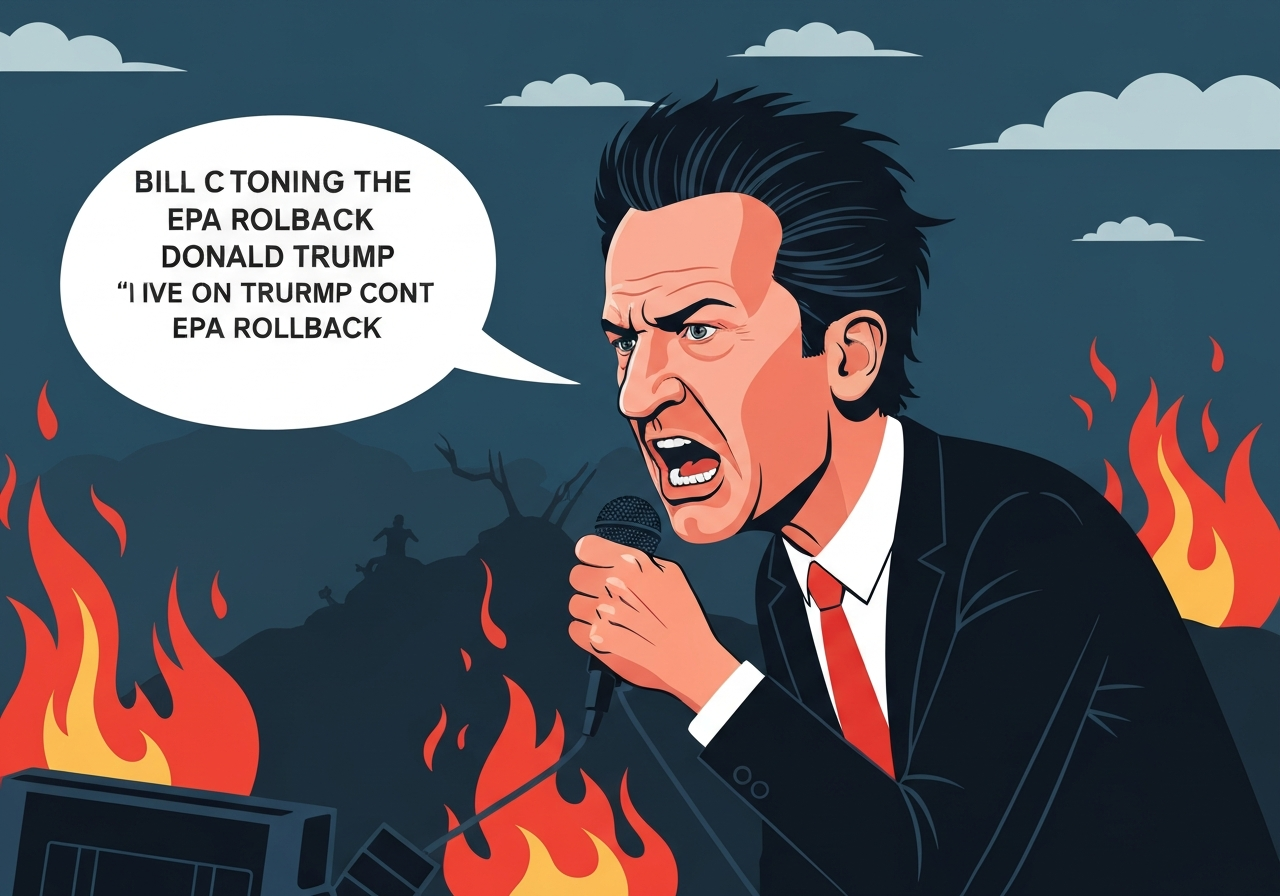
On the February 13 episode of Real Time With Bill Maher, the host, 70, criticized President Donald Trump, 79, after the administration moved on February 12 to rescind a 2009 Environmental Protection Agency finding that classified carbon dioxide and other greenhouse gases as a danger to public health. Maher condemned the decision on-air and framed it as a consequential deregulatory step with wide policy implications. The reversal eliminates federal greenhouse-gas standards for vehicles and has raised warnings about broader rollbacks affecting power plants and oil and gas facilities. The exchange highlights widening public debate over the administration’s climate stance.
Key Takeaways
- The Trump administration announced on February 12 the rescission of a 2009 EPA endangerment finding that linked greenhouse gases to public health risks.
- By rescinding that finding, the change removes federal greenhouse-gas emissions standards for vehicles, per reporting by the Associated Press.
- Bill Maher, 70, on Real Time (Feb. 13) called the action the “biggest dick move” in U.S. history, underscoring the cultural and political backlash.
- EPA director Lee Zeldin described the action as the “single largest deregulatory action in American history,” a characterization cited by Maher.
- The move could pave the way for additional rollbacks of regulations affecting power plants and oil and gas facilities, according to reporting and expert warnings.
- President Trump reiterated skepticism about climate science during a September 2025 UN address, calling climate warnings a “con job,” per PBS reporting.
Background
The 2009 EPA finding—often called the endangerment finding—established that greenhouse gases such as carbon dioxide present a danger to public health and welfare, a legal basis used to regulate emissions at the federal level. That determination underpinned vehicle emissions standards and other rules intended to curb greenhouse-gas output across multiple sectors. Over the intervening years, climate policy has become a polarizing political issue in the United States, entwined with debates over industry regulation, economic growth, and international commitments.
Recent years have seen partisan efforts to roll back federal environmental regulations, framed by proponents as deregulation to spur business activity and by critics as harmful to public health and the climate. The Trump administration has repeatedly questioned mainstream climate science, a stance that reached public prominence during high-profile speeches and policy actions. Domestic stakeholders—from state governments to industry groups and environmental advocates—have divergent reactions to federal changes, complicating the policy landscape.
Main Event
On February 12, the administration formally moved to repeal the 2009 EPA endangerment finding for greenhouse gases. According to contemporary reporting, the repeal eliminated federal emissions standards for vehicles, a step that could weaken a primary regulatory lever used to limit transportation-sector emissions. The Associated Press noted that the action might open the door to further deregulatory measures affecting power generation and the oil and gas industry.
The next day, on Real Time With Bill Maher (Feb. 13), Maher addressed the repeal and President Trump’s long-standing public skepticism of climate science. Maher accused the president of dismissing scientists and characterized the repeal as not only politically aggressive but morally irresponsible given the stakes on public health and the climate. He referenced EPA director Lee Zeldin’s claim that the move was the largest deregulatory action in U.S. history and used blunt language to emphasize his view of the political and ethical dimensions.
The administration and its allies argue the rollback corrects regulatory overreach and supports economic priorities, while critics warn of increased emissions, weakened federal oversight, and negative long-term consequences for climate mitigation. The immediate policy effect removes a statutory basis for certain federal emissions standards, though legal, legislative, and state-level pushback could influence how broadly and quickly those changes take effect.
Analysis & Implications
Rescinding the EPA’s endangerment finding is significant because it erases a legal justification that courts and regulators have used to enforce nationwide emissions controls. Without that foundational finding, the federal government loses a clear statutory pathway for implementing wide-reaching greenhouse-gas limits, potentially constraining future administrations’ options for rapid regulatory action. That legal shift could push more responsibility for emissions reductions onto states, municipalities, and the private sector.
Economically, supporters argue reduced regulation lowers compliance costs for automakers and fossil-fuel producers, at least in the near term. Critics counter that any short-term savings may be outweighed by long-term economic risks from worsening climate impacts, such as extreme weather, infrastructure damage, and public-health costs. The policy choice thus reflects an intergenerational trade-off between immediate economic priorities and longer-term climate resilience.
Politically, the action intensifies polarization: it will likely energize environmental groups and progressive constituencies while consolidating support among constituents who prioritize deregulation. Internationally, the move may complicate U.S. credibility in climate diplomacy, especially where prior U.S. commitments rested on domestic regulatory capacity. Courts and state governments could become pivotal arenas for contesting the practical effects of the repeal.
Comparison & Data
| Year | Action | Primary Effect |
|---|---|---|
| 2009 | EPA endangerment finding (greenhouse gases) | Established federal legal basis to regulate GHGs for public-health protection |
| Feb 12 (current) | Rescission of the 2009 finding | Removes federal findings used to justify vehicle emissions standards and may enable further rollbacks |
This comparison underscores that the 2009 finding served as a structural anchor for multiple regulatory programs. Removing the finding does not instantaneously alter every regulation, but it strips away a foundational legal rationale that regulators and courts have relied upon. The practical consequences will depend on subsequent rulemaking, litigation, and actions by state governments and private actors.
Reactions & Quotes
“He thinks it’s just some bulls*** that people made up out of nothing to get rich,”
Bill Maher, host of Real Time (paraphrased)
Maher’s on-air remarks framed the repeal as both a policy error and a moral failing, invoking the president’s long-running skepticism of climate science.
“This is the single largest deregulatory action in American history,”
Lee Zeldin, EPA director (quoted)
Zeldin’s description was cited by Maher and by administration officials to emphasize the scale and intention behind the change.
“This ‘climate change,’ it’s the greatest con job ever perpetrated on the world,”
President Donald Trump, United Nations speech (Sept. 2025, paraphrased)
Trump’s UN remarks illustrate the rhetorical context in which the administration is framing its policy choices on climate, reinforcing skepticism expressed in domestic policy moves.
Unconfirmed
- Whether the repeal will immediately increase nationwide greenhouse-gas emissions is subject to timing of subsequent rule changes, state actions, and market responses.
- The full scope of future deregulation affecting power plants and oil and gas facilities has not been finalized and remains contingent on forthcoming agency rulemaking.
- Projected economic impacts from the repeal—positive or negative—depend on a range of assumptions and have not been definitively quantified in government-published analysis at the time of reporting.
Bottom Line
The administration’s decision to rescind the 2009 EPA endangerment finding is a consequential policy change with legal, economic, and diplomatic ramifications. It removes a key federal legal justification for greenhouse-gas regulation and raises the prospect of broader rollbacks in energy and environmental policy.
Public debate is likely to intensify, with environmental advocates, states, and courts positioned to challenge or mitigate federal moves while proponents stress deregulatory benefits. For observers, the episode illustrates how rhetoric, regulatory power, and legal foundations interact to shape the pace and direction of U.S. climate policy.
Sources
- Yahoo Entertainment (news aggregation: original report supplied by Yahoo)
- The Associated Press (news agency: reporting on EPA repeal and regulatory effects)
- PBS NewsHour (public broadcaster: coverage of UN speech)
- HBO — Real Time With Bill Maher (official program page)