
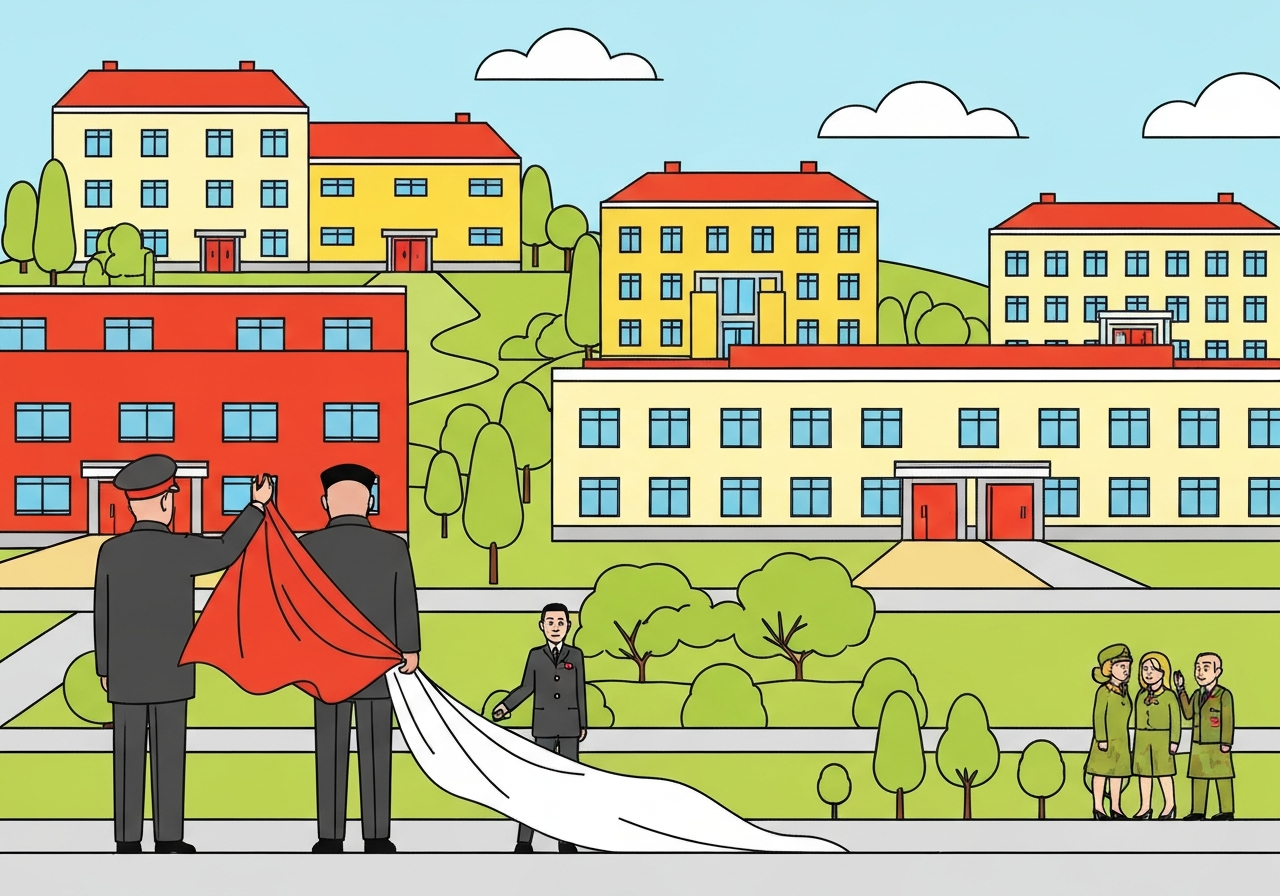
North Korea announced the completion of a new housing district in Pyongyang on 16 February 2026 intended for the families of North Korean soldiers killed while fighting alongside Russian forces in Ukraine. State media published images of leader Kim Jong-un walking the new Saeppyol Street in the Hawasong district and visiting several of the homes with his daughter, believed to be Kim Ju-ae. Kim framed the development as an expression of the state’s duty to honour the “young martyrs,” saying the residences should let bereaved families “take pride” and live with dignity. Officials said the project was finished ahead of schedule in a bid to offer some comfort to the families ahead of a major ruling party congress planned later this month.
Key takeaways
- North Korean state media reports completion of Saeppyol Street in Pyongyang’s Hawasong district on 16 February 2026 for families of soldiers killed in Ukraine.
- Images show Kim Jong-un and his daughter, believed to be Kim Ju-ae, touring newly completed homes; the daughter’s public role has become more prominent in recent months.
- Seoul, Kyiv and Western sources estimate that roughly 14,000 North Korean personnel were sent to Ukraine in 2024 and that more than 6,000 of them were killed.
- Pyongyang has recently opened other memorials and stepped up propaganda glorifying those deployed to support Russia’s campaign.
- Seoul’s National Intelligence Service told lawmakers North Korean forces gained modern combat experience and Russian technical support from deployments in Ukraine.
- Analysts see the housing project’s timing as political, aimed at shoring up domestic support before a party congress where Kim will set his agenda for the next five years.
- North Korea has publicly pledged strong political backing for Russia and said it will “unconditionally support” President Vladimir Putin’s policies and decisions.
Background
Relations between Pyongyang and Moscow have strengthened amid shared tensions with the United States, producing closer military cooperation in recent years. In 2024 the two capitals deepened ties that analysts and regional governments say included troop deployments and transfers of artillery and missile systems. North Korean state media has intensified coverage framing those deployments as heroic service to allied causes, while Western and regional intelligence agencies have monitored personnel and equipment movements closely.
Domestically, the North Korean leadership routinely uses public projects and ceremonies to underscore regime legitimacy and unity. Providing housing for bereaved families fits a pattern of high-visibility social programs meant to translate military sacrifice into state-provided welfare and symbolic recognition. The unveiling of Saeppyol Street follows other recent displays — including a new memorial complex in Pyongyang — that memorialise troops deployed to Ukraine and praise their sacrifices.
Main event
State photographs released by the Korean Central News Agency (KCNA) show Kim Jong-un walking along Saeppyol Street and entering several units with his daughter at his side. Officials described the homes as finished “even one day earlier” than planned, a detail Kim cited as evidence of the leadership’s commitment to the families’ welfare. The district is said to be in the Hawasong area of the capital and was presented as a material repayment to families whose relatives died abroad.
North Korean commentary emphasised the symbolic value of the new street, saying it represents the “spirit and sacrifice” of the dead soldiers and should give surviving relatives public recognition. The state framed the project as both consolation and reward, intended to reassure citizens that their losses will not be forgotten. The rollout included formal speeches and handshakes; KCNA captions stressed gratitude toward the fallen and the leadership’s personal attention to families’ needs.
Outside analysts and regional officials read the timing as politically calculated. With a major ruling party congress due later this month, observers say Pyongyang is staging conspicuous acts of social provision to strengthen internal cohesion and blunt potential domestic unease over military losses. South Korean agencies have also highlighted that the deployments provided North Korea with combat exposure and access to Russian technical expertise.
Analysis & implications
The housing project serves several simultaneous objectives for Pyongyang. It acknowledges and memorialises losses in a way that elevates state care, converting battlefield casualties into a narrative of patriotic sacrifice the regime can showcase. That narrative helps sustain morale among military families and the broader public by presenting material compensation as proof of reciprocal obligation between state and soldier.
Externally, the construction emphasises the depth of the Pyongyang–Moscow alignment. North Korea’s public pledge of support for Russian policy, and the visible deployment of personnel and materiel, signal a bilateral relationship that advances both leaders’ strategic posture against Western influence. The exchange of battlefield experience and technical assistance could accelerate North Korea’s weapons development and operational competence, which Seoul’s intelligence officials have warned may improve the regime’s military performance.
Politically, the move is timely: ahead of a party congress, highly visible domestic projects reduce the political cost of controversial foreign ventures by turning casualties into state-managed martyrdom. That reduces the space for public grievance and frames losses as collectively meaningful. For foreign governments, the calculated public relations element complicates efforts to isolate Pyongyang; the regime is demonstrating it can translate external military cooperation into domestic legitimacy.
Comparison & data
| Item | Reported figure |
|---|---|
| North Korean personnel sent to Ukraine (2024) | About 14,000 |
| Reported North Korean combat deaths in Ukraine | More than 6,000 |
| Recent public memorial projects in Pyongyang | New street (Saeppyol), memorial complex |
The numbers above are drawn from South Korean, Ukrainian and Western reporting cited by regional officials and news agencies. They illustrate the scale of Pyongyang’s contribution as reported externally and the state’s subsequent propaganda and commemorative activity. While North Korea’s official media highlights the provision of housing and ceremonial recognition, independent verification of some operational details remains limited.
Reactions & quotes
South Korean lawmakers and intelligence briefings emphasised the operational benefits North Korea may derive from the deployments, including combat experience and technical assistance that could upgrade its forces.
“North Korea appears to be gaining modern combat experience and Russian technical support that could bolster its weapons systems,”
South Korea National Intelligence Service (reported)
Analysts tied the inauguration to internal political aims, viewing the timing as unmistakably linked to Pyongyang’s calendar and the upcoming party congress.
“The timing is a highly calculated political move to justify its soldier deployment and to visualise the state providing concrete compensation,”
Hong Min, Korea Institute for National Unification (analyst)
State media framed the homes as a paternal response to sacrifice and presented Kim’s personal involvement as an expression of leadership care.
“We must repay the young martyrs who sacrificed all to their motherland and allow their families to live with pride,”
KCNA (state media quotation)
Unconfirmed
- The exact name and public status of Kim’s daughter remains reported as believed to be Kim Ju-ae in state and outside coverage; North Korean confirmation of personal details is limited.
- Precise figures for troop deployments and casualties are reported by South Korean, Ukrainian and Western sources; Pyongyang has not independently corroborated the full tallies.
- Details of any formal mutual-defence arrangements or operational command links between Russian and North Korean forces remain incompletely documented in public sources.
Bottom line
The inauguration of Saeppyol Street is both a domestic propaganda measure and a political signal. It converts battlefield losses into a managed narrative of sacrifice and state reciprocity, strengthening the leadership’s portrayal of care for families while deterring social unease ahead of a major party congress. For analysts and regional governments, the event underscores how Pyongyang packages external military cooperation as internal legitimacy-building.
Policy implications are twofold: first, reported North Korean combat experience and Russian technical assistance could make the regime’s forces more capable over time; second, the timing and staging of welfare projects show Pyongyang’s intent to neutralise domestic fallout from foreign military ventures. Continued monitoring and corroboration by independent sources remain essential to verify operational claims and to assess the long-term military and political effects.
Sources
- The Guardian — international news organisation reporting on the housing unveiling and regional reactions.
- KCNA — North Korean state news agency (official statements and released images).
- Reuters — international news agency (coverage of deployments and official comments cited in regional reporting).
- Associated Press — international news agency (reported corroborating details referenced by multiple outlets).
- South Korea National Intelligence Service (NIS) — official government intelligence body (briefings to lawmakers cited for operational assessments).
- Korea Institute for National Unification (KINU) — government-affiliated research institute (analyst commentary on political implications).