
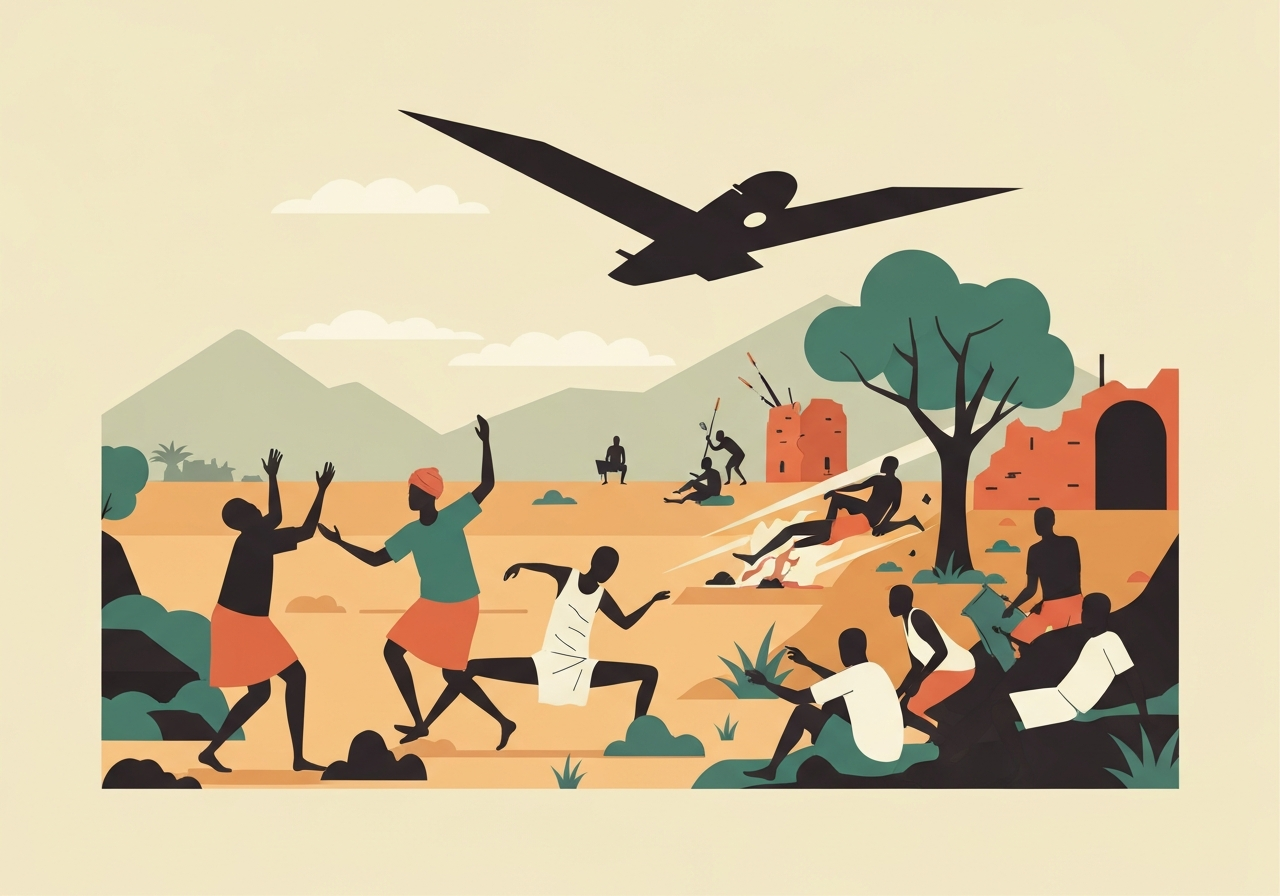
UN investigators say more than 6,000 people were killed during a late-October offensive by the Rapid Support Forces (RSF) on el-Fasher in North Darfur. The U.N. Human Rights Office reported that the RSF and allied Arab militias overran the city after an 18‑month siege and carried out mass killings, sexual violence and abductions over a three‑day period. The office concluded the documented acts amount to war crimes and may amount to crimes against humanity, and it called for accountability for commanders and forces involved. The report draws on 140 interviews and corroborating satellite imagery and video.
Key takeaways
- The U.N. Human Rights Office reports at least 6,000 people were killed in the el‑Fasher offensive; the estimate combines 4,400 killed inside the city (Oct. 25–27) and more than 1,600 killed while fleeing.
- The World Health Organization reported at least 460 people were killed on Oct. 28 when the RSF stormed the Saudi Maternity Hospital; those figures are not included in the 4,400 figure for Oct. 25–27.
- The U.N. documented mass executions (including an estimated 600 people, 50 of them children), an attack on a sheltered crowd of about 1,000 at Rashid dormitory (about 500 killed), widespread sexual violence, abductions for ransom, torture and disappearances.
- The RSF and allied Arab militias (often referred to as Janjaweed) reportedly targeted non‑Arab Zaghawa communities among others; many attacks appear to have ethnicity‑based motives according to the report.
- The offensive mirrors previous RSF assaults in Darfur, including attacks on Zamzam camp, Geneina and Ardamata in 2023, and follows a wider conflict in Sudan that began in April 2023 and has produced grave humanitarian needs.
- The U.N. report documents at least 10 detention sites used by the RSF in el‑Fasher, including the city’s Children Hospital, and says several thousand people remain missing or unaccounted for.
- The International Criminal Court has opened investigations into atrocities in the conflict, and the U.N. called for investigation and prosecution of those bearing responsibility.
Background
The Sudan conflict erupted into open fighting in April 2023 after a power struggle between the Sudanese Armed Forces and the Rapid Support Forces, a powerful paramilitary group. Fighting spread beyond Khartoum to regions across Sudan, with Darfur again becoming a major battlefield after earlier waves of violence in the 2000s. The renewed war has produced what U.N. agencies describe as the world’s largest humanitarian crisis, with pockets of famine and millions displaced.
El‑Fasher, the capital of North Darfur, remained one of the last government strongholds in the region until the late‑October offensive. The city had been under siege for over 18 months before the reported RSF assault that overwhelmed local defenses. Local health facilities, internally displaced persons (IDP) camps and university dormitories were focal points for civilians seeking shelter during the attack.
Main event
According to the U.N. report, RSF fighters and allied Arab militia forces mounted a concentrated push into el‑Fasher starting Oct. 25. Over the three days between Oct. 25 and Oct. 27 the office documents mass killings inside the city, followed by continued violence as civilians attempted to flee. The U.N. investigators say their count of at least 4,400 killed inside el‑Fasher during that window is based on 140 witness interviews and analysis of satellite imagery and video evidence.
The report cites multiple specific incidents. One documented attack involved heavy weapons fired into a crowd of roughly 1,000 people sheltering in the Rashid dormitory at el‑Fasher University on Oct. 26, which the U.N. estimates resulted in about 500 deaths. In another case investigators recorded an execution of around 600 people — including about 50 children — who were sheltering in university facilities on the same day.
After the initial three‑day onslaught, the RSF continued operations that included an Oct. 28 assault on the Saudi Maternity Hospital that the World Health Organization says killed at least 460 people. The U.N. report also details large‑scale sexual violence, abductions for ransom, and the conversion of medical facilities into detention sites. Witnesses reported bodies, mass graves and widespread destruction across neighborhoods and IDP camps near the city.
Analysis & implications
The U.N. characterization of the el‑Fasher events — as containing patterns consistent with war crimes and possible crimes against humanity — raises urgent questions about command responsibility and the failure of deterrence mechanisms. The report stresses that impunity for prior abuses by the RSF and allied militias has likely contributed to the scale and brazenness of the attacks. Without credible, independent investigations and prosecutions, the cycle of mass atrocities in Darfur is likely to continue.
Regionally, the offensive deepens destabilization across Darfur and complicates humanitarian response capacity. The destruction of health infrastructure and the reported detention of thousands — including detention centers inside hospitals — impede medical care and the ability to document abuses. Displacement pressure will intensify needs in neighboring towns and camps, straining already limited aid access and raising the risk of secondary crises, including disease outbreaks and food insecurity.
Internationally, the findings increase pressure on institutions that can act on accountability. The International Criminal Court’s ongoing inquiries and any future referrals or cases will hinge on access, evidence preservation and political will among states. At the same time, humanitarian and diplomatic tools face limits: sanctions or referrals can take months or years to produce legal outcomes, while civilians continue to face immediate danger.
Comparison & data
| Event | Dates | Reported deaths |
|---|---|---|
| El‑Fasher (inside city) | Oct. 25–27, 2025 | ≈4,400 (U.N. HR Office) |
| Killed while fleeing el‑Fasher | Oct. 25–27, 2025 | >1,600 (U.N. HR Office) |
| Saudi Maternity Hospital attack | Oct. 28, 2025 | ≥460 (WHO) |
| Abu Shouk displacement camp shelling | Oct. 23–24, 2025 | ≈300 (U.N. HR Office) |
The table summarizes the principal casualty figures the U.N. report cites and the WHO figure for the hospital attack; the U.N. report notes its overall toll for the week‑long offensive is likely a conservative estimate. Analysts caution that access constraints, destroyed records and ongoing insecurity make precise accounting difficult. Still, the clustering of high‑fatality incidents within days of one another signals a deliberate, coordinated campaign rather than isolated battlefield collateral damage.
Reactions & quotes
U.N. officials urged accountability and highlighted the broader pattern of abuses linked to the RSF and allied militias. Below are brief, representative quotations included in the U.N. report and associated coverage.
“The wanton violations … underscore that persistent impunity fuels continued cycles of violence.”
Volker Türk, U.N. High Commissioner for Human Rights
“It was like a scene out of a horror movie,”
Witness to the Rashid dormitory attack (reported in U.N. interviews)
The RSF did not provide a direct response to email requests for comment for the U.N. report. Gen. Mohammed Hamdan Dagalo has in previous statements acknowledged that some fighters committed abuses while disputing accounts of their scale; the U.N. office says its findings are corroborated by multiple independent sources. International bodies including the WHO and the ICC have highlighted the need to document and respond to the violence.
Unconfirmed
- The true death toll for the full week‑long offensive is likely higher than the reported figures; exact totals remain unverified due to ongoing access limits.
- Reports of the total number of missing persons vary; the U.N. notes several thousand unaccounted for but precise numbers are unconfirmed.
Bottom line
The U.N. report presents a detailed and corroborated account that more than 6,000 people died in and around el‑Fasher during a concentrated RSF offensive in late October, with multiple incidents amounting to mass killings, sexual violence and large‑scale detentions. The documentation strengthens the case that these events fit patterns of war crimes and possibly crimes against humanity, and it increases pressure for independent investigations and prosecutions.
For policymakers and humanitarian actors, the report underscores two urgent priorities: protect civilians and preserve evidence. Immediate humanitarian access and security guarantees are needed to reduce further loss of life, while secure evidence‑gathering and witness protection are essential for future accountability efforts. Without concerted international and domestic action, the report warns that impunity will continue to fuel cycles of violence across Darfur.
Sources
- NPR — (news report summarizing U.N. Human Rights Office findings)
- U.N. Human Rights Office (OHCHR) — (official U.N. human rights institution; full report available from OHCHR)
- World Health Organization (WHO) — (U.N. health agency; reporting on hospital attack casualty figures)
- International Criminal Court (ICC) — (international tribunal; investigations into crimes in Sudan)