
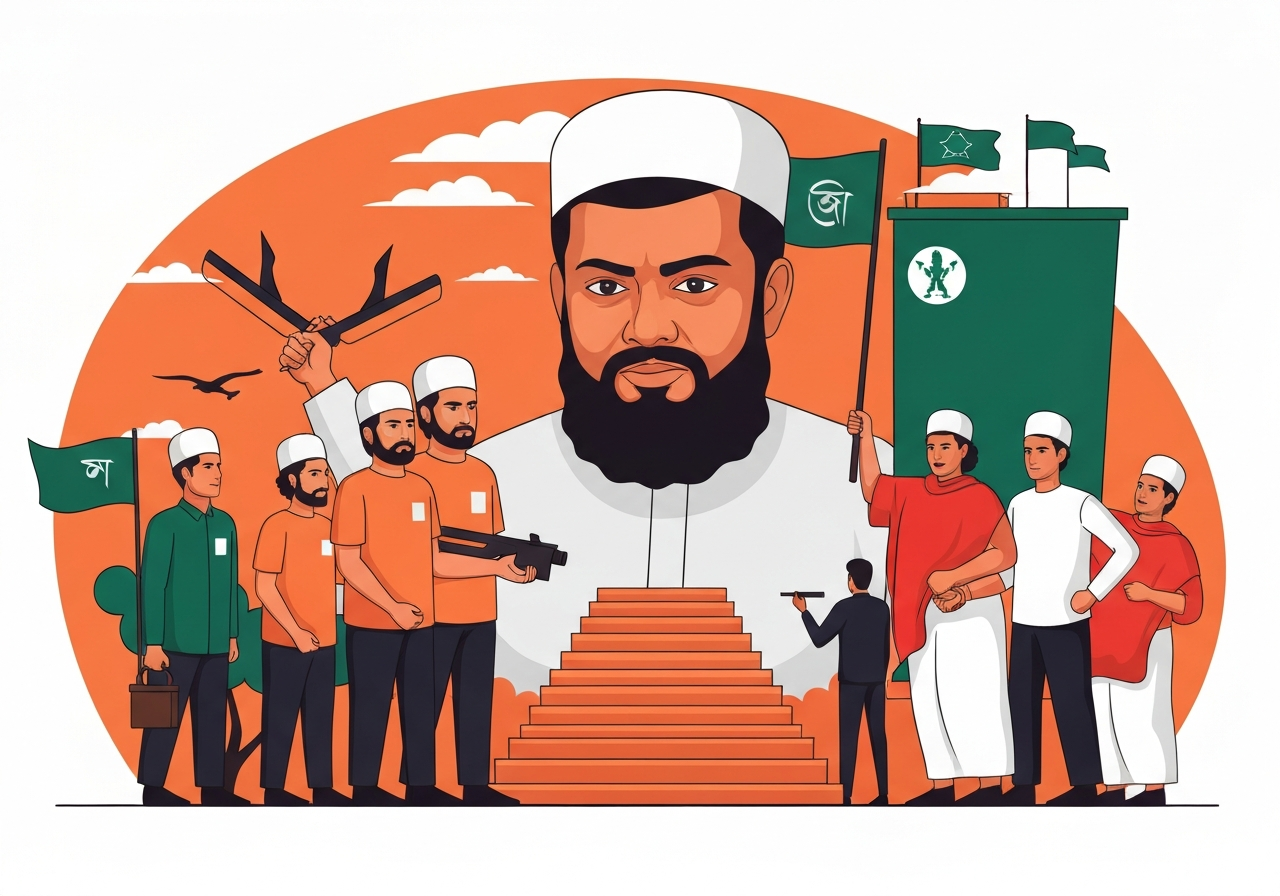
The Islamist party Jamaat-e-Islami emerged as a decisive force in Bangladesh’s first national election since the 2024 student-led upheaval, winning 68 of the 297 parliamentary seats and reshaping a political landscape long dominated by two dynastic parties. The vote, held in mid-February 2026 and reported on Feb. 15, 2026, delivered a clear parliamentary majority to the Bangladesh Nationalist Party, whose leader Tarique Rahman is set to become prime minister. The result confirmed that Jamaat’s earlier campus breakthrough — a landslide in student union elections at the University of Dhaka in September — was not an isolated phenomenon and that new alliances forged after the revolution have real electoral consequences.
Key Takeaways
- Jamaat-e-Islami won 68 out of 297 seats (about 23 percent), its best national result to date, signaling a major growth in parliamentary representation.
- The Bangladesh Nationalist Party (BNP) secured a clear majority in the new parliament; Tarique Rahman is positioned to lead the next government.
- In September, Jamaat’s youth wing captured a landslide in student government at the University of Dhaka, a traditional center of left-liberal activism.
- The National Citizen Party, formed last year by leaders of the 2024 student uprising, entered an electoral alliance with Jamaat two months before the national vote.
- The alliance bridged organizational strength (Jamaat’s student networks) and the National Citizen Party’s reformist agenda, producing unexpected seat gains.
- The 2024 revolution that toppled Sheikh Hasina’s government set the context for rapid shifts in Bangladesh’s party system and voter alignments.
Background
Since independence in 1971, Bangladesh’s politics have been dominated by two dynastic parties: the Awami League and the Bangladesh Nationalist Party. That pattern was interrupted by a sweeping student movement in 2024 that mobilized young activists across campuses and urban streets, culminating in the removal of Prime Minister Sheikh Hasina’s government. The uprising energized new actors and prompted party realignments that continued into the 2026 national vote.
Jamaat-e-Islami is a decades-old Islamist party that has historically advocated governance aligned with Islamic principles. Ahead of the election, it presented a comparatively moderate, electorally palatable platform and leaned on an extensive student and grassroots network to expand its reach. The National Citizen Party, created by leaders of the 2024 movement, campaigned for a more inclusive democratic order and stronger protections for political freedoms and women’s rights; its decision to ally with Jamaat was pragmatic and controversial.
Main Event
The national contest, held in mid-February 2026, confirmed a reconfigured party map. The BNP won a majority of seats and will form the next government with Tarique Rahman as prime minister-designate. Jamaat-e-Islami’s 68 seats — its largest haul in a national election — marked a dramatic surge from earlier parliamentary showings and made it a significant parliamentary actor and potential coalition partner or opposition kingmaker.
Two months prior to the national vote, the National Citizen Party announced an electoral alliance with Jamaat-e-Islami. Party leaders said the arrangement would improve their chances in constituencies where Jamaat’s student networks and local organization were strongest. The alliance allowed both groups to translate campus-level momentum into votes at the ballot box, particularly in urban university towns and some suburban districts.
On election day, polling stations in Dhaka showed visible campaigning and activism. Posters of Jamaat figures, including images of party leader Shafiqur Rahman, were reported outside some polling sites. Observers noted high turnout among young voters in university precincts, a continuing legacy of the 2024 mobilization. The campaign atmosphere mixed traditional dynastic politics with new activist energy, producing an outcome that surprised many analysts.
Analysis & Implications
Jamaat’s electoral advance complicates assumptions about the student movement’s long-term trajectory. The student coalition that propelled the 2024 revolution had emphasized civil liberties and gender equality; Jamaat’s conservative social platform contrasts with those aims. The alliance between the National Citizen Party and Jamaat suggests that electoral pragmatism can override ideological incompatibilities when organizational reach and vote-winning capacity are at stake.
For the incoming BNP-led government under Tarique Rahman, Jamaat’s gains create both opportunities and risks. If Jamaat supports policy initiatives, the BNP may benefit from a broader parliamentary base. At the same time, Jamaat’s ideological stances on women’s public roles and legal order could provoke friction with reformist partners and civil-society groups, complicating governance and policy consensus on social issues.
Regionally, the shift reinforces a pattern of political volatility in South Asia, where protest movements can produce rapid party-system realignments. International partners and donors concerned with human rights, gender equality and democratic norms will be watching whether the new parliament produces legislative changes that alter legal protections or civic space.
Comparison & Data
| Party / Group | Seats (of 297) | Notes |
|---|---|---|
| Jamaat-e-Islami | 68 | Best national showing to date |
| Bangladesh Nationalist Party (BNP) | Clear majority | Exact seat tally not specified in the reporting |
| National Citizen Party | Allied with Jamaat | New party formed by 2024 student leaders |
The table above summarizes the allocation and context reported in coverage. While Jamaat’s seat count is explicit (68 of 297), the public reporting emphasized BNP’s majority without publishing a precise seat breakdown in the material used for this analysis. That gap limits exact arithmetic on coalition arithmetic but does not change the central finding: Jamaat’s parliamentary presence has expanded significantly.
Reactions & Quotes
“The election outcome shows how quickly political alignments can shift after mass movements; new actors now matter at the national level.”
Political analyst interviewed in Dhaka (paraphrased)
“Our student networks delivered results where it counted: at the ballot box.”
Jamaat-e-Islami youth organizer (paraphrased)
“We entered an alliance to maximize seats and translate our campus momentum into parliamentary representation.”
National Citizen Party representative (paraphrased)
Unconfirmed
- The specific policy concessions, if any, that Jamaat and the National Citizen Party negotiated as part of their alliance remain unpublished and unverified.
- The internal dynamics within the National Citizen Party about aligning with an Islamist partner are not fully known and may include dissent that has not been publicly disclosed.
- Precise seat-by-seat vote tallies and any constituency-level irregularities referenced by local observers have not been independently verified in the reporting used here.
Bottom Line
Bangladesh’s February 2026 election confirmed a major reordering of political forces set in motion by the 2024 student revolution: new parties and alliances translated campus influence into parliamentary power, and Jamaat-e-Islami emerged with its strongest national showing. The result complicates the reformist ambitions of student-origin parties and raises questions about how ideological differences within alliances will be managed in practice.
For voters, civil-society groups and international observers, the immediate focus will be on how the new parliament addresses governance, rights and social policy. The next months will test whether the electoral pragmatism that produced the alliance between reformist student leaders and an Islamist party proves stable, and whether policy outcomes align with the public promises made during the campaign.
Sources
- The New York Times — news report (Feb. 15, 2026)