
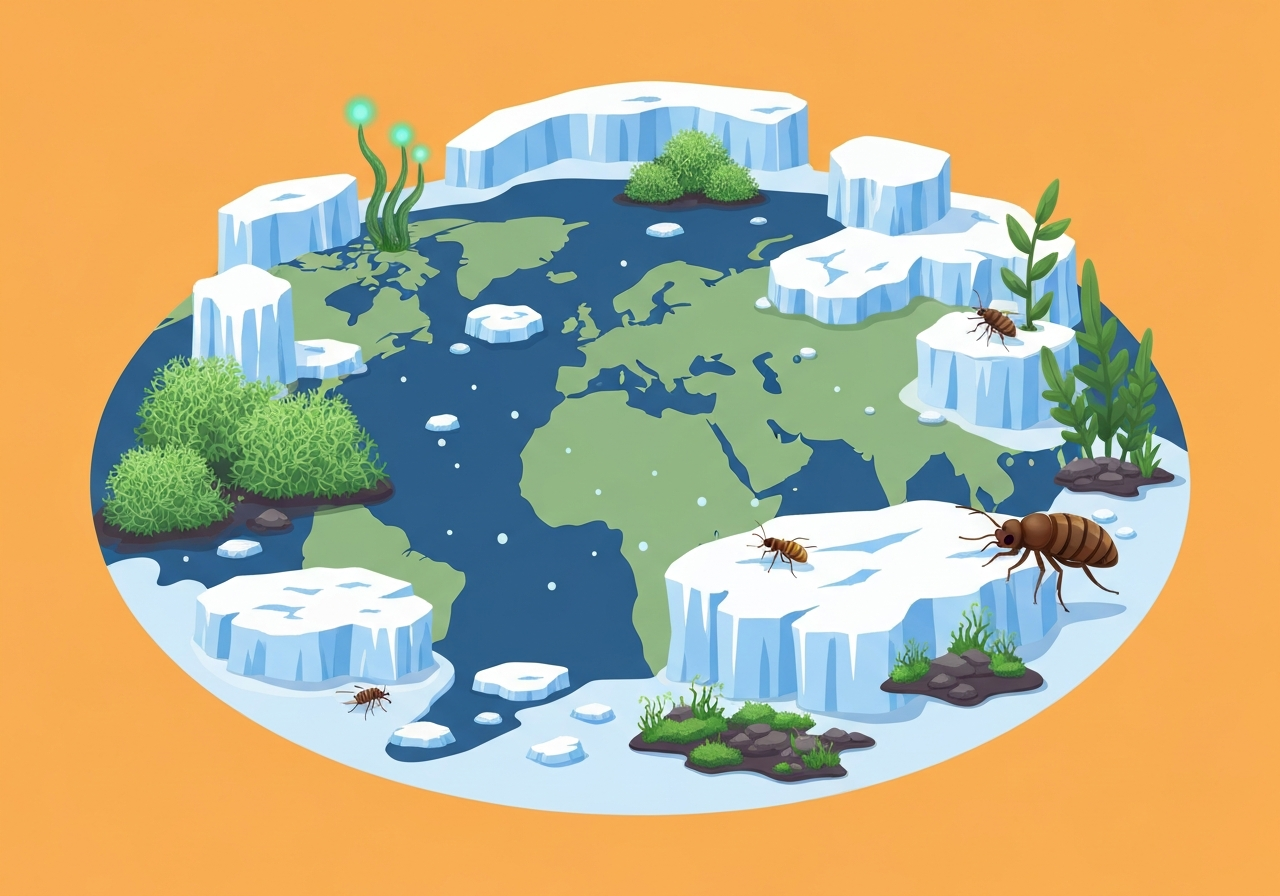
Lead: On remote outcrops in the Garvellach islands off Scotland’s west coast, a continuous rock sequence records a global turning point: between about 717 and 635 million years ago the planet plunged into repeated, near-global glaciations. These Cryogenian events — chiefly the Sturtian (beginning ~717 Ma, lasting ~57 Myr) and the Marinoan (about 645–635 Ma) — drove radical shifts in climate, chemistry and habitat. Researchers working the Port Askaig succession link sedimentary change and carbon isotopes to a planetary-scale freeze and rebound that reorganized oxygen cycles and set the stage for complex multicellular life. In short, the Snowball Earth interval appears to have been a proximate cause of the evolutionary dynamics that led to animals.
Key takeaways
- The Cryogenian hosted at least two major global glaciations: the Sturtian began ~717 million years ago and persisted for roughly 57 million years, while the Marinoan spanned about 645–635 million years ago.
- The Garvellachs and nearby Port Askaig formation preserve an unusually complete >70–80 m sedimentary record that captures the transition from tropical shorelines to glacial deposition at low paleolatitudes.
- Field evidence includes increasing dropstones, frost-shattered substrata, and large glacial clasts such as the so-called ‘Bubble’, showing ice-transport and deformation of carbonate platforms.
- Carbon isotope excursions in these rocks record swings between very low and relatively high organic burial, consistent with dramatic greenhouse oscillations before, during and after glaciations.
- Geological timing links Rodinia rifting and emplacement of fresh basalt to weathering-driven CO2 drawdown (the ‘fire-and-ice’ hypothesis), but this mechanism alone does not fully explain why Snowball episodes were so extreme.
- Evidence implies life persisted in refugia (marine margins, cryoconite-like holes, sub-ice microhabitats) and that repeated bottlenecks may have accelerated evolutionary innovation toward complex multicellularity.
- The beginning of the Cryogenian (the proposed golden-spike/GSSP in Scotland/Ireland) is a candidate for formal global stratigraphic definition, with a vote expected during 2026 in the geological community.
Background
For more than a century geologists debated whether Earth could ever have been entirely or nearly entirely ice-covered. Early skepticism rested on the idea that such a state would be irreversible and incompatible with the survival of complex life. Over recent decades multiple lines of field, geochemical and paleomagnetic evidence overturned that view: ice reached low latitudes on at least two occasions during the Cryogenian, and the planet recovered. The Garvellachs, now at high latitudes, were situated much closer to the equator during the Cryogenian, so their sediments uniquely capture low-latitude responses to global cooling.
Plate tectonics had arranged continents very differently before the Cryogenian. The supercontinent Rodinia had experienced long intervals of weathering and interior aridity; rifting of that assembly began shortly before the first major glaciation. Rifting produced fresh basalt and new continental margins: while volcanic outgassing adds CO2, exposure and chemical weathering of fresh basalt can draw down atmospheric CO2 over geological timescales. This interplay of tectonics, weathering and climate sits at the heart of proposed triggers for global glaciation, though it does not by itself explain the uniqueness of the Cryogenian events.
Main event
Field teams working the Port Askaig succession on the Garvellachs can walk through tens of metres of strata that transition from carbonate-rich, warm-water deposits into sequences dominated by glacial diamictites and contorted beds. Early warning signs in the record include isolated dropstones and gravel clusters that must have fallen from icebergs, and frost-shattered horizons indicating persistent cold and desiccation before full glaciation set in. Massive clasts and deformed carbonates provide dramatic evidence of ice-sheet transport and load-driven folding.
Geochronology and volcanic stratigraphy show rifting around Laurentia began within roughly a million years of the initial glaciation, making basalt weathering a plausible proximal driver of CO2 decline. Carbon isotope profiles across the boundary mark a shift toward heavier isotopic values exactly where sedimentary cooling indicators appear, consistent with increased burial of organic carbon removing CO2 from the atmosphere. That isotope–sediment coupling is a key reason the Port Askaig sequence is proposed as a potential GSSP to define the Cryogenian base.
The cold extremes were bracketed by exceptionally warm intervals. Isotopic and sedimentary data indicate pre-glacial hothouse conditions in which organic matter burial was inefficient, amplifying greenhouse warming through positive feedbacks. When conditions tipped toward greater organic burial, carbon isotopes swing and global cooling followed — sometimes into runaway glaciation — illustrating a climate system with unusually strong positive feedbacks compared with the Phanerozoic.
Analysis & implications
The Cryogenian’s extreme oscillations in climate and carbon burial would have had profound consequences for oxygen levels. Increased burial of organic carbon sequesters reduced carbon and allows free oxygen to accumulate in the atmosphere and ocean. Conversely, poor burial during hothouse intervals would have depressed oxygen. These swings plausibly produced repeated ‘oxygen booms and busts’ that altered ecological opportunity for energy-demanding multicellular organisms.
Repeated bottlenecks created by alternating glacial and hothouse episodes can accelerate evolutionary change by culling diversity, isolating populations and favouring innovations that improve survival under stress. The fossil and molecular records suggest many lineages that persist today — fungi, several algal groups and protists related to animals — survived the Cryogenian, and that diversification pulses coincided with and followed these climatic extremes.
Snowball episodes may also have promoted new ecological architectures. Isolated refugia such as sub-ice melt ponds, coastal upwelling zones and cryoconite-like microhabitats would select for cooperative behaviour, cell differentiation and life histories adapted to scarcity and intermittency. Such conditions can favor multicellularity and division of labor, offering a plausible pathway from colonial or facultatively multicellular forms toward obligate, integrated multicellular animals.
However, causation is complex and not singular: tectonics, weathering, ocean chemistry, nutrient supply and ecology all interacted. The Port Askaig record strengthens the case that Cryogenian glaciations were global, prolonged and tightly coupled to carbon-cycle perturbations — but it does not by itself resolve exactly why a billion years of relative stasis gave way to rapid complexification in the late Neoproterozoic and Cambrian.
Comparison & data
| Glaciation | Approx. age (Ma) | Duration |
|---|---|---|
| Sturtian | ~717 Ma (start) | ~57 million years |
| Marinoan | ~645–635 Ma | ~10 million years |
These numbers emphasize the extraordinary persistence of Sturtian conditions and the shorter Marinoan termination. The Port Askaig succession records the onset and local progression from warm carbonate deposition to glacigenic facies across nearly 80 metres of strata, a thickness rarely preserved at low paleolatitudes. When combined with carbon isotope excursions, the stratigraphy provides a tight relative framework for correlating climate steps across continents.
Reactions & quotes
Field teams and laboratory analysts stress the unusual completeness of the Garvellach record and its value for global correlation.
‘These layers give us one of the clearest local records of how the tropics tipped into global ice,’
field geologist involved in Port Askaig studies
Other researchers highlight the evolutionary implications and caution against single-factor explanations.
‘The Cryogenian looks increasingly like an engine of evolutionary turnover, but the mechanisms that favored complex multicellularity are multifaceted and remain under active study,’
paleobiologist studying Neoproterozoic evolution
Unconfirmed
- The precise trigger or combination of triggers that forced Earth into full equatorial glaciation remains debated; basalt weathering is plausible but insufficient as a lone cause.
- The exact locations and ecological character of the most persistent refugia for complex life during Snowball intervals are inferred from modern analogues and theory but lack direct fossil confirmation.
- The degree to which Cryogenian oxygen fluctuations versus ecological selection pressures alone drove the emergence of animal-level complexity is still unresolved.
Bottom line
Rocks on the Garvellachs and the broader Port Askaig formation provide one of the clearest windows into the Cryogenian transition from warm shallow seas to a near-global icehouse. The coincidence of sedimentary evidence and carbon isotope shifts makes a compelling case that global-scale glaciations occurred and that they were accompanied by major perturbations to the carbon and oxygen cycles.
Those perturbations likely produced repeated ecological bottlenecks and refugial isolation that favoured innovations in cooperation, energy use and life-history strategies — conditions that plausibly accelerated the rise of complex multicellularity and helped set the stage for the Cambrian explosion. Yet multiple interacting drivers remain to be untangled, and ongoing stratigraphic, geochemical and paleobiological work — including prospective GSSP decisions in 2026 — will test and refine this narrative.