
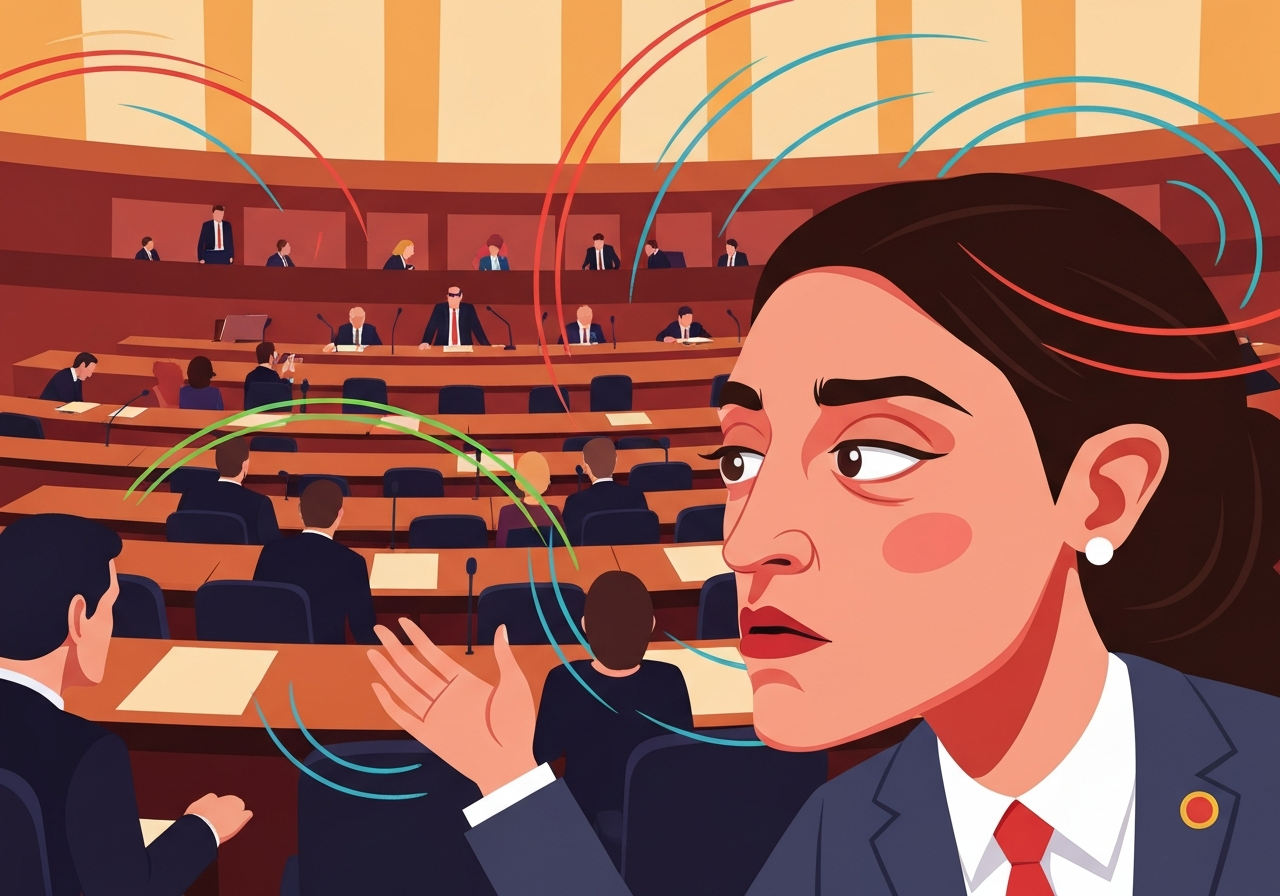
Lead: On Feb. 16, 2026, Representative Alexandria Ocasio-Cortez, 36, returned from the Munich Security Conference in Germany and told reporters she felt the visit’s substantive arguments were overshadowed by attention to on-camera missteps and speculation about a possible 2028 White House bid. At the conference she sought to press a class-based case against rising authoritarianism, arguing economic grievances fuel right-wing movements. Instead, video clips of pauses and cautious answers — most prominently a roughly 20-second stall when asked about sending U.S. troops to defend Taiwan — dominated reaction online. She said the focus on performance risked burying her call for leaders to address working-class concerns worldwide.
Key Takeaways
- Rep. Alexandria Ocasio-Cortez traveled to the Munich Security Conference in Germany on Feb. 16, 2026; she described the forum as an “elite” venue where class-based messages face headwinds.
- Her visit was described in reporting as her most prominent foreign trip to date, shifting her profile from primarily domestic politics to the international stage.
- During a press moment, she paused for roughly 20 seconds when asked whether the U.S. should send troops to defend Taiwan if China invaded; her answer ultimately echoed long-standing U.S. strategic ambiguity.
- Short video clips of the pause circulated widely on conservative social media, shaping coverage and prompting speculation about effects on any future 2028 presidential prospects.
- Ocasio-Cortez emphasized that her substantive warning — that failing to address economic insecurity can open the door to authoritarianism — was being lost amid debate over performance and electability.
- Observers highlighted a tension common to progressive figures: translating class-based economic arguments to forums traditionally oriented toward security elites.
Background
The Munich Security Conference has long been a gathering point for foreign ministers, defense leaders and senior officials to discuss geopolitical trends and security policy. For lawmakers focused chiefly on domestic issues, the conference can be both an opportunity and a difficult forum: policy conversations often prioritize statecraft and alliance building over structural economic grievances. Rep. Ocasio-Cortez, who rose to national prominence as a critic of economic inequality and a proponent of progressive domestic policies, had limited experience on the high-profile international stage before this trip.
Her intervention in Munich framed economic insecurity as an international accelerant of illiberal politics: she argued that leaders who ignore working-class distress risk ceding ground to authoritarian alternatives. That argument situates her within a broader debate about how to counter right-wing movements — whether through hard security measures or by addressing redistribution, labor rights and social safety nets. The visit therefore tested whether a class-based message could gain traction among senior foreign-policy audiences and allied governments.
Main Event
At the Munich Security Conference, Ms. Ocasio-Cortez delivered remarks and took questions that emphasized economic drivers of political instability. She pressed the point that wealthy policymakers and established institutions must do more for working people to blunt the appeal of authoritarian actors. Her prepared remarks aimed to link domestic economic policy and global democratic resilience rather than to recast traditional security prescriptions.
During a media scrum, she was asked whether the United States should deploy troops to defend Taiwan if China attempted an invasion. After a pause lasting roughly 20 seconds, she responded in terms consistent with long-standing U.S. policy of strategic ambiguity — declining to spell out a categorical troop commitment. The moment was captured on video and clipped widely across social platforms within hours.
The clips were amplified by critics and commentators who framed the pause as evidence of insufficient foreign-policy readiness, with some suggesting the footage would matter politically should she mount a presidential campaign. Ms. Ocasio-Cortez pushed back, saying she was frustrated that those performance-focused narratives obscured her broader warning about economic insecurity and authoritarian risk.
Analysis & Implications
The episode illustrates a persistent media dynamic: performance moments can trump substantive points, especially in an ecosystem that amplifies short video. For a politician whose brand is rooted in policy proposals on economic justice, the risk is twofold: her argument may not penetrate elite security forums, and her perceived credibility on international affairs can be questioned in ways that complicate future national ambitions. Both effects can reshape how supporters, donors and potential coalition partners evaluate her candidacy or influence.
Strategically, the incident underscores a communications challenge for progressives entering global security spaces. Security conferences tend to reward detailed, technical displays of expertise and experience; class-based appeals require different translation to resonate with diplomats and defense officials. If Ocasio-Cortez and allies seek to broaden their foreign-policy profile, they will need to combine clear messaging with sustained engagement that anticipates policy detail and rapid-response media environments.
For opponents and neutral observers, the viral focus on a pause serves as a reminder that political narratives are often set by what can be excerpted and monetized online. Whether that narrative endures depends partly on how Ocasio-Cortez and her team frame follow-ups: rapid clarifications, substantive briefings and appearances with credible foreign-policy interlocutors can blunt performance critiques over time. Still, the episode may recalibrate the calculus for any future national campaign about the balance between domestic policy authenticity and perceived foreign-policy competence.
Comparison & Data
| Dimension | Typical Security Forum | Class-Based Populist Message |
|---|---|---|
| Primary audience | Ministers, diplomats, defense officials | Workers, labor groups, economically insecure voters |
| Communication style rewarded | Technical detail, alliance signaling | Narrative on economic hardship, redistribution |
| Short-term risk | Limited media soundbites | High susceptibility to viral clips |
The table highlights why a speaker focused on class and redistribution can struggle to gain reflexive traction at elite security forums. Translating grievances into policy prescriptions that reassure allies on defense while addressing socio-economic drivers requires bridging two different communication ecosystems.
Reactions & Quotes
“An elite place of decision makers that, frankly, are not responsive to a class-based message.”
Rep. Alexandria Ocasio-Cortez (interview)
Ocasio-Cortez used that phrase to explain why she expected resistance to her central argument at Munich: she was signaling a structural mismatch between her core message and the forum’s typical priorities. She added that she remained committed to highlighting economic roots of political instability despite the climate of elite debate.
“Video clips focused on pauses, not policy, and that shaped the discussion within hours.”
Campaign spokesperson (statement)
The campaign’s communications team said the viral circulation of short clips altered the story line quickly, emphasizing optics over substance. They described a plan of follow-up briefings and policy discussions to re-center attention on her proposals for strengthening social protections worldwide.
Unconfirmed
- Whether the media attention to brief on-camera hesitations will materially reduce Ms. Ocasio-Cortez’s standing among Democratic primary voters in a potential 2028 race remains unproven and speculative.
- The degree to which world leaders’ private reactions at Munich reflected substantive disagreement with her economic thesis — beyond polite public reception — has not been independently verified.
- Claims circulating on social platforms that the pause reflected a lack of preparation rather than a measured response have not been corroborated by on-the-record sources.
Bottom Line
The Munich trip revealed a central tension for high-profile progressive politicians: delivering a message about economic insecurity to audiences oriented toward security and statecraft requires both policy fluency and media-savvy presentation. AOC’s core argument — that unaddressed economic grievances can fuel authoritarian tendencies — remains a live and widely debated proposition regardless of the viral moment that followed her answers on Taiwan.
What to watch next: whether Ocasio-Cortez follows up with detailed foreign-policy engagements, whether her communications operation can shift coverage from optics to substance, and whether the episode alters donor and voter perceptions ahead of any decision about a 2028 campaign. The incident is a reminder that in today’s media environment, substantive interventions can be eclipsed by brief, sharable clips unless teams proactively manage both message and medium.
Sources
- The New York Times — news report on trip and interview (media).
- Munich Security Conference — conference program and attendee information (official organization).