
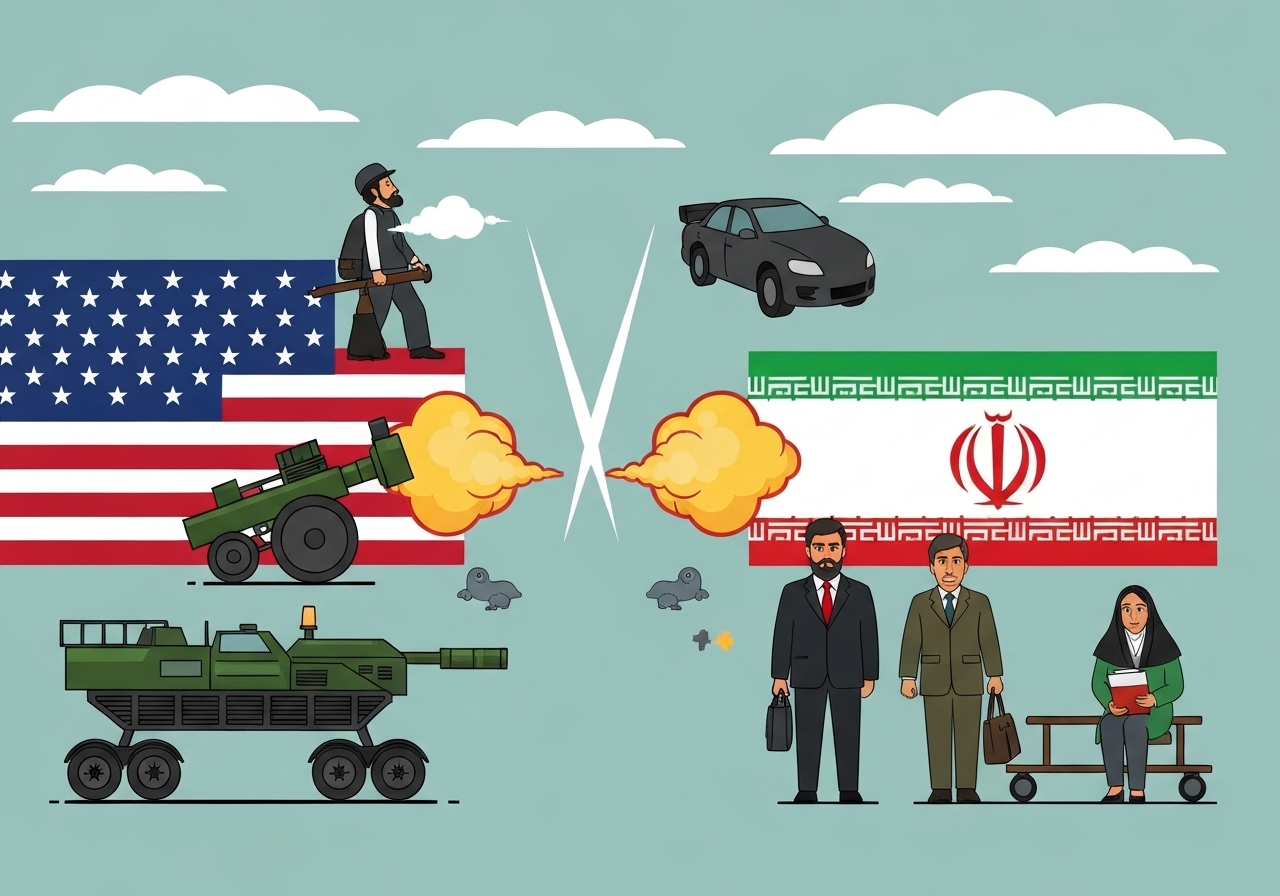
Lead: The United States has mounted a substantial repositioning of air and naval forces in the Middle East ahead of planned talks with Iran in Geneva on Tuesday. Pentagon assets — including tankers, fighter aircraft and air-defense systems — have been moved closer to the region while carrier strike groups and cargo flights increase logistical support. US officials and multiple sources say the deployments are intended both to coerce Tehran during negotiations and to preserve strike options should diplomacy fail. The buildup, and public comments by President Donald Trump favoring regime change, have raised regional tensions and amplified stakes for the Geneva meeting.
Key Takeaways
- The US has repositioned UK-based Air Force tankers and fighters toward the Middle East to increase operational reach ahead of Tuesday’s Geneva talks.
- Dozens of US military cargo flights have moved equipment to Jordan, Bahrain and Saudi Arabia; open-source data show more than 250 cargo flights into the region in recent weeks.
- Satellite imagery indicates 12 US F-15 aircraft have been stationed at Jordan’s Muwaffaq Salti Air Base since January 25.
- Two carrier strike groups are involved: the USS Abraham Lincoln is in the region and the USS Gerald R. Ford is en route, expanding strike and air operations options.
- US forces have delivered additional air-defense systems and extended deployment orders for several units originally slated to rotate out.
- Washington has publicly signaled it will not accept any uranium enrichment; President Trump said he will be “indirectly” involved in the talks.
- Diplomatic delegations in Geneva are expected to be led by Steve Witkoff and Jared Kushner for the US and Foreign Minister Abbas Araghchi for Iran, with IAEA director Rafael Grossi engaged in technical preparations.
- US officials and intelligence sources warn that removing Iran’s current leadership risks unpredictable outcomes, including a stronger role for the IRGC.
Background
Relations between Washington and Tehran have deteriorated amid domestic unrest in Iran and repeated public threats from US leaders. Over recent weeks President Trump warned Iranian officials that military action remained an option, and has stated publicly that regime change “would be the best thing that could happen” in Iran. Those comments build on a longer period of friction that included the US killing of Maj. Gen. Qasem Soleimani during Trump’s first term, an action experts say complicated US understanding of Iranian internal command structures.
The current military posture reflects both immediate tactical planning and longer-term strategic concerns. Regional partners — notably Gulf Arab states — have urged caution, fearing that strikes could destabilize critical shipping lanes and energy markets. Israel, by contrast, has reportedly been among the most vocal proponents of a robust military response. Against this geopolitical backdrop, Geneva has been chosen as the venue for high-stakes, indirect talks intended to address Iran’s nuclear program and de-escalate tensions.
Main Event
US forces have shifted multiple categories of assets into the region: aerial refueling tankers and fighter squadrons from the UK theater, additional air-defense batteries, and logistical shipments moved by dozens of cargo aircraft. Flight-tracking records referenced by sources show equipment deliveries to Jordan, Bahrain and Saudi Arabia, while some units originally set to leave have had deployments extended. Open-source air-traffic communications show several fighters were cleared into Jordanian airspace on Friday evening.
Satellite images released this month show a dozen F-15 jets at Muwaffaq Salti Air Base in Jordan since January 25, which adds a forward posture for both presence and potential operations. Naval power has been concentrated as well: the USS Abraham Lincoln carrier strike group is operating in the region and the USS Gerald R. Ford strike group was reported as inbound. Carrier strike groups typically operate with destroyers, attack submarines and escort aircraft that expand long-range strike options.
Military planners note a wide palette of weapons available should kinetic options be chosen. Guided-missile destroyers can carry Tomahawk cruise missiles with roughly 1,000-mile range and 1,000-pound conventional warheads; attack submarines maintain similar strike capabilities. Fifth-generation and legacy strike fighters — including F-35s and F-15Es — can deliver guided bombs and air-to-surface missiles, enabling strikes on command-and-control hubs as well as fixed installations beyond nuclear facilities.
Diplomatically, the US delegation to Geneva is expected to be led by Steve Witkoff and Jared Kushner, while Iran will be represented by Foreign Minister Abbas Araghchi. Preparatory technical discussions took place Monday between Araghchi and IAEA Director Rafael Grossi. President Trump said he would be “indirectly” involved in the talks and reiterated a hard line on enrichment, framing the discussions as a final chance before consequences follow.
Analysis & Implications
The repositioning serves dual purposes: deterrence and contingency. Publicizing assets raises the costs for Tehran to escalate while giving Washington a range of military options if negotiations break down. But signal-based coercion carries risks. The visibility of strike forces can accelerate reactive planning inside Iran and among its proxies, increasing the probability of rapid escalation if misperceptions occur.
Intelligence gaps complicate strategic choices. US sources acknowledge less certainty about Iran’s succession dynamics than in other recent regime-change scenarios; analysts warn that a leadership vacuum could strengthen the Islamic Revolutionary Guard Corps (IRGC), potentially producing a more hard-line posture. The assassination of Soleimani earlier in the decade reduced US clarity around IRGC hierarchies — a factor planners cite when assessing the consequences of kinetic action.
Regionally, Gulf partners fear fallout for commerce and internal stability; Arab states have reportedly lobbied Washington to prioritize diplomacy. Israel’s advocacy for strikes creates friction between allied priorities, while any kinetic campaign risks drawing in third-party actors and raising insurance costs for shipping through the Strait of Hormuz. Economically, sustained escalation could push oil prices higher and disrupt global supply chains tied to Middle East security.
Comparison & Data
| Asset / Indicator | Reported Count / Status |
|---|---|
| US cargo flights into region | Over 250 (open-source flight data) |
| F-15s at Muwaffaq Salti AB (Jordan) | 12 aircraft since Jan 25 (satellite imagery) |
| Carrier strike groups | USS Abraham Lincoln (in region); USS Gerald R. Ford (en route) |
| Tomahawk missile range | ~1,000 miles; 1,000-lb conventional warheads |
The table above condenses the most concrete, public indicators of US force posture. Analysts caution that presence alone does not equal imminent attack, but it does reflect a readiness to act across a range of contingencies. Monitoring these metrics over the next 72 hours will show whether forces are stabilizing for deterrence or preparing for rapid operations if talks fail.
Reactions & Quotes
“If they’re not, it’s going to be a very bad day for Iran.”
President Donald Trump
This comment, made publicly shortly before the Geneva talks, signals administration impatience and underlines the coercive intent behind the force posture. Officials say the president will remain engaged indirectly while delegating lead negotiator duties to designated envoys.
“Iran ultimately is governed… by radical Shia clerics. It’s hard to do a deal with Iran.”
Marco Rubio
The statement reflects skepticism about Iran’s negotiating flexibility and echoes congressional concerns over verification and enforcement. Lawmakers have repeatedly asked how and when they would be notified if kinetic measures are contemplated.
“Everybody is pushing against a strike.”
Regional diplomat (unnamed)
Several Gulf diplomats have privately and publicly urged Washington to prioritize diplomacy to avoid destabilizing the wider region. At the same time, Israeli officials are reported to favor more immediate military options, creating divergent allied pressures on US decision-makers.
Unconfirmed
- Reports of a planned US-Israel joint operation remain unverified and are described only as discussion in some sources.
- Whether extended US deployments signal an imminent strike timetable or a posture intended purely for deterrence is not publicly confirmed.
- Claims about who would immediately assume control in a hypothetical Iranian regime collapse are speculative and lack full intelligence confirmation.
Bottom Line
The United States has visibly increased military pressure around Iran in the run-up to the Geneva talks, combining a forward force posture with hardline diplomatic signals. The deployments enhance Washington’s ability to coerce Tehran and provide contingency strike options, but they also raise the risk of miscalculation and regional escalation. Key near-term indicators to watch include the tone and outcome of Tuesday’s negotiations, any changes in force posture around the Strait of Hormuz, and public statements from Gulf partners and Israel.
For now, diplomacy remains the path publicly pursued by the US, even as military planners prepare alternatives. The coming days will show whether visible pressure produces concessions, entrenches positions, or triggers a cycle of action and counteraction — outcomes that will shape regional stability and global energy markets in the weeks ahead.
Sources
- CNN (news organization; primary reporting referenced)