
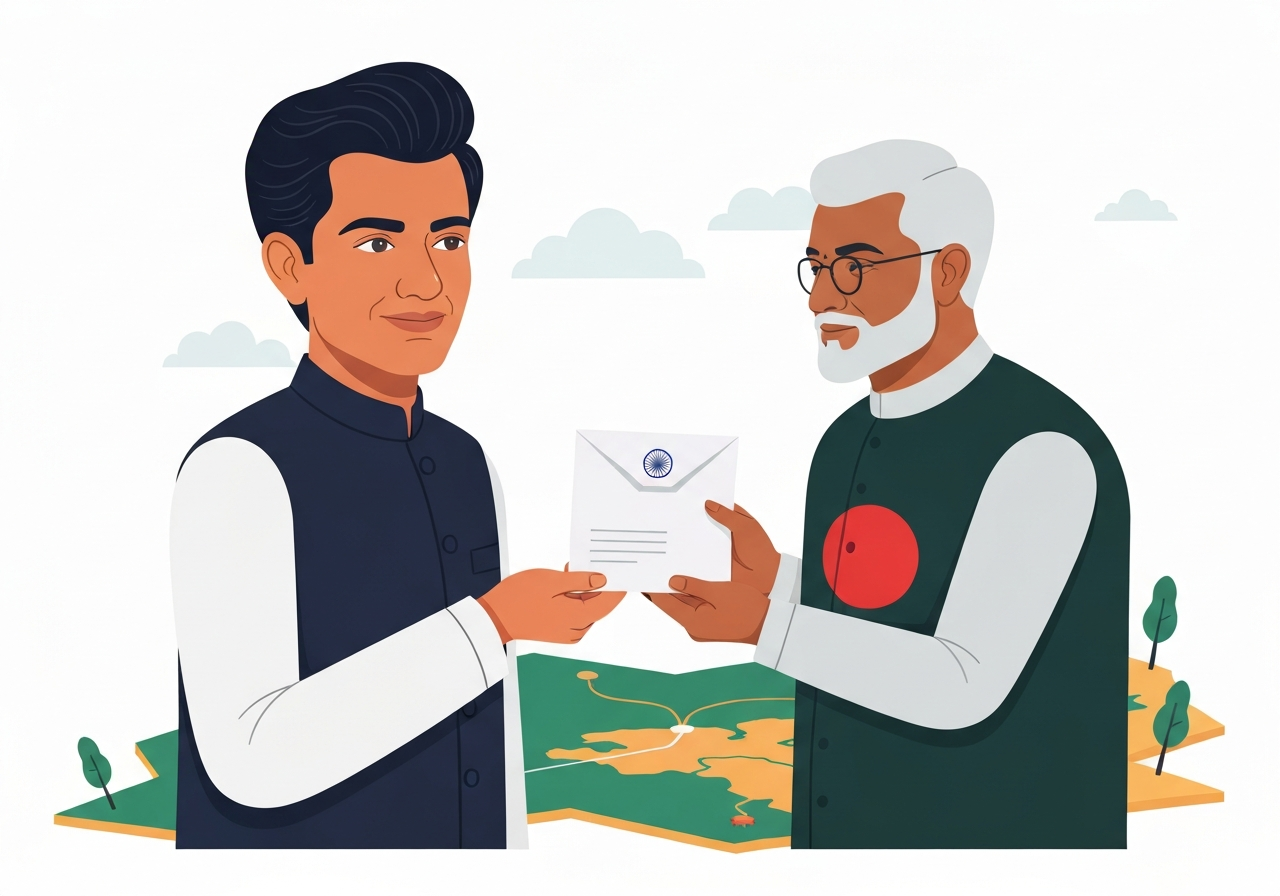
Lead: Lok Sabha Speaker Om Birla met Bangladesh’s newly sworn-in prime minister, Tarique Rahman, on Tuesday and handed over a personal congratulatory letter from India’s prime minister, Narendra Modi. The meeting took place shortly after Rahman’s oath-taking in Dhaka, where Birla represented the Indian government. Bangladesh’s high commissioner to India said both leaders exchanged greetings and expressed a shared interest in people-centered cooperation. Birla was accompanied to the swearing-in by India’s foreign secretary, Vikram Misri.
Key Takeaways
- Om Birla officially delivered PM Narendra Modi’s congratulatory letter to Prime Minister Tarique Rahman at a courtesy meeting in Dhaka on Tuesday.
- Birla attended Rahman’s swearing-in as India’s representative, accompanied by Foreign Secretary Vikram Misri.
- Rahman, 60, was sworn in at the South Plaza by President Mohammed Shahabuddin, departing from the customary Bangabhaban venue.
- The new cabinet ceremony included oaths for 25 cabinet ministers and 24 state ministers, and representatives from neighbouring countries including India and Pakistan attended.
- In the Feb 12 general elections, the BNP won 209 of 297 seats while Jamaat-e-Islami won 68 seats; the Awami League did not contest.
- Rahman returned to Bangladesh in December after 17 years in self-imposed exile and begins his first term as prime minister.
- The new cabinet includes two ministers from minority communities and the surprise induction of the interim regime’s security adviser as a technocrat minister.
Background
Bangladesh’s political landscape has shifted sharply since nationwide student-led protests in August 2024 that precipitated the fall of the Awami League government. In the aftermath, Nobel laureate Muhammad Yunus led an interim administration from August 2024 until the February 2026 elections. During Yunus’s tenure, bilateral ties between Dhaka and New Delhi cooled, affecting cooperation on trade and security.
Tarique Rahman, son of former prime minister Khaleda Zia and late president Ziaur Rahman, spent 17 years in self-imposed exile in London before returning in December. The February 12 general election delivered a decisive victory to the BNP, which secured a parliamentary majority and set the stage for Rahman’s first term as prime minister. Observers view the new government as marking an end to a prolonged period of political uncertainty that followed the August protests.
Main Event
The swearing-in ceremony on Tuesday diverged from tradition when President Mohammed Shahabuddin administered the oaths at the South Plaza rather than at Bangabhaban. President Shahabuddin oversaw the swearing-in of Rahman and the new ministerial team—25 cabinet ministers and 24 state ministers—before a gathering that included neighbouring delegations. Indian representation was led by Lok Sabha Speaker Om Birla and Foreign Secretary Vikram Misri, who attended on behalf of Prime Minister Narendra Modi and the Indian government.
At a courtesy meeting after the ceremony, Birla handed Prime Minister Rahman a personal congratulatory letter from PM Modi. Bangladesh’s high commissioner to India, Riaz Hamidullah, posted that Rahman conveyed greetings to India and Modi and that Birla extended wishes and an invitation from India. According to the high commissioner’s post, both leaders expressed optimism about pursuing a people-centric cooperation agenda between the two countries.
Rahman’s return to power follows a period of interim rule under Muhammad Yunus, who had extended an invitation to Prime Minister Modi to attend the swearing-in. Modi declined, citing concurrent events in India, including French President Emmanuel Macron’s visit to Mumbai and an Artificial Intelligence Summit in Delhi. The new cabinet features representation from minority communities—BNP vice president Nitai Roy Chowdhury (Hindu) and Dipen Dewan (Buddhist)—and included a surprise appointment of the interim regime’s security adviser, Khalilur Rahman, as a technocrat minister.
Analysis & Implications
The exchange between Speaker Birla and Prime Minister Rahman signals an early diplomatic reset between New Delhi and Dhaka after a period of cooler ties under the interim government. A formal delivery of a letter from PM Modi and India’s official representation at the ceremony are practical first steps toward restoring regular channels of communication and cooperation on shared priorities such as trade, connectivity, and security.
For Bangladesh, Rahman’s government inherits the task of consolidating domestic stability after prolonged unrest and rebuilding international relationships strained during the interim period. The composition of the cabinet—minority representation alongside technocratic and unexpected appointments—suggests a mix of outreach and internal political balancing. How the administration addresses governance, judicial concerns, and economic priorities will shape both domestic legitimacy and foreign partnerships.
Regionally, an improving India-Bangladesh relationship could affect broader South Asian dynamics, including cooperation on cross-border issues and infrastructure projects. However, tangible progress will depend on follow-through: visits at prime ministerial level, revival of stalled projects, and concrete agreements on trade and security cooperation. International partners will watch whether the new government translates diplomatic gestures into stable policy and implementation.
Comparison & Data
| Party | Seats (of 297) |
|---|---|
| Bangladesh Nationalist Party (BNP) | 209 |
| Jamaat-e-Islami | 68 |
| Awami League | Did not contest |
The February 12 results gave the BNP a commanding majority in a 297-seat parliament, with allied Jamaat-e-Islami taking 68 seats. The Awami League’s decision not to contest left a recalibrated parliamentary arithmetic and enabled rapid formation of a BNP-led government. This configuration provides Rahman with legislative space to pursue his agenda, but coalition dynamics and public expectations will test the new administration’s governance capacity.
Reactions & Quotes
“PM Tarique Rahman conveyed his greetings to India and PM Narendra Modi, at a courtesy meet following the swearing-in of the new government,”
Riaz Hamidullah, Bangladesh High Commissioner to India (posted on X)
“Birla conveyed wishes from India and extended an invitation to the country; both leaders expressed optimism to work together for the well-being of the people of Bangladesh & India,”
Riaz Hamidullah, Bangladesh High Commissioner to India (posted on X)
Indian officials described Birla’s attendance as a formal representation of India at the swearing-in, signalling New Delhi’s readiness to engage with the new Bangladeshi administration.
Official statement, Government of India (summary)
Unconfirmed
- Whether Prime Minister Modi will accept the invitation extended by Speaker Birla to visit Bangladesh remains undecided and has not been officially scheduled.
- The long-term political role of the interim regime’s security adviser Khalilur Rahman—now a technocrat minister—is not yet clear and requires further observation.
Bottom Line
Om Birla’s delivery of PM Modi’s letter to Prime Minister Tarique Rahman and India’s formal representation at the swearing-in are early diplomatic moves that open channels for renewed engagement between Dhaka and New Delhi. The new government’s composition and the BNP’s parliamentary majority provide Rahman with immediate governing authority, but translating political change into stable governance will depend on policy choices and institutional responses at home.
For India, a pragmatic approach of measured engagement—balancing invitations, project-level follow-through, and clear communication—can rebuild cooperation without premature expectations. Observers should watch for concrete steps: ministerial visits, revival of bilateral projects, and public signals on trade and security to assess whether the diplomatic reset becomes substantive cooperation.
Sources
- Times of India — News report summarising the ceremony and diplomatic exchanges