
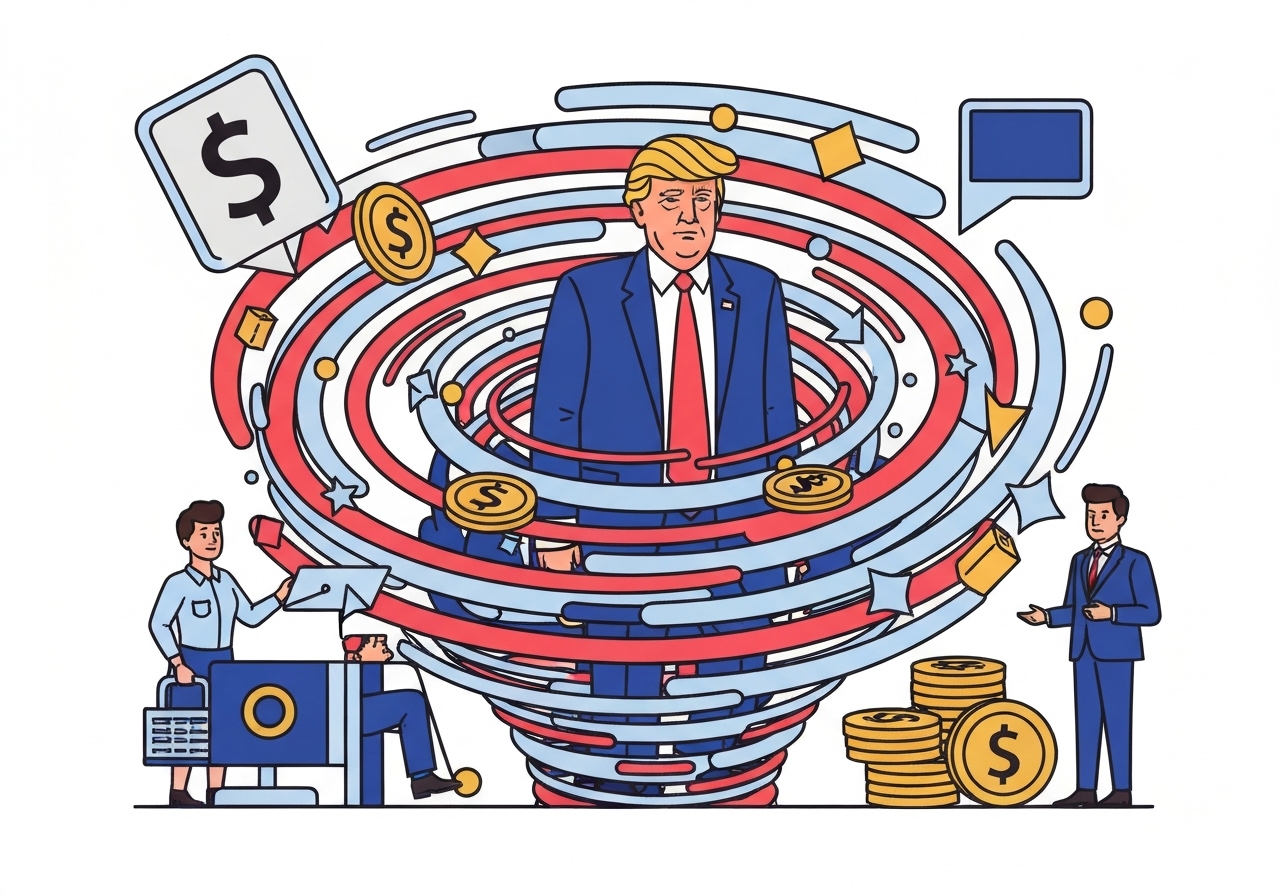
Lead: On 7 September 2025, President Donald Trump intensified a string of interventions — from tariff threats to a government stake in Intel and demands on Nvidia, together with pressure on regulators — moves that are accelerating change in the US economic model and raising market uncertainty.
Key takeaways
- Reciprocal tariffs were first announced on 2 April and remain central to the administration’s trade agenda.
- The administration has taken a reported 10% government stake in Intel and demanded 15% of revenue from Nvidia’s chip sales to China.
- Officials tied to independent agencies have been removed or targeted, including efforts to remove Fed board members and the firing of the Bureau of Labor Statistics head and NLRB chief Jennifer Abruzzo.
- Markets have so far been cushioned by AI-driven tech gains and expectations of future Federal Reserve rate cuts.
- Friday’s weak payrolls report left the unemployment rate near a four‑year high, signalling rising economic caution among firms.
- Observers say the combination of interventionist and deregulatory moves may make the US model hard to recognise in coming years.
Verified facts
Trade policy: The White House announced a set of “reciprocal” tariffs on 2 April; President Trump has also warned that, should the Supreme Court strike down the tariff regime, he might need to “unwind” trade deals declared since his so‑called “liberation day” in April.
Direct interventions in industry: The administration has taken a roughly 10% stake in Intel and publicly demanded a 15% share of revenue from Nvidia’s chip sales to China. Those measures have been framed as securing US strategic interests in semiconductors.
Pressure on regulators: The president has repeatedly criticised Federal Reserve chair Jerome Powell, sought to remove board members including Lisa Cook, and removed the head of the Bureau of Labor Statistics after disappointing jobs figures. Jennifer Abruzzo, the National Labor Relations Board chair, was also dismissed.
Market reaction: Despite the upheaval, markets have shown restrained volatility because big tech valuations—partly driven by an AI rally—and hopes for Fed easing have propped equities. That calm, however, may mask elevated political and policy risk.
Context & impact
These policy shifts come on top of longer trends. Public faith in free‑market financialised capitalism was dented after the 2008 crisis and the large financial rescues that followed, undermining the US’s role as a model for liberal economic reform.
On geopolitics, the Trump approach builds on bipartisan moves: prior China tariffs from his first term were largely kept in place by the Biden administration as strategic competition hardened. Biden also pursued large state‑led investments, for example through grants and loans under the Inflation Reduction Act aimed at industrial priorities.
The present combination of state intervention in strategic firms and simultaneous dismantling of regulatory norms creates policy ambiguity. Potential effects include shifts in corporate behaviour, changes to foreign investment patterns, and sharper trade frictions with major partners.
Risks for credibility: As seen in other episodes of abrupt policy change, such as the UK experience after 2022, economic credibility can be quickly eroded and is slow to recover. That reputational loss could make financing, long‑term planning and international cooperation more difficult.
“If my tariff regime is struck down … I may need to unwind some of the trade deals”
President Donald Trump (reported)
Unconfirmed
- Whether the administration’s industrial stake strategy will be extended beyond targeted firms or become institutionalised.
- The legal outcome of tariff challenges at the Supreme Court and the full scope of any subsequent policy reversals.
- The durability of investor tolerance if political interventions continue week after week.
Bottom line
The administration’s mix of activist industrial policy and attacks on regulatory independence is already reshaping expectations about the US economic model. While markets have so far looked past much of the disruption, continued unpredictability will raise the risk premium for investment, complicate monetary policy, and alter America’s economic influence abroad.