
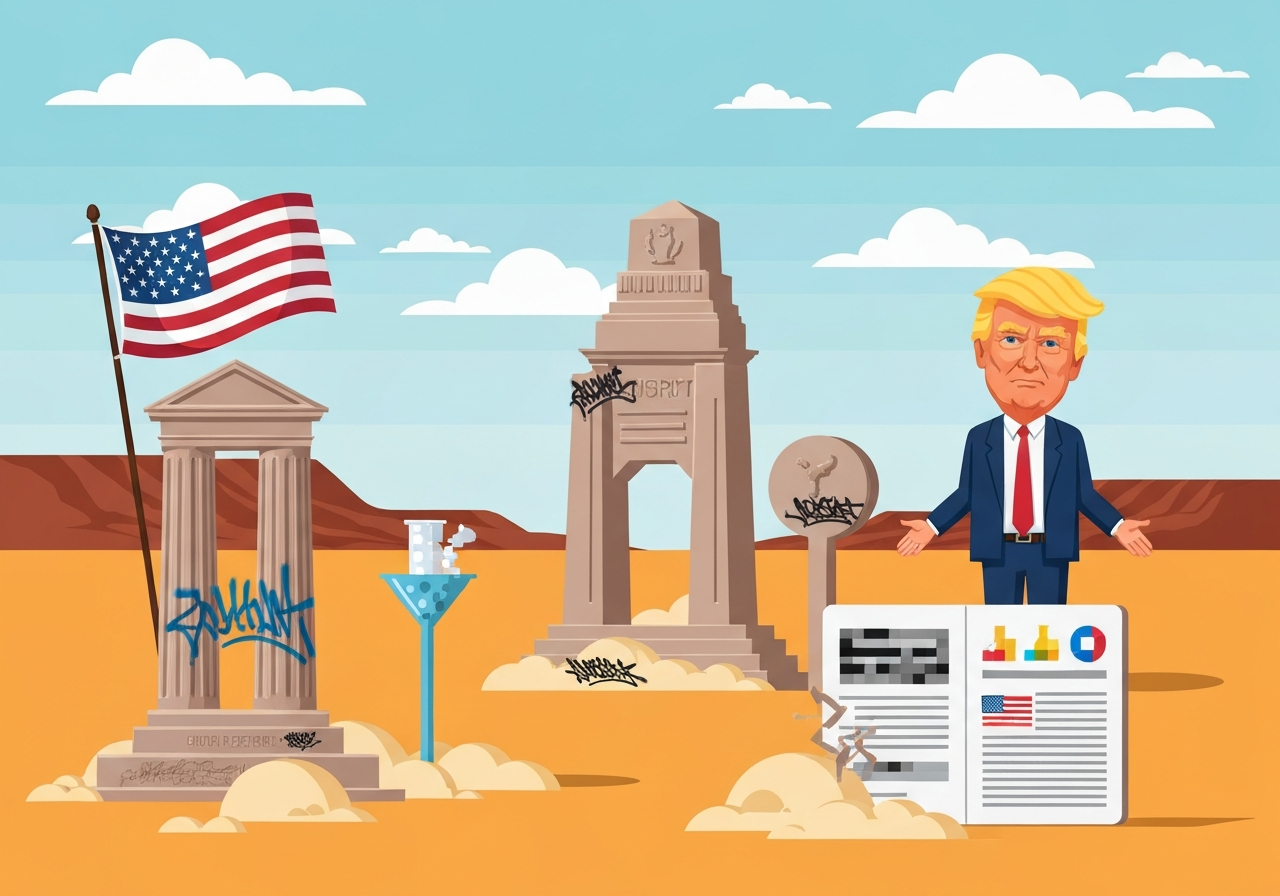
Lead: Conservation and historical groups filed suit in Boston on Tuesday, saying orders from President Donald Trump and Interior Secretary Doug Burgum have compelled National Park Service staff to remove or censor exhibits that present factual U.S. history and established science. The complaint cites removals and flagged materials at sites from Independence National Historical Park in Philadelphia to Glacier National Park in Montana, and seeks to halt what plaintiffs call politically driven revision. A separate suit challenges the removal of a rainbow Pride flag from the Stonewall National Monument in New York.
Key Takeaways
- Conservation, historical and scientific organizations filed the Boston lawsuit on Tuesday, naming the Interior Department and Park Service as defendants.
- The complaint says exhibits about slavery, Indigenous displacement, civil rights and climate science have been removed or flagged for removal at multiple parks.
- Independence National Historical Park had panels about nine people enslaved by George Washington removed; a federal judge ordered those materials restored on Presidents Day while litigation continues.
- Officials flagged roughly 80 items for removal at the Selma to Montgomery National Historic Trail, according to the lawsuit.
- Glacier National Park exhibits discussing climate change and glacial retreat were ordered taken down, per the complaint.
- The Stonewall suit says a Pride flag installed in 2022 — the first permanent rainbow banner on federal land — was taken down despite its historical context.
- The Interior Department says it is reviewing exhibits under a presidential executive order to ensure they do not “inappropriately disparage Americans past or living.”
Background
The legal challenge comes amid a broader federal review initiated by a presidential executive order titled to “restore truth and sanity to American history” at federal museums, parks and landmarks. The order directed the Interior Department to identify and eliminate materials that allegedly “inappropriately disparage Americans past or living,” and Interior Secretary Doug Burgum later instructed Park Service staff to remove “improper partisan ideology.” Plaintiffs argue the directive is being applied to remove materially accurate historical explanations and established scientific findings rather than partisan advocacy.
Conservation groups, professional historians and scientists say national parks function as public classrooms where interpretive panels and exhibits convey context about land use, Indigenous displacement, slavery and ecological change. Those organizations — including the National Parks Conservation Association, American Association for State and Local History, Association of National Park Rangers and Union of Concerned Scientists — formed the coalition that brought the Boston lawsuit. They contend the review has escalated in recent weeks, producing a wave of removals and flags across diverse sites.
Main Event
The suit details specific instances: Independence National Historical Park in Philadelphia removed explanatory panels last month that discussed the nine people enslaved by George and Martha Washington while they lived there in the 1790s. A U.S. District Court judge, Cynthia Rufe, ordered those panels restored on Presidents Day and barred installation of replacement materials that would present a different account while the legality of the removal is litigated.
At the Selma to Montgomery National Historic Trail in Alabama, park officials have identified about 80 items for potential removal, the complaint states; those items include interpretive texts tied to the civil rights movement. The complaint also says the permanent exhibit at Brown v. Board of Education National Historical Park in Kansas was flagged because it used the term “equity.” In the Grand Canyon, signage that referenced settlers pushing Native American tribes off their land and exploiting the landscape for mining and grazing has reportedly disappeared.
Climate-related materials have also been targeted. At Glacier National Park in Montana, the Park Service reportedly ordered the removal of materials describing the role of climate change in the park’s rapidly shrinking glaciers. Plaintiffs argue that removing scientific explanations undermines the parks’ educational mission and deprives visitors of evidence-based interpretation.
Analysis & Implications
The plaintiffs frame the campaign as an effort to sanitize public history and suppress scientifically grounded information in federally managed sites. If the administration’s review leads to widespread replacement of interpretive content, visitors could receive a less complete or less accurate account of how landscapes were formed and how communities were affected by historical policies. That outcome would alter how millions of annual park visitors understand national history and environmental change.
Legally, the suits test the boundary between executive authority over federal properties and First Amendment and administrative law constraints on censoring government speech or rewriting interpretive materials without following established procedures. The preliminary injunction in the Philadelphia case shows courts may intervene quickly when plaintiffs demonstrate immediate harm or procedural irregularity. Further rulings could define how far the administration may go in shaping narratives at public sites.
Politically, the disputes are likely to amplify tensions between federal officials and local stakeholders, including state and municipal leaders, historians, museum professionals and Indigenous groups. Several cities and activists reacted publicly — for example, New York politicians and advocates re-raising a Pride flag at Stonewall after it vanished — suggesting local pushback could become routine. The controversy may also spur Congress to weigh legislative guardrails on museum and park interpretive standards.
Comparison & Data
| Site | Action Reported | Detail / Count |
|---|---|---|
| Independence National Historical Park (Philadelphia) | Panels removed | Exhibits about nine people enslaved by George Washington |
| Selma to Montgomery National Historic Trail (Alabama) | Items flagged | About 80 items flagged for removal |
| Brown v. Board National Historical Park (Kansas) | Exhibit flagged | Permanent exhibit flagged for use of the word “equity” |
| Glacier National Park (Montana) | Materials ordered removed | Panels on climate change and glacier retreat |
| Grand Canyon National Park (Arizona) | Signage missing | Text describing displacement of Native tribes and exploitation |
| Stonewall National Monument (New York) | Flag removed | Rainbow Pride flag installed 2022; later taken down |
These items, drawn from the complaint and contemporaneous reporting, illustrate both geographic breadth and the mix of historical and scientific subjects under review. The numerical detail — such as the roughly 80 items in Selma and nine enslaved individuals at the Philadelphia site — are specific claims the plaintiffs have put before the court.
Reactions & Quotes
Advocacy organizations and former Park Service officials described the changes as a threat to institutional integrity and visitor education. Their comments highlight the professional norms at stake and the practical consequences for park interpretation.
“Censoring science and erasing America’s history at national parks are direct threats to everything these amazing places stand for.”
Alan Spears, National Parks Conservation Association (cultural resources director)
Former Glacier superintendent Jeff Mow framed the order as a practical hindrance to staff doing scholarly, evidence-based interpretation.
“You cannot tell the story of America without recognizing both the beauty and the tragedy of our history.”
Jeff Mow, retired Glacier superintendent
Legal advocates for the plaintiffs emphasized the lawsuit’s purpose: to ensure federally curated sites present accurate and comprehensive accounts rather than politically curated narratives.
“This lawsuit seeks to preserve the parks’ role as living classrooms that present truthful history and science.”
Skye Perryman, Democracy Forward (legal representative)
Unconfirmed
- Extent of any formal, system-wide lists of all exhibits slated for removal is not publicly available; plaintiffs cite multiple sites but a comprehensive government inventory has not been disclosed.
- Whether exemptions cited in agency memos will be applied consistently across sites — for example, allowing Confederate-related banners while removing a Pride flag — remains unclear pending internal guidance or further agency action.
Bottom Line
The lawsuits place the Park Service’s interpretive review under immediate legal and public scrutiny, forcing courts to consider whether administrative directives are being implemented lawfully and whether they imperil factual history and mainstream science in national sites. A federal judge’s order to restore panels in Philadelphia shows the judiciary can act swiftly to preserve contested materials while litigation proceeds.
If courts ultimately allow broad removals or replacements, national parks could present narrower narratives that downplay or omit topics such as slavery, Indigenous dispossession, civil rights and climate impacts. Conversely, a judicial check on the administration’s actions could reaffirm procedural norms and protect the parks’ educational mission. Practically, expect continued litigation, localized political pushback, and possible legislative attention as stakeholders seek clearer rules about how federally managed sites interpret the past and present.
Sources
- Associated Press (news report)
- National Parks Conservation Association (advocacy organization)
- Union of Concerned Scientists (scientific nonprofit)
- Democracy Forward (legal nonprofit representing plaintiffs)