
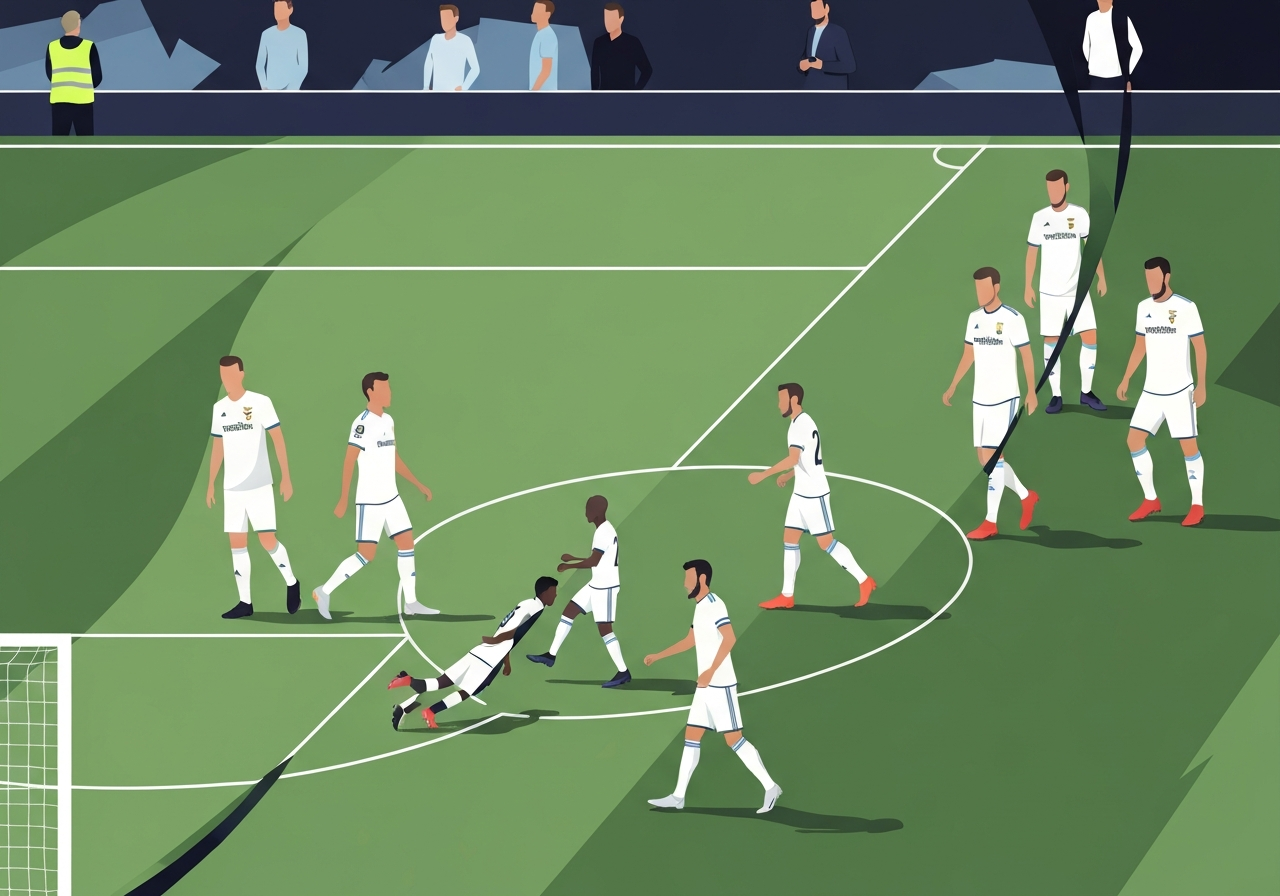
Real Madrid’s Champions League knockout play-off at Benfica was paused for about 10 minutes on Tuesday after Vinicius Jr. reported alleged racial abuse and led his team off the Estadio da Luz pitch. The Brazil forward had opened the scoring in the 50th minute and was later booked for an exuberant celebration before an altercation with Benfica youngster Gianluca Prestianni. Referee François Letexier signalled alleged racist abuse with the crossed-arms gesture after speaking to Vinicius, and Real’s players temporarily abandoned the match. Play resumed in the 60th minute and Real held on to win 1-0, with the game finishing after a lengthy 12 minutes of stoppage time during which an object thrown from the crowd struck Vinicius on the arm.
Key takeaways
- Vinicius Jr., 25, scored in the 50th minute to give Real Madrid a 1-0 lead; the goal celebration later resulted in a yellow card.
- After an on-pitch interaction with Benfica winger Gianluca Prestianni, Vinicius reported alleged racist abuse; referee François Letexier used FIFA’s crossed-arms signal.
- The Real Madrid squad left the field and the match was halted for roughly 10 minutes, with play restarting in the 60th minute.
- Objects were thrown from the stands; one such object struck Vinicius on the arm during 12 minutes of stoppage time before the match concluded 1-0 to Real.
- Benfica forward Vangelis Pavlidis publicly defended Prestianni, while Prestianni had not issued a response at the time of reporting.
- The Brazilian Football Confederation condemned the incident and publicly supported Vinicius, calling racism a crime and praising the player’s decision to activate the protocol.
- FIFA introduced the on-field crossed-arms gesture to signal racist abuse in May 2024; referees may use it when they observe or are informed of racial abuse.
- Vinicius has been the target of multiple racist incidents in the past; five people were given suspended prison sentences related to earlier abuse directed at him.
Background
Vinicius has been a repeated target of racist abuse during his career in Spain and elsewhere, making him a prominent figure in the sport’s anti-discrimination debates. Incidents directed at him previously led to criminal convictions, including a case that resulted in suspended prison sentences — a legal milestone in Spain for racism at football matches. FIFA and UEFA have faced pressure in recent seasons to implement clearer on-field protocols and sanctions to deter discriminatory behaviour by fans.
Benfica and Real Madrid meet periodically in high-profile European fixtures, where tensions are often heightened by passionate support and historical rivalries. Benfica’s squad includes a number of young South American talents such as Gianluca Prestianni, whose interaction with Vinicius immediately preceded the complaint. Clubs, national associations and governing bodies are all stakeholders in managing fan conduct and ensuring player safety during continental matches.
Main event
The decisive moment came shortly after Vinicius’s 50th-minute strike, when he celebrated near the corner flag and objects were observed being thrown from the crowd. That sequence triggered a confrontation between players on the field and a subsequent exchange between Vinicius and Prestianni near the halfway line. According to Real Madrid, Vinicius informed referee François Letexier that he had been racially abused by Prestianni.
Letexier then made the crossed-arms gesture used to indicate racist abuse after speaking with Vinicius on the pitch. Vinicius immediately walked off the field and was followed by his team-mates, prompting a 10-minute suspension of play while officials, managers and staff from both sides engaged at the touchline. Benfica manager José Mourinho was among those involved in the immediate post-incident exchanges.
Match action resumed in the 60th minute and continued to a conclusion in which Real Madrid maintained the 1-0 lead. During extended stoppage time — amounting to 12 minutes — an object thrown from the crowd struck Vinicius on the arm. The match finished without further official stoppages, and Real celebrated an away win in a knockout tie.
Analysis & implications
The incident illustrates the persistent challenge of fan misconduct in elite football and tests the effectiveness of newly introduced on-field protocols. FIFA’s crossed-arms signal, implemented in May 2024, is designed to standardise referee response and make allegations of abuse visible to spectators and broadcast audiences, but its deterrent effect depends on consistent follow-up by clubs and governing bodies.
A team walking off the pitch is a powerful, visible protest that shifts pressure onto hosts and competition organisers to act; in this case the break lasted about 10 minutes and play resumed, which some observers say risks normalising a short pause rather than prompting decisive sanctions. The willingness of a whole squad to leave the field raises questions for competition administrators about escalating protocols, immediate sanctions and post-match disciplinary processes.
Politically and commercially, high-profile incidents like this have broad ramifications: sponsors, broadcasters and national associations increasingly demand concrete action against racism or risk reputational damage. For players, repeated targeting can have lasting personal and professional consequences, and repeated incidents may encourage stronger collective measures — for example, longer suspensions for clubs whose fans engage in racist abuse, point deductions, or fixtures behind closed doors.
Comparison & data
| Season / Year | Incident | Immediate Outcome |
|---|---|---|
| 2023 | Convictions for racially abusing Vinicius in Spain | Five people given suspended prison sentences |
| May 2024 | FIFA introduces crossed-arms on-field signal | Referees authorised to signal racist abuse |
| 2025 (this match) | Allegation at Estadio da Luz; Real walked off | 10-minute halt; match resumed; Real won 1-0 |
The table above places the match in a recent timeline of actions and responses: legal outcomes in Spain, FIFA’s protocol introduction, and the present fixture’s halted restart. While the immediate sanctions in this match were limited to a stoppage and in-game signalling, prior legal rulings and institutional measures create a context in which post-match investigations and disciplinary reviews are expected.
Reactions & quotes
“Racists are, above all, cowards. They need to put their shirts in their mouths to show how weak they are.”
Vinicius Jr., social media statement
Vinicius published a statement condemning the abuse and defended his decision to trigger the protocol. He described receiving a yellow card for his celebration as a poorly executed part of the match protocol and expressed frustration that the incident reflects a repeated pattern in his career.
“Racism is a crime. It is unacceptable. It cannot exist in football or anywhere else… We will remain steadfast in the fight against all forms of discrimination.”
Brazilian Football Confederation (official statement)
The Brazilian Football Confederation issued a public statement supporting Vinicius, praising his use of the protocol and reiterating a commitment to fight discrimination.
“I don’t think Prestianni said anything like that to Vinicius. I think it has more to do with the heated rivalry between Brazil and Argentina than anything else.”
Vangelis Pavlidis, Benfica forward
Pavlidis defended his team-mate and framed the episode as tied to on-field rivalry rather than deliberate racial abuse; Prestianni himself had not responded publicly at the time of reporting.
Unconfirmed
- Whether Benfica player Gianluca Prestianni used racially abusive language has not been independently established in published match reports at the time of writing.
- Any immediate internal disciplinary measures by Benfica or competition authorities were not publicly detailed immediately after the fixture.
Bottom line
The stoppage at Estadio da Luz and Real Madrid’s decision to leave the pitch underscore both the visibility of racial abuse in elite football and the limited immediate remedies available during matches. FIFA’s on-field signal provides a formal mechanism to mark such incidents, but it does not by itself determine punishment; that requires subsequent investigation and action by competition authorities and, potentially, legal systems.
For stakeholders—clubs, associations, broadcasters and sponsors—the episode increases pressure to ensure swift, transparent follow-through when allegations arise, including credible investigations and proportionate sanctions against perpetrators and, where appropriate, clubs whose fans engage in abuse. For players and fans, the case is likely to intensify debates about whether current protocols sufficiently deter misconduct or whether stronger, pre-emptive measures are needed.
Expect post-match inquiries by competition organisers and statements from both clubs and governing bodies in coming days; the way those responses are handled will influence whether the episode is seen as an exception addressed promptly or another instance prompting calls for deeper reforms.
Sources
- BBC Sport – Match report and incident details (media)
- FIFA – on-field protocol announcement (May 2024) (governing body)
- Real Madrid CF – club statements (club/official)
- Brazilian Football Confederation – public statement (national association)