
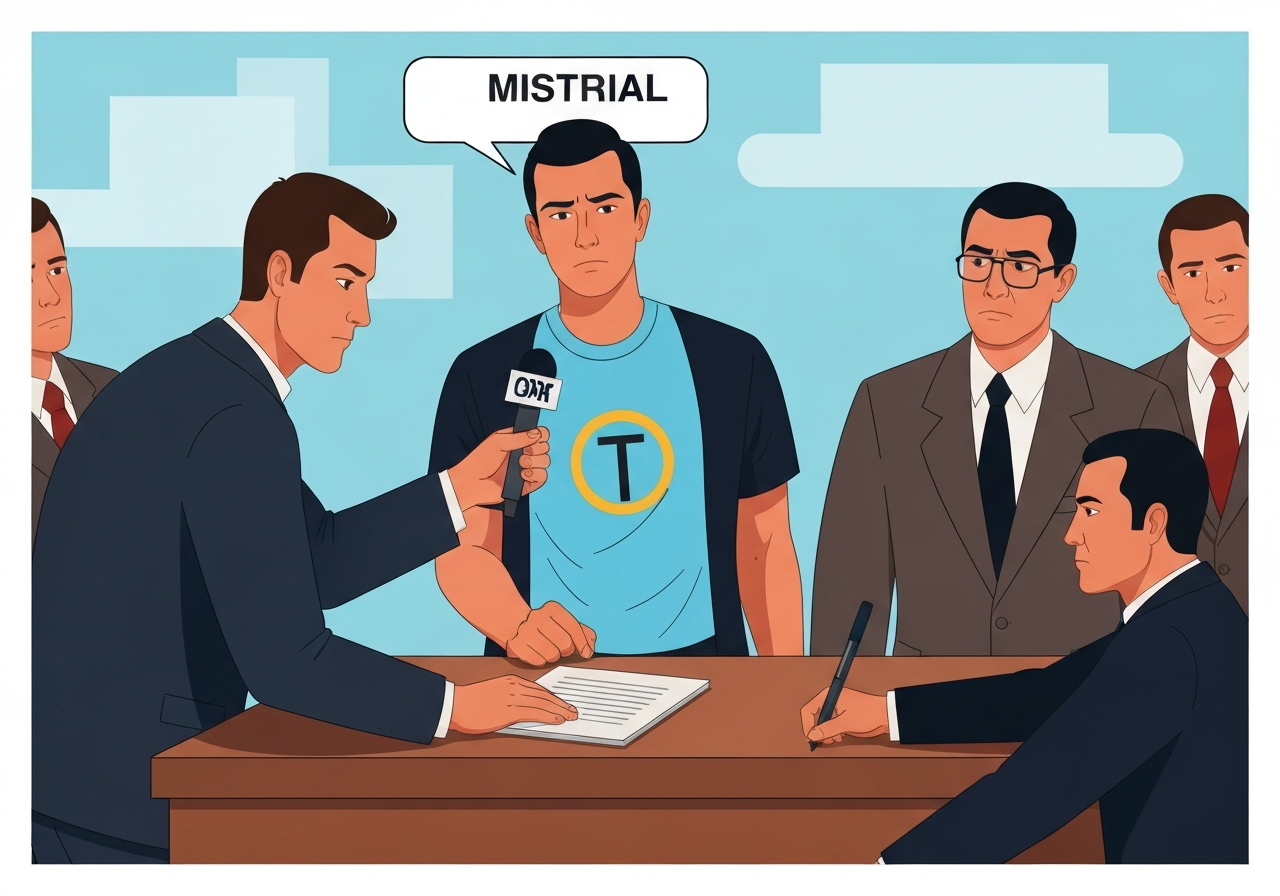
Lead: A federal judge on Tuesday declared a mistrial in the prosecution of nine people accused in the July 4, 2025 ambush outside the Prairieland ICE Detention Facility in Alvarado, Texas, after a defense lawyer wore a T‑shirt bearing civil‑rights figures during jury selection. U.S. District Judge Mark Pittman said the garment — worn by attorney MarQuetta Clayton beneath a blazer while defending Maricela Rueda — risked prejudicing the venire and left him “no other choice.” The judge will hold a show‑cause hearing to consider potential sanctions against Clayton; the government says the attack wounded one Alvarado police officer, who survived.
Key Takeaways
- Nine defendants are charged in an ambush at the Prairieland ICE Detention Center on July 4, 2025; federal prosecutors allege the group fired on officers after igniting fireworks and damaging property.
- U.S. District Judge Mark Pittman declared a mistrial on Tuesday after learning defense attorney MarQuetta Clayton had worn a T‑shirt depicting Shirley Chisholm and Martin Luther King Jr. during jury questioning.
- Jury selection had begun with 75 potential jurors questioned; the court will summon a larger pool of about 130 prospective jurors next Tuesday to restart the process.
- About 20 potential jurors voiced opposition to ICE enforcement efforts during voir dire; one told the court, “We’re a family of immigrants.”
- The other defense attorneys opposed a mistrial, and the judge said he would schedule a show‑cause hearing for Clayton to explain why she should not face sanctions.
- Prosecutors characterize the attack as orchestrated by a North Texas Antifa cell; the defendants deny wrongdoing.
Background
The incident under trial stems from a July 4, 2025 confrontation outside the Prairieland Detention Facility in Alvarado, Texas, where federal authorities say suspects set off fireworks, damaged buildings and vehicles, then opened fire on ICE officers and responding local law enforcement. An Alvarado police officer was shot in the neck and survived. The Justice Department moved quickly to charge nine people it says participated in the ambush.
Trials connected to politically charged protests at immigration facilities have drawn intense public attention and contested courtroom fights over impartiality. The government’s characterization of the group as an “Antifa” cell reflects prosecutorial framing that has been both influential and controversial in media and political debates. Defense teams in such cases often push voir dire — the jury‑selection process — to expose biases that could affect a fair trial.
Main Event
On the first day of jury selection, Clayton questioned prospective jurors for roughly 22 minutes while wearing a shirt that displayed images of civil‑rights leaders beneath her blazer. Judge Pittman later told the court he had learned of the shirt and deemed it improper during voir dire, saying, “I don’t know why in the world you would think that’s appropriate.” He added that the circumstance was unprecedented in his experience and concluded a mistrial was required.
Other defense attorneys objected to declaring a mistrial, arguing the shirt did not merit ending the trial before a seated jury could be empaneled. The judge overruled those objections and announced plans for a show‑cause hearing in which Clayton must explain why she should not be sanctioned for courtroom conduct. The record shows the judge emphasized the need to protect the impartiality of the prospective jury pool.
Jury selection had involved 75 potential jurors before the mistrial; the judge ordered that a new pool of roughly 130 prospective jurors be summoned next Tuesday to begin selection anew. Court observers reported that approximately 20 of the potential jurors expressed opposition to ICE’s enforcement role, underscoring the sensitivity of juror attitudes in cases tied to immigration and protest.
Analysis & Implications
The judge’s decision turns on long‑standing rules that restrict advocacy and symbolic expression during voir dire, when attorneys question potential jurors about biases. Courts have broad discretion to declare a mistrial if a party’s conduct threatens a defendant’s right to an impartial jury or if the integrity of the process is compromised. A clothing choice that may signal values or political alignment can be seen as undermining that neutrality.
Practically, the mistrial resets the prosecution’s timetable and could extend pretrial detention, discovery disputes and scheduling burdens for both sides. A retrial will require reassembling witnesses and evidence and may shift plea calculus; prosecutors maintain the case rests on allegations of organized, violent conduct, while defendants continue to deny involvement.
There is also a reputational and disciplinary dimension. The show‑cause hearing could lead to sanctions if the court finds the attire was intended to influence jurors or displayed carelessness that risked prejudice. Even absent sanctions, the episode may sharpen media and political scrutiny around courtroom decorum and how attorneys signal positions in high‑profile political cases.
Comparison & Data
| Item | Figure |
|---|---|
| Defendants charged | 9 |
| Attack date | July 4, 2025 |
| Potential jurors questioned (first session) | 75 |
| New juror pool ordered | About 130 |
| Officers wounded (reported) | Several ICE officers; 1 Alvarado officer shot in neck (survived) |
The figures above frame the immediate procedural consequences: a full retrial process will be required and a substantially larger jury pool will be summoned. Those numeric realities affect calendar constraints, witness availability and potential public‑safety planning for court and detention‑facility security.
Reactions & Quotes
“I don’t know why in the world you would think that’s appropriate.”
U.S. District Judge Mark Pittman
Judge Pittman expressed that the apparel risked compromising the court’s ability to seat an unbiased jury, prompting the mistrial declaration.
“We’re a family of immigrants.”
Prospective juror during voir dire
That comment, echoed by several potential jurors who voiced opposition to ICE enforcement, illustrated the kinds of strongly held views the court must vet during selection.
Defense counsel objected to ending the trial at the outset, arguing the T‑shirt did not justify a full mistrial.
Defense team (paraphrased)
Other attorneys on the defense team opposed the mistrial and said the court could have addressed any concerns without aborting the proceedings.
Unconfirmed
- Prosecutors allege the attack was organized by a North Texas Antifa cell; that organizational tie is asserted by the government and remains a charged allegation contested by defendants.
- Media accounts differ slightly on the timing of when the judge became aware of the T‑shirt and how jurors perceived it; precise contemporaneous perceptions by individual jurors have not been independently verified.
Bottom Line
The mistrial halts a politically and legally sensitive prosecution and underscores how courtroom optics and attorney conduct can decisively shape high‑stakes cases. The judge prioritized perceived juror impartiality over moving forward with a seated panel, a choice that will extend litigation timelines and potentially affect case strategy on both sides.
Key developments to watch are the outcome of the show‑cause hearing for MarQuetta Clayton, the scheduling and management of a retrial, and whether courts adopt additional measures during selection to screen for strong views on immigration or law‑enforcement policies. Those steps will determine how quickly the case can be tried again and how similar trials are conducted in an increasingly polarized environment.
Sources
- Fox News — News outlet (media)