
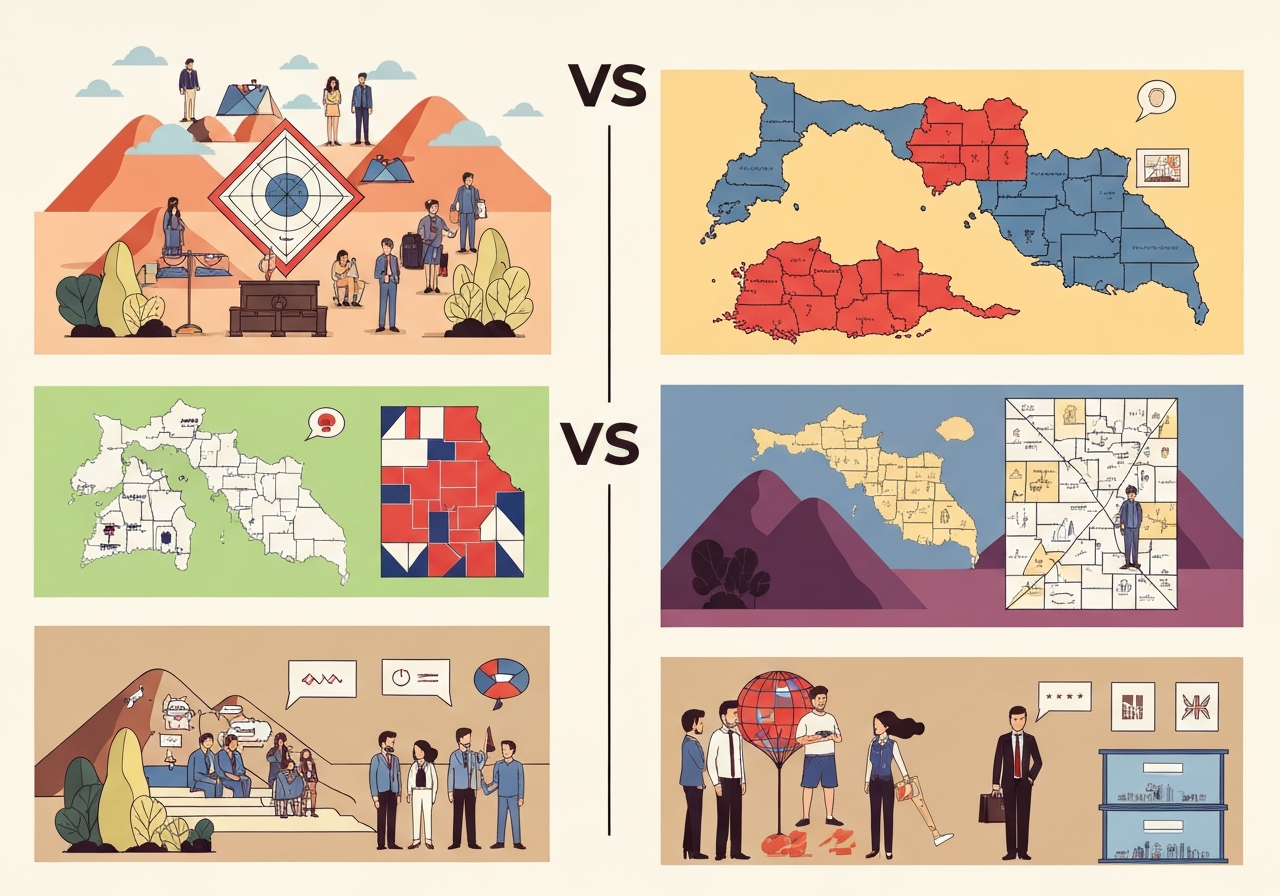
Lead
Who: U.S. states and national lawmakers; When: ahead of the 2026 midterm elections; Where: across the United States; What: a wave of mid-decade map changes is reshaping House districts; Result: political control of the U.S. House of Representatives is at stake as partisan mapmaking accelerates in several states. The pace and timing of these redraws have few parallels in established democracies, where legal and institutional guardrails typically constrain partisan manipulation of district boundaries.
Key Takeaways
- 2026 midterm stakes: Control of the U.S. House of Representatives will be decided in November 2026 amid extensive redistricting activity in multiple states.
- Historical note: The practice of partisan mapmaking in the United States dates back to at least 1812, the origin of the term “gerrymander.”
- State-driven process: Redistricting in the U.S. is administered by individual states, producing wide procedural variation and opening opportunities for partisan advantage.
- International contrast: Countries such as Australia, Canada and the United Kingdom assign map drawing to independent or semi-independent commissions to limit legislative influence.
- Timing difference: Many democracies redraw boundaries on fixed schedules tied to censuses; in the U.S., mid-decade or politically timed changes have occurred and are now more frequent.
- Legal recourse: U.S. redistricting battles often move to state and federal courts, producing uneven outcomes and continuing uncertainty about final maps.
Background
Redistricting in the United States is a decentralized, state-by-state process that follows the decennial census but can be altered by legislatures, courts or state officials. Because each state sets its own rules, the mechanics vary: some states use partisan legislatures, some use mixed systems, and others have adopted independent commissions. That fragmentation has long made the U.S. vulnerable to partisan map drawing, a practice traced back to 1812 and the coining of “gerrymander.”
In recent decades several states and civic groups have pushed reforms—constitutional amendments, statutes and judicial rulings—to limit extreme partisan gerrymanders. Still, the U.S. system allows for mid-decade changes and aggressive litigation strategies that can produce maps tailored to benefit one party. By contrast, many other democracies embedded neutral procedures and timetable constraints to reduce political interference.
Main Event
As the 2026 midterms approach, a number of state legislatures have introduced or rushed through new congressional maps, arguing they reflect legal rulings, population shifts or statutory obligations. Opponents have countered that the timing and geometry of some redraws are calculated to entrench partisan advantage. That dispute has led to a patchwork of legal challenges in state and federal courts, delaying finalization of ballots and precinct plans in several jurisdictions.
Election administrators report increased workload and uncertainty as candidate filing periods and primary calendars interact with ongoing map litigation. In some states, courts have ordered special masters or independent map drawers to propose alternatives; in others, legislatures have adopted interim plans that remain subject to appeal. The result is a varied landscape of map finality: some districts are settled months before elections, others remain in flux as ballots are printed.
Federal litigation has played an outsized role: plaintiffs often seek court intervention on grounds of racial discrimination, constitutional violations or state-law requirements. Outcomes have differed across circuits and state benches, producing a body of case law that continues to shape both immediate races and longer-term reform efforts. Meanwhile, public attention has heightened as voters and civic groups weigh in on perceived fairness and representation.
Analysis & Implications
Institutional design matters. Democracies that assign boundary drawing to nonpartisan or multi-partisan commissions reduce opportunities for incumbent protection and partisan packing. Commissions typically operate under transparency rules, published criteria and fixed timetables tied to census data, which together lower the political temperature of mapmaking. In practice, independent bodies are not immune to controversy, but they shift the locus of contest from late-night legislative maneuvering to structured review processes.
Timing also shapes incentives. Mid-decade redraws allow a majority party in power to capitalize on transient political advantages, creating instability and eroding public trust in representation. Countries that restrict redistricting to post-census cycles or require supermajorities for changes limit strategic manipulation and provide predictable schedules for parties and voters alike. The U.S. experience shows how the absence of such constraints fuels repeated legal and political conflict.
Legal frameworks are another lever. Clear statutory criteria—such as respecting communities of interest, minimizing splits and protecting minority representation—help guide mapmakers and give courts concrete standards for review. Where laws are vague, as in many U.S. states, courts struggle to prescribe consistent remedies, producing patchwork precedents. That legal uncertainty can be as consequential as the political calculations behind map proposals.
Comparison & Data
| Jurisdiction | Typical Map Authority | Timing | Common Safeguards |
|---|---|---|---|
| United States (most states) | State legislature or mixed | Decennial; sometimes mid-decade | Varies by state; litigation common |
| Australia | Independent electoral commissions | Regular, census-linked | Transparent rules, public consultations |
| Canada | Independent federal/provincial commissions | Census-linked, fixed schedule | Clear criteria, public hearings |
| United Kingdom | Boundary Commissions (independent) | Regular reviews on set timetable | Statutory criteria, consultation |
The table above summarizes common arrangements: the United States stands out for state-level variation and occasional mid-decade adjustments, while Australia, Canada and the U.K. rely on independent or semi-independent bodies operating on fixed timetables. Those institutional differences correlate with fewer high-profile map disputes in the latter group, though no system is entirely dispute-free.
Reactions & Quotes
Election officials and civic groups have issued public statements pointing to the risks of politicized mapmaking and the strain it places on election administration. Legal experts note that litigation is filling the governance gap where statutory guidance is weak.
“When legislatures control both the map and the ballot timetable, incentives to draw lines for political gain rise sharply,”
Nonpartisan election law scholar (academic)
Neutral observers have emphasized transparency and clear criteria as practical remedies. Advocacy groups have urged reforms that combine independent review, public input and judicially manageable standards.
“Independent commissions and published criteria help depoliticize the process and reduce costly litigation,”
Election policy analyst (think tank)
State officials defending legislative control argue that elected representatives should have a role in defining districts, while critics say that creates conflicts of interest and damages public confidence in fair representation.
“Legislatures reflect voter choices and therefore have a legitimate role in drawing districts,”
State legislative spokesperson (official)
Unconfirmed
- Specific claims that a single foreign democracy mirrors the current U.S. pattern of mid-decade partisan redraws require further verification; publicly documented cases vary by country and context.
- Attributions of motive—claims that particular state map changes were solely intended to flip a House majority—remain contested in many pending legal filings.
Bottom Line
The U.S. redistricting landscape ahead of the 2026 midterms highlights institutional choices that make partisan mapmaking more likely: decentralized authority, variable statutory standards and opportunities for mid-decade changes. Other established democracies limit those opportunities through independent commissions, fixed timetables and clearer legal criteria, which together reduce the frequency of high-stakes map fights.
For U.S. reformers, the options are familiar: adopt independent or hybrid commissions, clarify legal standards for acceptable maps, and align redraws with census schedules to curb strategic timing. Absent such changes, litigation and political conflict over district lines are likely to recur, with consequences for representation, voter confidence and the functioning of Congress.
Sources
- The New York Times (news reporting)
- Brennan Center for Justice (policy research on redistricting)
- Australian Electoral Commission (official electoral body)
- Elections Canada (official electoral body)
- Boundary Commission for England (official review body)