
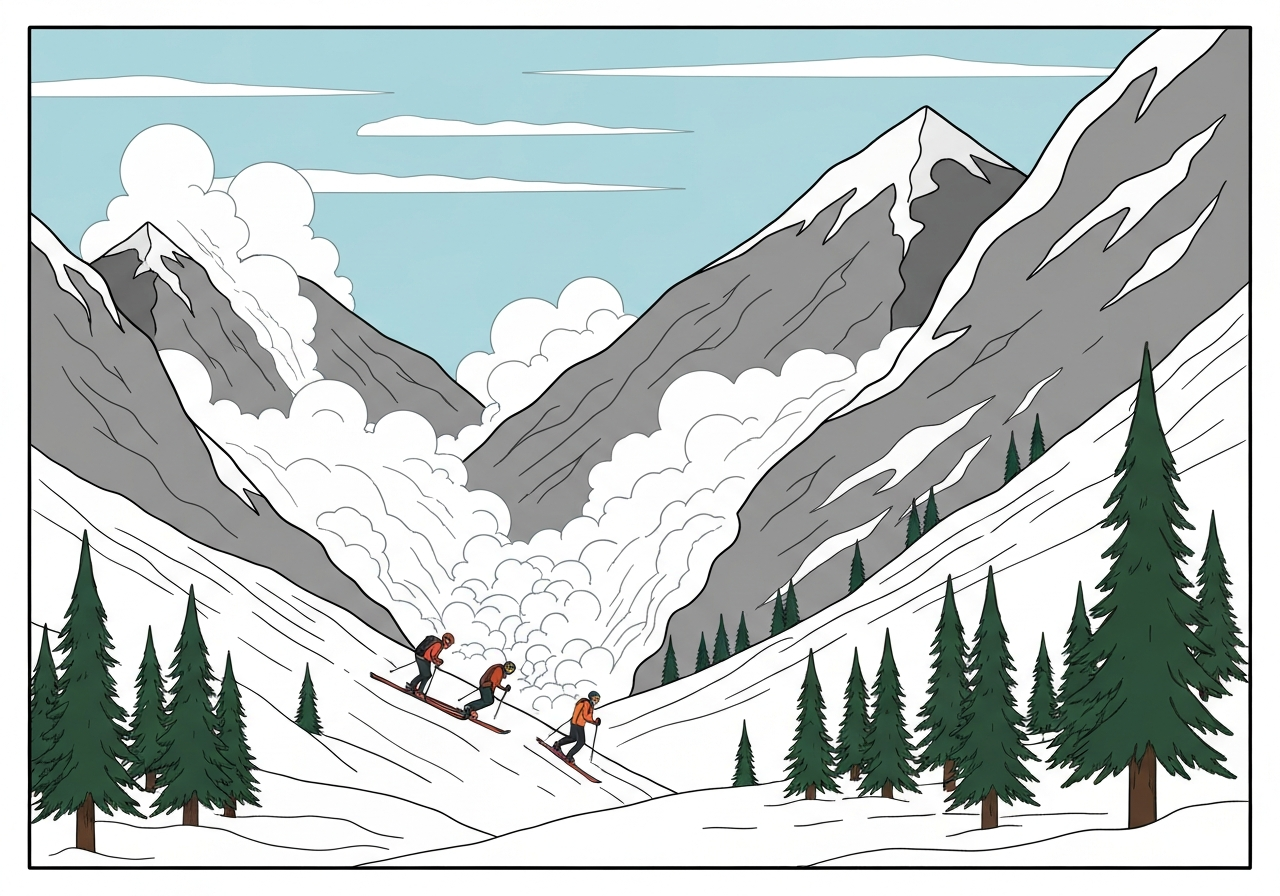
Rescuers continued to race against the clock on Wednesday, Feb. 18, 2026, after an avalanche near Castle Peak in the Lake Tahoe region left nine backcountry skiers unaccounted for. The group of 15 — which included four guides staying at the Frog Lake huts near Truckee — was returning to the trailhead on Tuesday when the slide occurred. Six members of the party activated emergency beacons and were eventually reached; two of those were evacuated to hospital facilities with injuries. Heavy, recent snowfall and high winds have complicated search operations and raised concern that this may be one of the deadliest U.S. avalanches in decades.
Key Takeaways
- Nine skiers remain missing after an avalanche near Castle Peak, Sierra Nevada; the incident unfolded on Tuesday while the group was returning from a three-day trip.
- The party numbered 15 people, including four guides from Blackbird Mountain Guides; six activated emergency transceivers and were contacted late Tuesday, two required hospital care.
- Rescue efforts on Wednesday faced continuing hazards: nearly 3 feet of new snow at Donner Peak in the prior 48 hours and an expanded avalanche warning covering the northern Sierra Nevada.
- The Sierra Avalanche Center extended an avalanche warning through Thursday morning; forecasts warned up to 18 inches on ridgelines and 2–6 inches at lake level.
- Castle Peak’s summit reaches roughly 9,100 feet; the Frog Lake huts opened in late 2021 and have been a popular backcountry base since then.
- Interstate 80 experienced multiple storm-related closures this week; roadside snowdrifts as large as 5 feet were reported at lower elevations near Truckee.
- Authorities from the Nevada County Sheriff’s Office say an official briefing was planned to provide updates; search teams face limited windows of safer weather.
Background
Castle Peak sits on the northern ridge of the Sierra Nevada, about 90 miles east of Sacramento and 40 miles west of Reno. The Frog Lake huts—private backcountry accommodations beneath the peak—have attracted experienced skiers since opening in late 2021. The area is a known draw for advanced backcountry touring, and winter access routes are commonly reached from the Interstate 80 corridor near Boreal Mountain Resort.
Weather this week was notable for a rapid accumulation of snow and strong winds. Avalanche forecasters issued a broad backcountry avalanche warning early Tuesday after nearly three feet of snow fell at Donner Peak in the previous 48 hours. Those conditions create layers of unstable snow that can fail under additional loading, especially on steep slopes favored by touring groups.
The missing group had been on a three-day expedition run by Blackbird Mountain Guides. Company postings and video from nearby Mount Rose in the days before the trip mentioned concerns about a weak layer and the potential for “unpredictable avalanches,” indicating awareness of elevated risk among organizers and clients.
Main Event
According to statements from the tour operator and local authorities, the group set out from the Frog Lake huts and was returning to the trailhead on Tuesday when a large avalanche occurred on slopes near Castle Peak. Six members of the party were able to activate emergency locator equipment and made contact with rescuers, but continued snowfall delayed immediate response. Teams did not reach them until shortly before midnight Tuesday; two of those six were treated at hospitals after evacuation.
Search and rescue personnel deployed from the Boreal/Castle Peak trailhead amid challenging conditions. Road closures on Interstate 80 and heavy drifts in the Truckee area limited access; rescue crews have had to balance the urgency of locating survivors with the safety risks posed by ongoing avalanche danger and whiteout conditions.
On Wednesday, weather was somewhat calmer with only light snowfall reported in the Lake Tahoe basin and winds that officials described as having “rapidly decreased.” Nonetheless, the Sierra Avalanche Center’s warning remained in effect through Thursday morning, and forecast models continued to show significant new accumulation at higher elevations.
Local authorities confirmed that the Nevada County Sheriff’s Office was coordinating the investigation and rescue operations and planned a public update. At the time of the briefing, officials emphasized the volatility of recent snowpack and the narrow window for locating people who may be buried.
Analysis & Implications
The scale of this incident—nine missing from a single slide—could place it among the deadliest avalanches in recent U.S. history, underscoring both the inherent risks of backcountry travel and the limits of forecasting. Rapidly deposited snow combined with strong winds creates slabs that can break unpredictably; even experienced groups and guides can be caught when conditions exceed typical thresholds for safe travel.
This event raises questions about group decision-making in the face of issued avalanche warnings. Tour operators and recreational parties routinely weigh the risks of travel during storms against client expectations and logistics. Documentation that the operator posted warnings about unstable layers suggests awareness, but investigators will need to examine the group’s route choice, timing, and safety protocols to determine contributory factors.
Search-and-rescue capacity is also tested by large storms. Heavy accumulation and continued wind loading limit safe access and can bury debris deeper as secondary slides occur. Even when locator beacons are used, survival odds decline rapidly if burial times exceed the typical minutes-to-hours window for successful extrication and medical stabilization.
Longer term, such high-profile incidents can prompt regulatory and industry responses: enhanced guidance for commercial backcountry operators, stricter client screening, or expanded education about terrain selection during high-risk periods. They also tend to increase public scrutiny of how warnings are communicated and acted upon before and during storms.
Comparison & Data
| Metric | Recent Measurements / Reports |
|---|---|
| Group size | 15 people (including 4 guides) |
| Missing | 9 skiers |
| Contacted via beacons | 6 people; 2 hospitalized |
| Snow accumulation (prior 48 hrs) | ~3 feet at Donner Peak |
| Forecasted new snow | Up to 18 inches on ridgelines; 2–6 inches at lake level |
The table summarizes the confirmed figures authorities and forecasters have released. Those numbers frame why rescue teams face such a narrow margin for successful recoveries and why investigators are focusing on timing, route, and weather bulletins issued before the trip.
Reactions & Quotes
“A weak layer could lead to unpredictable avalanches,”
Blackbird Mountain Guides (company social post)
The company that guided the trip had posted video and commentary in the days before the storm, noting instability in nearby terrain. Those posts have come under scrutiny as investigators review pre-trip communications and route planning.
“[W]inds had rapidly decreased,”
Colin McKeller, National Weather Service, Reno (meteorologist)
Meteorologists said conditions eased enough on Wednesday to give rescuers better visibility, but warned that residual avalanche danger and additional storm cycles could complicate ongoing searches.
“We will hold a news conference with updates in a few hours,”
Nevada County Sheriff’s Office (law enforcement)
Local law enforcement said it was coordinating search efforts and would provide further operational details at the scheduled briefing.
Unconfirmed
- Whether the group proceeded along a route explicitly identified as high-risk in the avalanche bulletin remains under investigation.
- The precise trigger for the slide—natural stress from weather vs. human-triggered—has not been publicly confirmed.
- Final casualty figures and the identities of the missing have not been released as authorities continue searches and notifications.
Bottom Line
The search near Castle Peak is a race against time under continuing avalanche hazard. Confirmed figures—15 people on the trip, nine still missing, six contacted and two hospitalized—paint a stark picture of how rapidly conditions can become life-threatening in high‑elevation winter terrain.
Investigators will examine operational choices by the guide service and the group, the timing of travel relative to official warnings, and the snowpack structure that allowed such a large slide. For backcountry users and operators, this incident is a sobering reminder of the limits of mitigation when rapid storms load unstable layers across expansive alpine terrain.
Sources
- The New York Times — Live coverage (news)
- Blackbird Mountain Guides — company social post/Instagram (operator)
- Sierra Avalanche Center — avalanche warnings and regional forecasts (forecasting center)
- National Weather Service, Reno office — meteorological updates (official)
- Nevada County, CA — Sheriff’s Office / county communications (local law enforcement)