
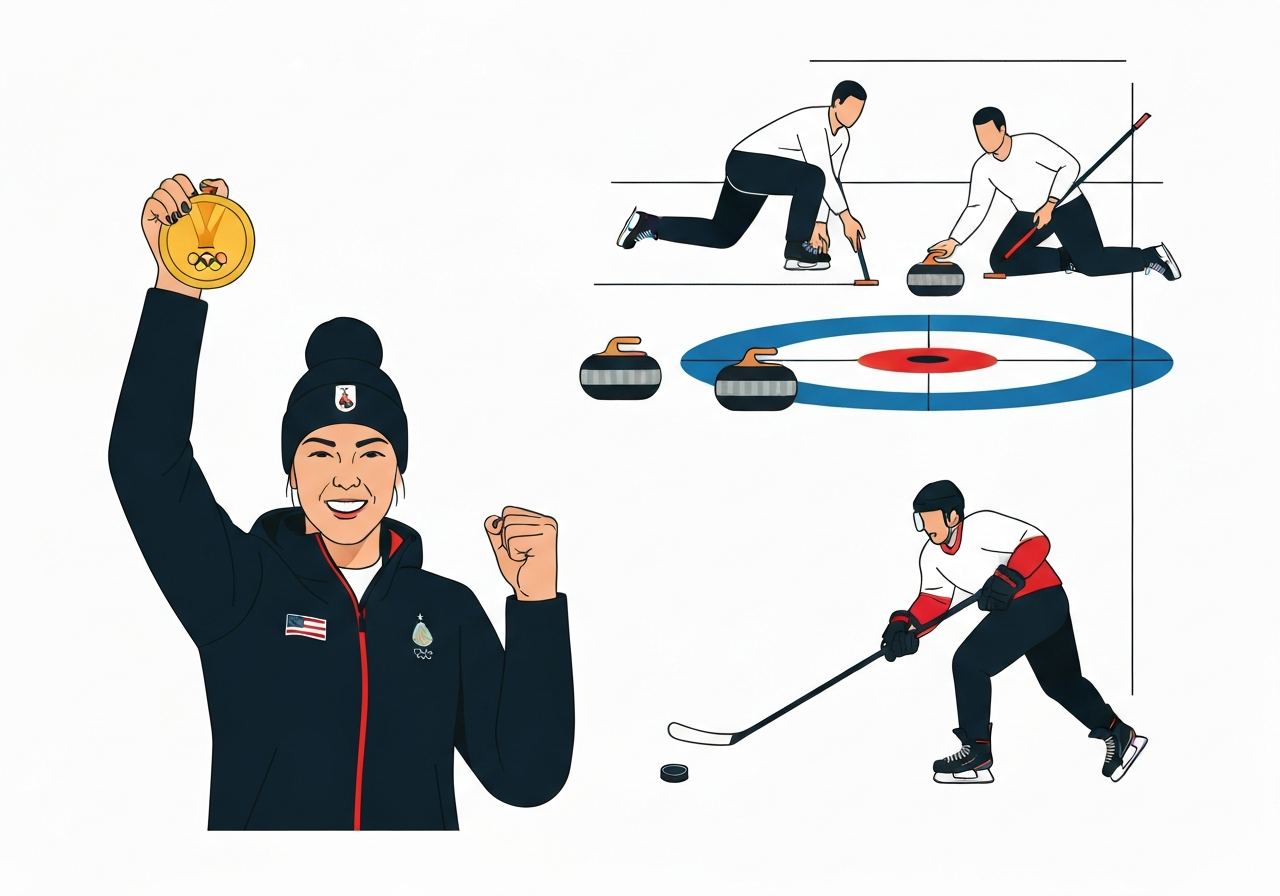
Lead: On Day 12 of the 2026 Winter Olympics in Milan–Cortina (18 February), Mikaela Shiffrin reclaimed Olympic slalom gold, ending a 12‑year gap since her first Olympic slalom win. Switzerland’s Camille Rast took silver and Sweden’s Anna Swenn‑Larsson earned bronze. The day also featured dramatic curling results that kept Great Britain’s hopes alive, a 4–3 overtime ice‑hockey quarter‑final win for Canada over Czechia, and multiple podiums in snowboarding and biathlon.
Key takeaways
- Mikaela Shiffrin won the women’s slalom gold on 18 February, 12 years after her first Olympic slalom title in Sochi 2014—the longest gap between individual golds in the same Winter Olympic event.
- Camille Rast (Switzerland) won silver and Anna Swenn‑Larsson (Sweden) took bronze in the women’s slalom final.
- Great Britain’s women won a crucial 8–7 curling match over the United States earlier in the day; Team GB later beat Japan and remain in contention for the semis depending on tomorrow’s results.
- Canada beat Czechia 4–3 in overtime with Mitch Marner scoring the winner, advancing Canada to the ice‑hockey semi‑finals; Sidney Crosby left a match earlier in the tournament with injury concerns.
- Japan’s 19‑year‑old Mari Fukada won women’s snowboard slopestyle gold; Zoi Sadowski‑Synnott (NZL) took silver and Kokomo Murase (JPN) bronze amid inconsistent snow conditions.
- France claimed gold in the women’s 4x6km biathlon relay, with Sweden second and Norway third after a comeback over the race distance.
- Norway’s Johannes Høsflot Klæbo added to his tally as Norway won the men’s cross‑country team sprint, marking his fifth gold at these Games.
Background
The Milan–Cortina 2026 Winter Olympics have mixed traditional powerhouses with emerging stars across alpine skiing, snowboarding and ice hockey. Alpine events returned to technically demanding courses after course changes and weather variability at recent Games, while snowboarding slopestyle has continued to spotlight younger athletes producing high‑risk, high‑reward runs. Curling remains tightly contested, with round‑robin permutations making each match crucial for quarter‑final and semi‑final qualification.
USA, Canada, Norway and Switzerland entered the Games with large medal ambitions in snow and ice disciplines; Japan and smaller European teams have shown they can upset expectations in judged events like slopestyle and in tactical sports such as curling. The Games also carry geopolitical overtones: participation rules for some delegations and broader international tensions have been part of the background narrative, but on‑ice results have so far been decided by performance.
Main event
Mikaela Shiffrin’s victory in the women’s slalom was the headline result of Day 12. Shiffrin completed two clean runs under clear nerves at the finish line, then crouched and embraced her mother as the significance of the win became clear. The time gap between this gold and her slalom title in Sochi 2014—12 years—sets a new Winter Games record for the longest interval between individual golds in the same event.
Camille Rast of Switzerland posted a steady performance to secure silver, while Sweden’s Anna Swenn‑Larsson delivered a dependable second run to claim bronze. Officials and commentators noted Shiffrin’s composure after the disappointment of Beijing 2022, where she left without a podium in a number of events she had been favoured in.
On the slopes of snowboarding slopestyle, 19‑year‑old Mari Fukada took gold in a final where variable snow conditions irritated some runs. Fukada’s winning score held off a strong challenge from defending champion Zoi Sadowski‑Synnott, who scored high technical marks for one nearly flawless run to take silver. Kokomo Murase picked up bronze for Japan.
In team sport drama, Canada edged Czechia 4–3 in a quarter‑final decided in overtime at Milano’s Santaguilia arena. Mitch Marner scored the sudden‑death winner after a period of sustained pressure; the match featured momentum swings, a key equaliser by Nick Suzuki late in regulation, and pivotal goaltending saves that pushed the game to extra time.
Analysis & implications
Shiffrin’s gold rewrites a small corner of Olympic history and underlines longevity in technical alpine events: athletes who combine early‑career excellence with careful program management can return to peak form across multiple Olympic cycles. Her win may influence coaching and athlete management models that balance World Cup schedules with targeted peaking for Olympic years.
For Team GB curling, narrow wins and favourable results elsewhere have kept semi‑final hopes alive but left qualification contingent on other matches. That situation highlights how round‑robin formats increase the value of match‑by‑match consistency; one surprise loss or an opponent’s unexpected win can reshuffle the standings dramatically.
Canada’s overtime win keeps them among medal favourites in men’s ice hockey, but the game also exposed vulnerabilities under sustained Czech pressure—special teams and turnover discipline will be focal points ahead of the semis. For Czechia, the close contest shows depth and tournament resilience despite the eventual loss in extra time.
The emergence of teenagers like Mari Fukada on podiums emphasizes the accelerating youth movement in judged snow sports, where technical progression and risk appetite can rapidly change the hierarchy. Snow conditions remain an important variable—athletes and organizers must adapt run construction and scoring expectations when snow quality is uneven.
Comparison & data
| Event | Gold | Silver | Bronze |
|---|---|---|---|
| Women’s slalom (alpine) | Mikaela Shiffrin (USA) | Camille Rast (SUI) | Anna Swenn‑Larsson (SWE) |
| Women’s snowboard slopestyle | Mari Fukada (JPN) | Zoi Sadowski‑Synnott (NZL) | Kokomo Murase (JPN) |
| Women’s biathlon 4x6km relay | France | Sweden | Norway |
| Men’s cross‑country team sprint | Norway | — | — |
The table above samples headline medals from Day 12. Across the Games, Norway continues to lead in Nordic events while North American teams remain strong in ice hockey; judged sports like slopestyle show greater volatility and younger podiums. These patterns reflect both historical strengths and shifting competitive dynamics at Milan–Cortina 2026.
Reactions & quotes
“Any overtime goal just feels good to score. It’s a pretty special feeling to do it in the Olympics.”
Mitch Marner, Canada forward
Marner’s comment came immediately after his sudden‑death winner against Czechia; it captured a player‑level view of momentum and pressure in knockout hockey. Team Canada praised collective defence and goaltending as decisive factors.
“It’s been a long journey to get back here. I’m proud of how I managed both runs.”
Mikaela Shiffrin (post‑race)
Shiffrin’s brief comment emphasised resilience and technical execution; coaches noted strategic run plans that balanced aggression with margin for error on a challenging course.
“We battled through and the relay came together in the final leg.”
Julia Simon, France biathlete
Simon’s remark came after France overturned an early deficit to win the women’s 4x6km relay, underscoring strong team depth and shooting consistency under pressure.
Unconfirmed
- Reports that Russia may still not win any medals at these Games are provisional; full event schedules and pending finals could change that count.
- Claims that snow quality materially affected scoring across all slopestyle runs are reported in commentary but not yet quantified by course‑condition data.
Bottom line
Day 12 of Milan–Cortina 2026 combined marquee individual triumphs and tight team contests. Mikaela Shiffrin’s slalom gold stands out both for the athletic feat and its historical significance; judged events continue to produce breakthrough young champions; and team sports delivered tense knockout drama that will shape the final days of competition.
As the Games move toward the closing phase, small margins—snow condition tweaks, a single curling end, or a sudden‑death hockey strike—will determine medal outcomes. Fans and national teams should watch scheduling permutations closely: a handful of results over the next 48 hours could alter both medal tables and qualification pathways.
Sources
- The Guardian (live coverage) — contemporary event reporting and play‑by‑play (media).
- International Olympic Committee – Olympics.com (official) — official schedule and results (official).
- Reuters — match reports and image dispatches (news agency).
- Associated Press — event photography and athlete interviews (news agency).