
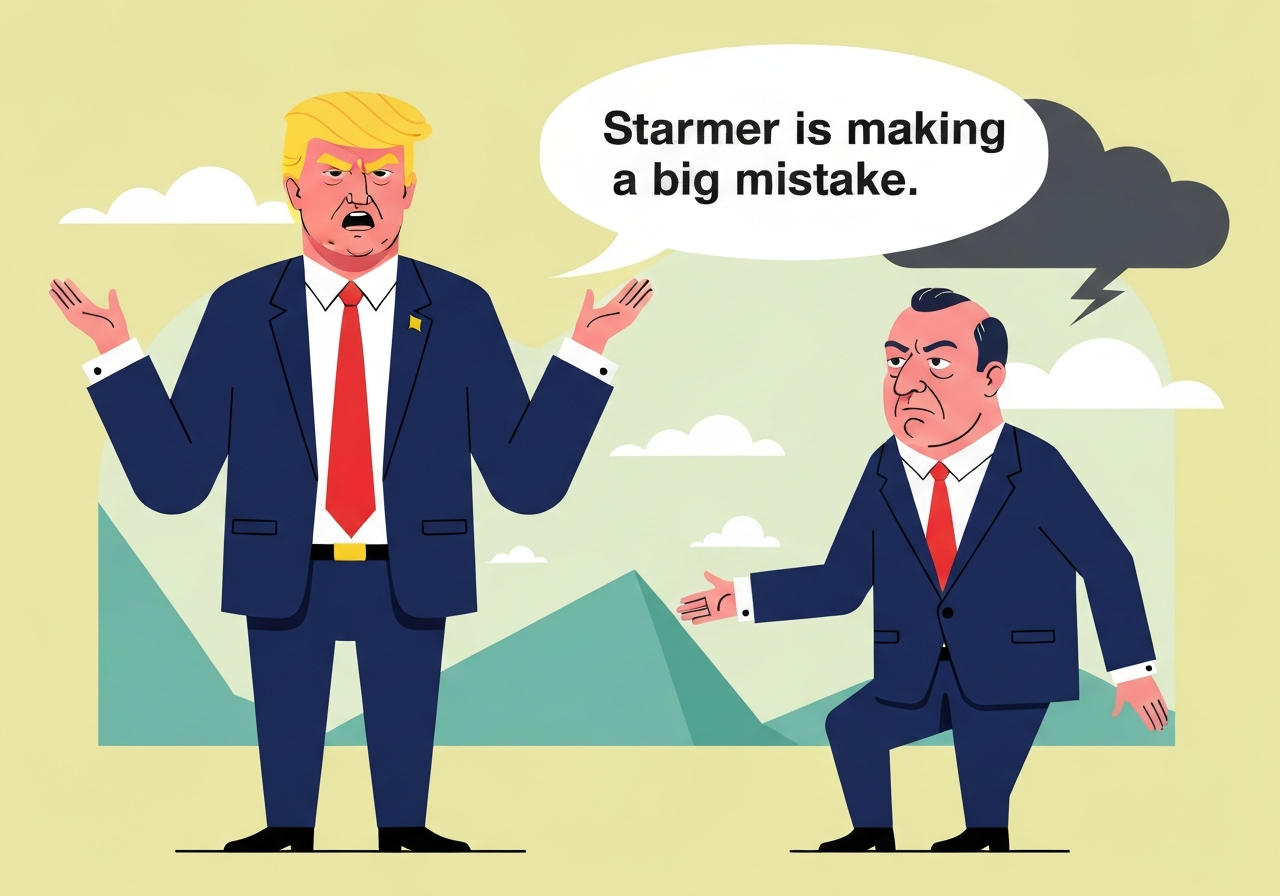
— Former US president Donald Trump publicly criticised the United Kingdom’s agreement to transfer sovereignty of the Chagos Islands to Mauritius while leasing back Diego Garcia, warning the move could weaken Western defences in the Indian Ocean. His comments followed the US Department of State’s formal approval of the arrangement and came a day after British and Mauritian officials finalised the framework for the handover and a 99-year lease of Diego Garcia. The UK government says the deal secures the long-term future of a vital base; Trump argued it was a strategic error that could complicate responses to threats from Iran. The dispute also revives long-running grievances from the displaced Chagossian community seeking a right to return.
Key takeaways
- The UK will transfer sovereignty of the Chagos archipelago to Mauritius while retaining a 99-year lease on Diego Garcia, with a reported annual lease cost of about £100 million (roughly $135 million).
- The US Department of State gave official approval to the UK–Mauritius deal a day before this article was published, signalling Washington’s formal clearance for the arrangement.
- Donald Trump publicly said on 18 February 2026 that Prime Minister Keir Starmer was “making a big mistake” and warned Diego Garcia and RAF Fairford might be needed to respond to a potential attack from Iran.
- The Chagos dispute has a legal pedigree: Mauritius won an advisory ruling from the International Court of Justice in 2019 and the UN General Assembly later called on the UK to cede control.
- Chagossians were forcibly removed in the late 1960s and early 1970s and have campaigned for restitution and the right to return; the new deal does not immediately resolve resettlement claims.
Background
The Chagos archipelago in the central Indian Ocean was ceded to Britain in 1814 and administratively separated from Mauritius before Mauritian independence in the 1960s. In the late 1960s and early 1970s the UK and the United States removed the indigenous Chagossian population to establish a military facility on Diego Garcia, a central atoll now hosting a joint UK–US base. Since then, the displaced population and their supporters have pursued legal and political remedies, culminating in a 2019 advisory opinion from the International Court of Justice that found the decolonisation process was not lawfully completed.
The ICJ opinion prompted a UN General Assembly resolution that called on the UK to end its administration of the territory and return it to Mauritius. Mauritius has maintained its claim to sovereignty and negotiated with the UK in multiple forums while also seeking assurances on the continued operation of the Diego Garcia base under terms acceptable to all parties. For defence partners, the island’s location has long been valued for expeditionary logistics and power projection across the Indian Ocean and into the wider Indo-Pacific.
Main event
On 18 February 2026, after the US State Department’s formal sign-off, the UK announced a bilateral accord with Mauritius transferring sovereign title to the island group while leasing the Diego Garcia atoll back to the UK for 99 years, with an option to extend. UK officials described the arrangement as the only practical means to guarantee the base’s long-term availability to the UK and its allies. The leaseback is reported to cost around £100 million per year, a figure the UK government said secures operational continuity.
Donald Trump responded with a string of posts on Truth Social, asserting that Prime Minister Keir Starmer was “making a big mistake” and claiming unnamed entities cited in the transfer were “fictitious in nature.” He also warned that the United States might need facilities such as Diego Garcia and the RAF base at Fairford to “eradicate a potential attack” he said could originate from Iran, a conditional remark presented as a hypothetical security rationale.
The UK Foreign, Commonwealth and Development Office (FCDO) reiterated that the deal was central to national and allied security, framing the arrangement as a pragmatic compromise: sovereignty returns to Mauritius while operational control of a strategic facility remains guaranteed under a long-term lease. Mauritian officials welcomed sovereignty recognition but said details on access, environmental protections and the welfare of the Chagossian community required further negotiation. Meanwhile, Chagossian groups and diaspora organisations continued to press for meaningful resettlement and reparations.
Analysis & implications
The agreement reshapes a long-running colonial dispute into a negotiated, state-to-state settlement that attempts to square legal sovereignty with military practicality. For the UK and US, retaining operational access to Diego Garcia preserves logistics, intelligence and strike options across the Indian Ocean; planners argue the base remains a core node for power projection and maritime security, particularly amid heightened tensions with Iran and broader competition in the Indo-Pacific.
For Mauritius, formal sovereignty is a diplomatic victory and a restoration of territorial claim recognised by international judicial and political bodies. However, sovereignty in name does not automatically translate into immediate control over land use or guarantee rapid economic benefits: treaty details, jurisdictional arrangements and environmental safeguards will determine how much authority Port Louis exercises in practice.
The deal carries domestic political consequences in the UK. Critics may frame the leaseback as an erosion of sovereignty despite official assurances, while supporters will stress continuity of defence cooperation. Trump’s intervention politicises the arrangement in Washington and London; his suggestion of potential military action linked to the base elevates tensions rhetorically and could complicate alliance messaging if such rhetoric persists.
Comparison & data
| Year / milestone | Status | Notes |
|---|---|---|
| 1814 | British control established | Archipelago incorporated into British territories. |
| 1960s–1970s | Detachment & displacement | Chagossians removed; Diego Garcia developed as a base. |
| 2019 | ICJ advisory opinion | ICJ concluded decolonisation was incomplete; recommended return. |
| 2026 | UK–Mauritius agreement | Sovereignty to Mauritius; 99-year lease of Diego Garcia to UK; ~£100m/year cost. |
The table shows a pattern of administrative control and legal contestation spanning two centuries. Quantitatively, the most immediate metric of the new arrangement is the 99-year lease and the reported £100 million annual cost for access to Diego Garcia; these figures will be pivotal in parliamentary and budgetary scrutiny in London and assessments in Washington.
Reactions & quotes
“He is making a big mistake,”
Donald Trump, former US president (Truth Social)
Trump’s short public rebuke framed the deal as strategically risky and questioned the factual basis of claims cited by UK negotiators. His post also couched a security rationale for retaining access to bases such as Diego Garcia and Fairford.
“The agreement we have reached is the only way to guarantee the long-term future of this vital military base,”
UK Foreign, Commonwealth and Development Office spokesperson (official statement)
The FCDO statement emphasised continuity of allied security and cast the arrangement as the pragmatic option to preserve defence capabilities and keep people safe, while acknowledging the diplomatic settlement with Mauritius.
Chagossian advocacy groups responded with caution, repeating calls for concrete commitments on resettlement, compensation and environmental restoration; civil society observers noted that legal recognition of sovereignty does not immediately translate into social and economic remedies for displaced populations.
Unconfirmed
- Trump’s claim that the groups cited by negotiators are “fictitious in nature” has not been substantiated and lacks public evidence in the diplomatic record.
- The suggestion that an Iranian attack is imminent and would require pre-emptive use of Diego Garcia or RAF Fairford is a hypothetical threat scenario presented by a political actor and is not corroborated by a public intelligence assessment in the record cited.
Bottom line
The UK–Mauritius deal attempts to reconcile legal and moral calls for decolonisation with strategic defence priorities by returning sovereignty while preserving access to a key military facility. It resolves a long-running legal question in diplomatic terms, but it leaves unresolved practical and human questions, notably the terms for Chagossian resettlement, environmental protection and the precise operational safeguards governing the base.
Observers should watch implementation closely: treaty text and subsidiary agreements will determine how sovereignty and usage rights operate in practice, whether the Chagossian community secures meaningful remedies, and how allies manage messaging about force posture in the Indian Ocean. Political rhetoric from influential actors may shape short-term perceptions, but the long-term outcome will be driven by legal detail, parliamentary oversight and the terms agreed among London, Port Louis and Washington.