
Lead
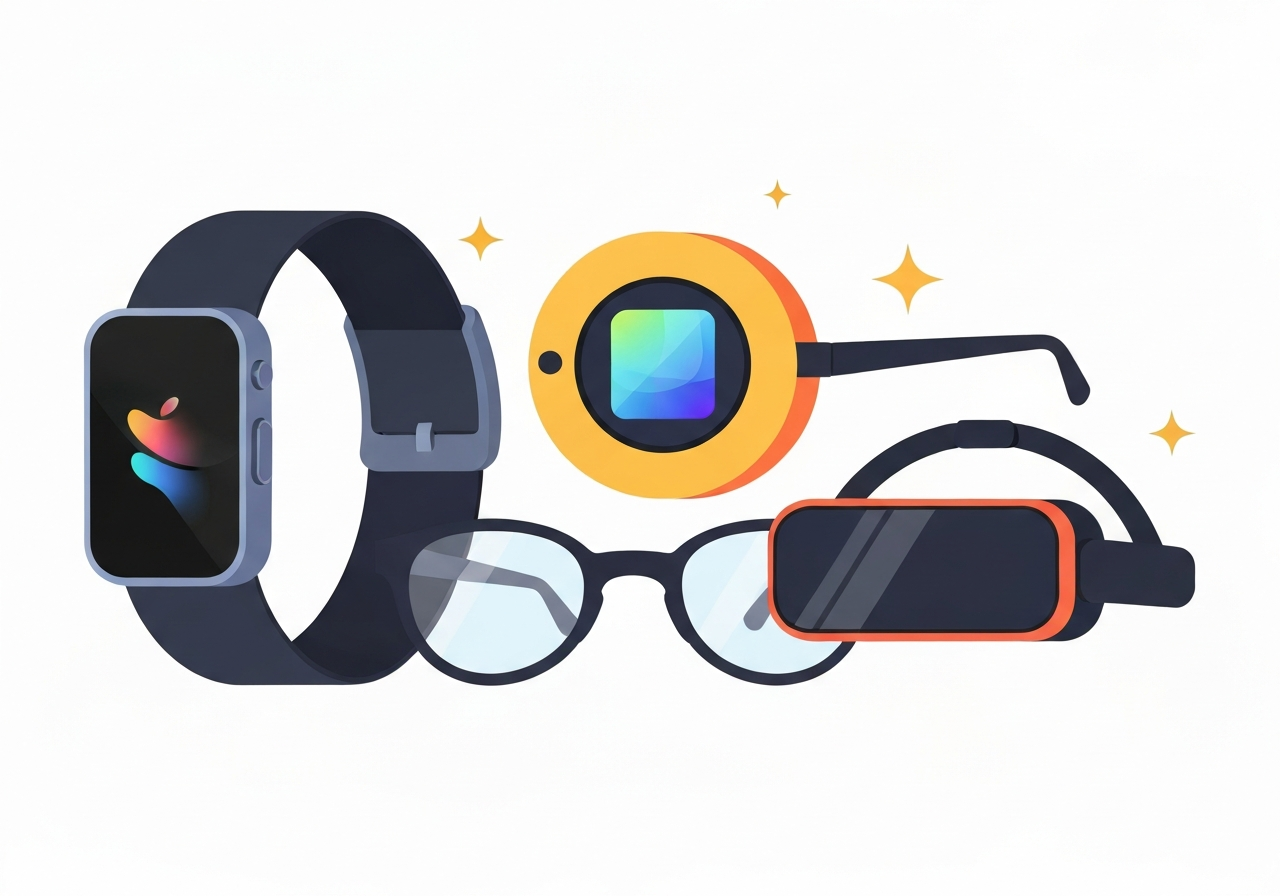
Apple is said to be advancing development on three AI-powered wearables, including an AirTag-sized camera pendant, upgraded AirPods and high-end smart glasses. Reports surfaced in February 2026, with The Information first describing the pendant and Bloomberg later adding production timing and device details. Bloomberg says Apple is aiming to start production as early as December 2026, ahead of a planned public release in 2027 for the glasses. All devices are reported to integrate tightly with the iPhone and rely on Siri as a core interface.
Key Takeaways
- Apple is developing three AI wearables: an AI pendant, AI-enhanced AirPods, and smart glasses code-named N50, according to recent reporting.
- The pendant is described as roughly AirTag-sized and may include on-board cameras intended to clip to clothing, first reported in January 2026 by The Information.
- Bloomberg reports Apple is targeting the start of production for the glasses as early as December 2026, with a public release expected in 2027.
- The N50 glasses are said to include a high-resolution camera and be positioned as more premium and feature-rich than other Apple wearables.
- All three products are expected to pair with the iPhone and use Siri as a primary control and AI integration point.
- Competitors named in reporting include Meta — a leading smart-glasses player — and Snap, which plans a new Specs release later in 2026.
- TechCrunch reached out to Apple for comment; no new official product announcement has been published by Apple at the time of reporting.
Background
The push into AI-first wearables follows a broader industry trend: major tech firms are shifting compute and AI experiences into new device categories beyond phones and laptops. Companies such as Meta and Snap have invested in wearable form factors that blend cameras, heads-up displays and on-device processing for augmented reality and contextual assistance. Apple has historically entered adjacent markets later than some rivals but often emphasizes tighter hardware-software integration when it does.
Apple’s Siri and iPhone ecosystem give the company a clear platform play: by making wearables function as extensions of the iPhone, Apple can keep data flow, privacy controls and user experience within its existing architecture. Previous Apple launches — from AirPods to the Apple Watch — show a pattern of multi-year internal development before a public debut. That timeline and the company’s focus on premium hardware help explain both the reported emphasis on camera quality for the N50 glasses and the staggered release schedule.
Main Event
According to The Information and Bloomberg, the smallest of the three reported devices is a pendant roughly the size of an AirTag, intended to be clipped to clothing and equipped with one or more cameras. The concept is to provide ambient capture or visual assistance while remaining compact and discreet; developers and designers reportedly debated placement, privacy controls and form factor during internal prototyping. Bloomberg notes Apple accelerated the project amid a competitive surge in AI wearables from rivals.
The N50 smart glasses are the centrepiece in Bloomberg’s reporting: they are described as higher-end, with a high-resolution camera and richer feature set than Apple’s other reported wearables. Sources told Bloomberg Apple is pushing for production to start in December 2026 to meet a 2027 public launch window, although an exact shipping date was not provided. The glasses are expected to offload some tasks to the iPhone while offering on-device camera and sensor capabilities.
Separately, Bloomberg reports Apple is upgrading AirPods with additional AI capabilities; details are sparse but the effort appears aimed at making earbuds more context-aware, improving voice assistance and possibly adding new audio-based interaction modes. Across all devices, Siri is described as a central element of the experience rather than a peripheral feature, implying tighter integration between Apple’s large language model work and on-device hardware.
Analysis & Implications
For Apple, success in AI wearables would depend on three linked factors: hardware differentiation, seamless iPhone integration and clear user privacy safeguards. Hardware differentiation means camera quality, battery life and sensor fusion that justify a premium price. Integration with the iPhone and services determines whether wearables become compelling extensions of users’ daily workflows instead of niche accessories.
Privacy will be a pivotal battleground. Wearables with always-available cameras and continuous sensing raise obvious concerns for bystanders and workplaces. Apple’s previous privacy positioning could be an advantage if the company publishes transparent controls and on-device processing guarantees; however, regulatory scrutiny in multiple markets may speed demands for clearer safeguards and limits on facial recognition or persistent recording.
Market timing is also strategic. Bloomberg’s reported December 2026 production window aims to position Apple to capture demand as competitors roll out their own devices. If Apple can deliver a premium product in 2027, it could push mainstream acceptance of AI wearables, but delays or subpar battery/performance trade-offs would give competitors room to claim leadership.
Comparison & Data
| Maker | Device (reported) | Timing | Key attributes |
|---|---|---|---|
| Apple | AI pendant; N50 glasses; AI AirPods | Production targeted Dec 2026; public launch 2027 (glasses) | High-res camera (glasses), Siri integration, iPhone pairing |
| Meta | Mixed-reality smart glasses (existing lineup) | Ongoing | AR tooling, ecosystem with Quest/AR platform |
| Snap | New Specs (planned) | Planned release later in 2026 | Social camera features, lightweight form factors |
The table aggregates public reporting and company positioning: Apple’s devices are presented as premium and tightly integrated with existing services, while competitors focus on platform or social-first experiences. Measured adoption will depend on price, developer support and how effectively each company addresses privacy and utility trade-offs.
Reactions & Quotes
Industry outlets characterized the reporting as an acceleration of Apple’s wearable roadmap, noting both the product diversity and the compressed timeline for the glasses.
“An AirTag-sized pendant with cameras is among the concepts being developed,”
The Information (reporting)
Bloomberg’s reporting emphasized the production timeline and the company’s intent to position the N50 glasses as a premium product.
“Targeting the start of production as early as December, ahead of a public release in 2027,”
Bloomberg (report)
Unconfirmed
- Exact launch dates beyond Bloomberg’s reported 2027 window remain unconfirmed and could slip depending on testing and regulatory reviews.
- Detailed technical specifications — such as exact camera resolution, battery capacities or on-device AI chip details — have not been publicly verified.
- Pricing, carrier and regional availability for any of the three devices is not yet known.
Bottom Line
Apple’s reported push into three distinct AI wearables signals a broader strategy to extend its device ecosystem into always-on, context-aware hardware. If the company meets reported timelines and balances performance with privacy safeguards, these products could reshape how users interact with AI in daily life.
However, delivery risks remain: engineering constraints, regulatory scrutiny and consumer acceptance of camera-equipped wearables could slow adoption. Observers should watch for official filings, patent activity and Apple’s own announcements for definitive confirmation and technical detail.
Sources
- TechCrunch — news article summarizing reporting and context (media).
- Bloomberg — reporting cited for production timing and device descriptions (media report).
- The Information — earlier reporting on the AI pendant concept (media report).