
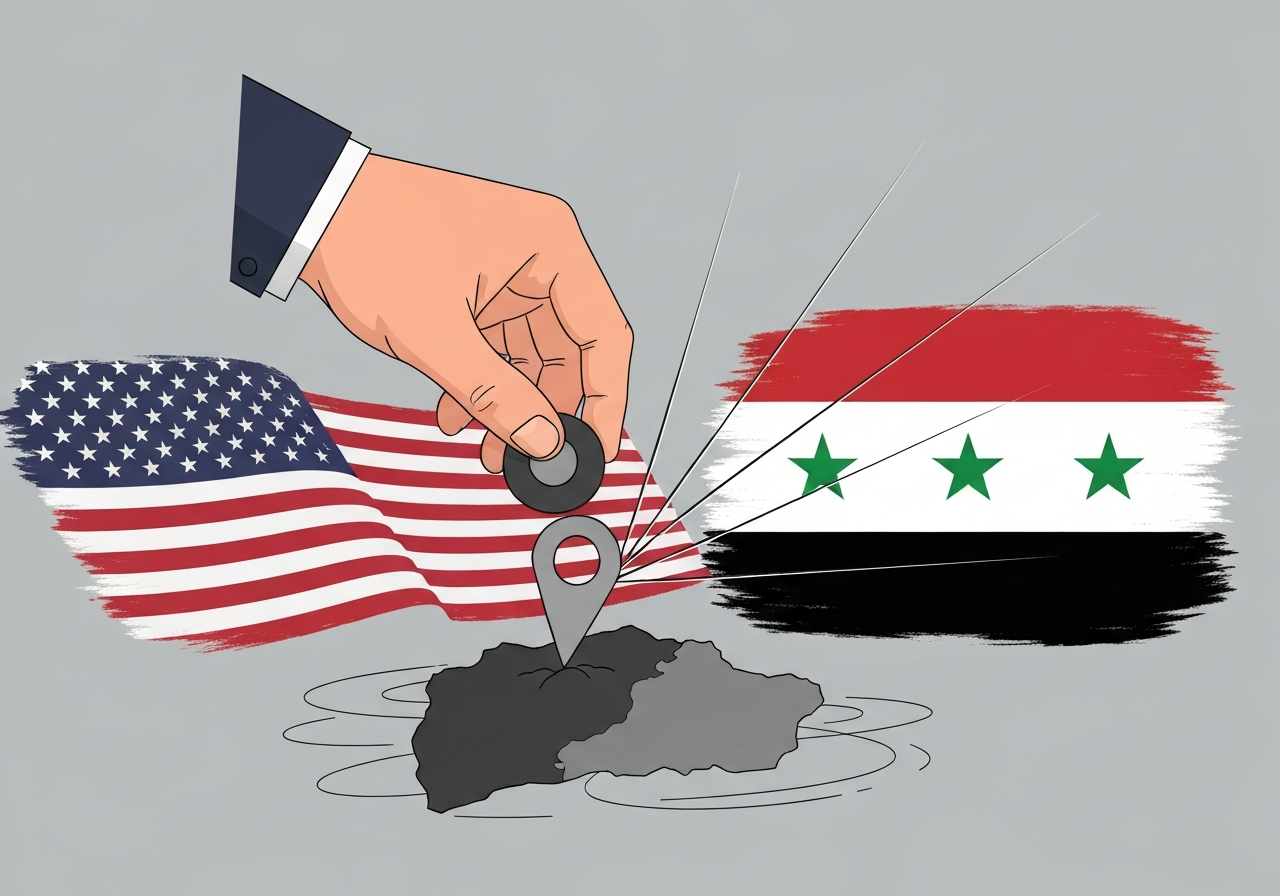
The White House has told the BBC the United States will largely withdraw its remaining forces from Syria over the coming months, after Damascus agreed to take the lead on counter‑terror operations inside its borders. A senior White House official described the move as a conditions‑based transition for roughly 1,000 U.S. personnel, while stressing Washington remains ready to respond to threats in the region. The announcement comes as the Trump administration simultaneously increases U.S. naval and air presence near Iran, citing rising tensions there. Officials and regional actors say the shift marks a major recalibration of U.S. military and diplomatic engagement in Syria.
Key takeaways
- US will largely withdraw the roughly 1,000 remaining troops from Syria over the next few months, according to a senior White House official.
- The Syrian government has agreed to assume primary responsibility for counter‑terrorism inside its borders, U.S. officials said.
- U.S. naval assets, including the USS Abraham Lincoln carrier strike group, have been confirmed near Iran; the USS Gerald R. Ford is reported en route and expected within about three weeks.
- Trump has increased forces in the wider Middle East and, per senior national security officials speaking to CBS News, said U.S. forces could be prepared for strikes on Iran as soon as Saturday (no final decision announced).
- Earlier this year U.S. troops withdrew from the al‑Tanf garrison in southern Syria and the al‑Shaddadi base in the north‑east.
- The move follows the collapse of the Assad government in 2024 and a marked reduction in Islamic State activity, according to U.S. assessments cited by officials.
- Diplomatic outreach has intensified: Syrian President Ahmed al‑Sharaa visited the White House in November, and a January deal reportedly began integrating the Kurdish‑led Syrian Democratic Forces with Syria’s armed forces.
- Security incidents persist: in December a translator and two Iowa National Guard members were killed in an ambush in Palmyra; U.S. forces carried out retaliatory raids named Operation Hawkeye Strike.
Background
U.S. forces have been present in Syria since 2015 as part of a campaign to defeat and contain the Islamic State (IS). The deployment grew out of coalition operations and partnership with local forces, notably the Kurdish‑led Syrian Democratic Forces (SDF), which Washington supported against IS strongholds. Over time the force posture evolved from high‑intensity operations to smaller advisory and counter‑terror roles as IS lost territory.
The regional picture has shifted substantially since 2024. The collapse of the Assad government that year, as described by U.S. officials, and the weakening of IS have altered Washington’s calculus on ground forces. At the same time, tensions between the U.S. and Iran have increased, prompting the Trump administration to surge carriers and other assets to the eastern Mediterranean and the Gulf. Diplomacy between Washington and Damascus has also advanced, culminating in a visit to the White House by Syrian President Ahmed al‑Sharaa in November and subsequent security‑sector negotiations.
Main event
A senior White House official told the BBC that U.S. forces will largely withdraw from Syria over the next several months as part of a conditions‑based transition. The official said the Syrian government has agreed to take the lead in combating terrorism on its territory and that a U.S. military presence “at scale” is no longer required. U.S. planners, the official added, will retain options to respond to emergent threats throughout the region.
The announcement arrived alongside an intensified U.S. military posture near Iran. BBC Verify confirmed the location of the USS Abraham Lincoln carrier strike group near Iranian waters; U.S. officials have also said the USS Gerald R. Ford is expected in the region within about three weeks. Senior national security officials told CBS News that President Trump said U.S. forces could be ready for potential strikes on Iran as soon as Saturday, though no final decision had been made at the time of reporting.
On the ground in Syria, U.S. troops had already pulled back from two bases earlier this year: the al‑Tanf garrison in the south and the al‑Shaddadi base in the north‑east. U.S. officials link those movements and the current withdrawal plan to improved security conditions and evolving diplomatic arrangements. In January, a deal was reported that would integrate the Kurdish‑led SDF with Syria’s armed forces, a step U.S. officials view as part of the transition to Syrian responsibility for internal security.
Analysis & implications
The planned withdrawal signals a strategic shift toward diplomatic engagement with Damascus and greater reliance on regional actors to secure Syrian territory. For Washington, the change reduces forward‑deployed ground forces while attempting to maintain leverage through naval and air assets. That posture aims to balance competing priorities: reducing boots on the ground while preserving rapid‑response capabilities elsewhere in the Middle East.
Risks remain. A reduced U.S. ground footprint could create space for IS or other militant groups to regenerate, particularly if Syrian security forces and integrated units do not sustain persistent pressure. The January integration of the SDF into Syria’s armed forces is a critical test; its success or failure will materially affect militant resurgence risk and local governance dynamics in former IS areas.
Regionally, the move will be read through the lens of U.S.‑Iran tensions. The deployment of carrier strike groups and the stated readiness for strikes on Iran are intended to reinforce deterrence, but they also increase the potential for miscalculation. Allies and partners in the region will watch whether Washington can simultaneously draw down in Syria while deterring Iranian adventurism, and how diplomatic ties with Damascus reshape alignments on the ground.
Comparison & data
| Moment | U.S. posture in Syria |
|---|---|
| 2015 | Initial deployment for anti‑IS operations |
| Early 2024 | Withdrawals from al‑Tanf and al‑Shaddadi bases |
| Now | Roughly 1,000 troops; conditions‑based large withdrawal planned |
Those entries summarize major inflection points rather than exhaustive troop accounting. The “roughly 1,000” figure for remaining U.S. personnel is the number cited by the senior White House official to the BBC. Historical peak and year‑by‑year troop levels vary by mission phase and are tracked in U.S. defense reports.
Reactions & quotes
“The Syrian government has agreed to take the lead combating terrorism within its borders,”
Senior White House official (to the BBC)
The official framed the withdrawal as a conditions‑based transition and emphasized U.S. readiness to counter threats if necessary. The comment accompanied confirmations about carrier movements and other force posture changes near Iran.
“U.S. forces remain ready to respond to any threats in the region,”
Senior White House official (to the BBC)
That statement was offered to reassure partners and Congress that operational options would remain available even as the ground presence in Syria diminishes.
Unconfirmed
- The precise timetable for a full U.S. withdrawal and which units will remain on short notice has not been publicly released.
- Whether Syria’s security forces can sustain counter‑terror operations nationwide without renewed assistance is unverified and depends on implementation of integration agreements.
- Reports that President Trump had set a concrete date for strikes on Iran remain unconfirmed; officials described readiness but no final order was reported.
Bottom line
The U.S. announcement marks a notable pivot: drawing down a limited ground presence in Syria while simultaneously escalating naval and aerial posture near Iran. Washington presents the decision as a transition to Syrian responsibility for interior security, coupled with retained options to respond to threats across the region.
How the shift plays out will depend on whether Syrian forces and integrated local units can hold gains against IS and other militants, and on whether increased U.S. naval forces near Iran successfully deter escalation without triggering incidents. For policymakers and regional observers, the coming months will be a test of whether diplomatic rapprochement and sea‑based deterrence can substitute effectively for a larger land presence.
Sources
- BBC (News report) — primary report on the withdrawal and related developments.
- CBS News (U.S. news outlet) — cited by U.S. officials regarding potential strike readiness.
- U.S. Department of Defense (official) — official casualty and operational statements, including responses to attacks and raid operations.
- U.S. Navy (official) — information on carrier movements and strike group deployments.