
Lead
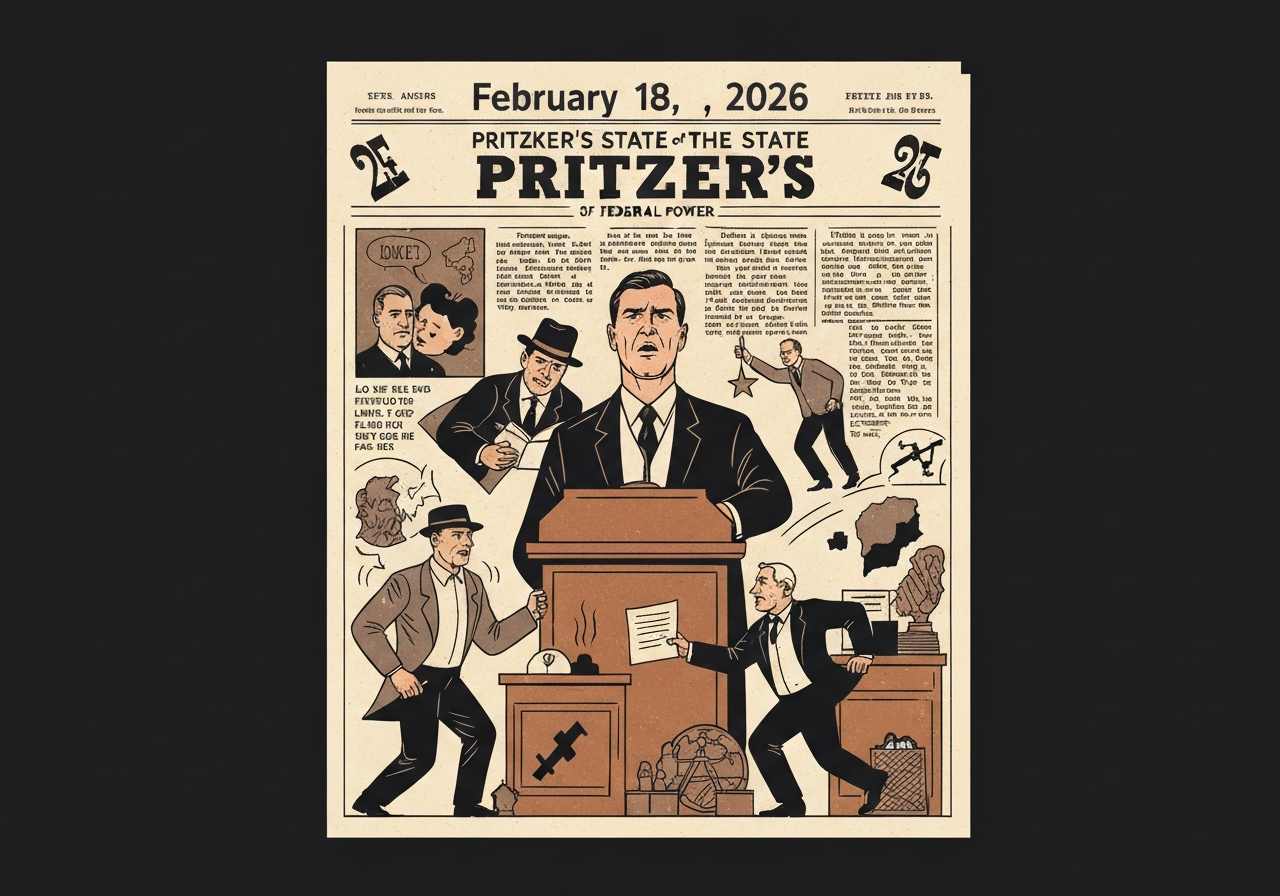
On February 18, 2026, Illinois Governor J.B. Pritzker used his annual State of the State address in Springfield to frame budget choices within a broader argument about democracy, federal overreach and community resilience. He invoked 19th‑century reformer John Peter Altgeld to link past progressive reforms to present policy goals, criticized actions by the Trump administration that he says have cost Illinois billions, and announced plans to reduce housing and energy costs while erasing $1 billion in medical debt for more than 500,000 residents.
Key Takeaways
- Gov. J.B. Pritzker delivered the address on February 18, 2026 in Springfield, using the speech to explain the budget and broader policy priorities.
- Pritzker cited John Peter Altgeld (Illinois governor 1893–1897) as a historical touchstone for workplace safety and inclusion.
- The governor said the Trump administration’s policies have cost Illinois $8.4 billion through withheld federal funds.
- Illinois’s GDP now exceeds $1.2 trillion, up from $881 billion when Pritzker took office, he noted.
- Pritzker pledged to tackle housing, electricity and healthcare costs, including pausing new data‑center tax credits and investing in renewables and nuclear power.
- The state purchased and erased roughly $1 billion of medical debt, benefiting over 500,000 people.
- Pritzker framed recent federal deployments of agents in Chicago as an authoritarian threat and named White House officials he accused of designing those operations.
- He emphasized civic solidarity and small acts of mutual aid as antidotes to political cruelty and division.
Background
State of the State addresses traditionally explain the governor’s budget proposals and policy agenda; Pritzker used the platform on February 18 to connect fiscal choices to broader civic values. He reached back to John Peter Altgeld, an Illinois governor from 1893 to 1897 who championed workplace safety, child labor protections, education investment and early appointments of women to public office despite women not yet having the vote. By invoking Altgeld, Pritzker placed his proposals in a lineage of state‑level progressive reform.
Over the past eight years, Pritzker said, Illinois has balanced annual budgets while increasing spending on education, child welfare, disability services and private‑sector job creation. He contrasted state fiscal discipline with what he described as damaging federal actions since President Donald J. Trump took office, arguing those actions transfer costs to states and complicate implementation of programs funded by congressional appropriations.
Main Event
In Springfield, Pritzker catalogued concrete budget impacts and policy priorities. He told lawmakers that $8.4 billion in federal funds had been withheld from Illinois, calling the action an illegal confiscation of dollars that Illinois taxpayers already paid. He stressed that states must balance budgets annually, so delayed or withheld federal appropriations force hard tradeoffs at the state level.
Turning to the economy, Pritzker highlighted Illinois’s growth: a gross domestic product now above $1.2 trillion compared with $881 billion at the start of his administration. He attributed those gains to a combination of state investment and private‑sector hiring even as the state met its budgetary obligations. He framed that record as proof that policy choices can expand opportunity while maintaining fiscal discipline.
On policy, Pritzker outlined three top priorities: reduce housing costs by loosening certain local regulations and expanding financing options; address rising electricity prices by pausing new data‑center tax credits and accelerating investment in renewables and nuclear energy; and lower healthcare costs, pointing to the state’s purchase and elimination of about $1 billion in medical debt affecting more than 500,000 people.
Pritzker also criticized federal deployments of law enforcement in Chicago over the prior year, saying masked, poorly supervised agents intimidated residents, used force against children and, in his words, at times detained or attempted to deport U.S. citizens. He named senior White House advisers as architects of tactics he described as a drip‑feed of authoritarianism into public life.
Analysis & Implications
Pritzker’s framing ties administrative and budgetary minutiae to a larger civic narrative: that state government must defend everyday people when federal actions undermine services or legal norms. If the $8.4 billion figure reflects withheld federal appropriations or delayed reimbursements, the practical effect on Illinois budgets can be immediate—forcing delayed projects, litigation costs and uncertainty for local governments and service providers.
Politically, the speech seeks to nationalize the governor’s grievances: by naming federal actors and tying present events to historic episodes like the Pullman strike, Pritzker appeals both to progressive constituencies and to voters concerned about stability and rule‑of‑law. That strategy may strengthen state‑level coalitions but also risks intensifying partisan responses in national media and in Washington.
On policy substance, the proposed pause to new data‑center tax credits aims to slow electricity demand growth in certain regions and create space for a broader energy strategy. Shifting incentives and investing in a mix of renewable and nuclear generation reflects a dual objective—manage near‑term rate pressure while pursuing longer‑term decarbonization and resilience goals.
The medical debt purchase is an immediate relief measure with symbolic and financial impact: spending state dollars to buy and erase debt can improve credit and reduce financial strain for hundreds of thousands, but the long‑term solution will require federal and private‑sector reforms to address rising medical costs and billing practices.
Comparison & Data
| Metric | At start of Pritzker term | As cited Feb 18, 2026 |
|---|---|---|
| Illinois GDP | $881 billion | Over $1.2 trillion |
| Withheld federal funds (claimed) | — | $8.4 billion |
| Medical debt erased | — | ~$1 billion for 500,000+ people |
| Pullman strike (historical) | Wage cuts ~25% | ~25 fatalities reported in 1894 |
The table places Pritzker’s fiscal claims alongside historical comparisons. The GDP increase indicates nominal growth but does not alone reveal distributional outcomes; the governor emphasized that gains have been uneven and concentrated among a small share of beneficiaries. The $8.4 billion figure represents the administration’s estimate of federal withholdings and is central to Pritzker’s charge that Illinois residents are bearing the cost of federal actions.
Reactions & Quotes
“To be perfectly candid, as Illinois is one of the states whose taxpayers send more dollars to the federal government than we receive back…I was hoping that his threats to gut programs were campaign hyperbole. There are no cooler heads at 1600 Pennsylvania Avenue these days.”
Gov. J.B. Pritzker (State of the State, Feb. 18, 2026)
Context: Pritzker used this line to explain why he views recent federal moves as deliberate and consequential for Illinois budgets, not mere rhetoric.
“Justice requires that the same rewards and honors that encourage and incite men should be equally in reach of women in every field and activity.”
John Peter Altgeld (quoted in Pritzker’s address)
Context: Pritzker cited Altgeld to anchor his speech in a tradition of state‑level reform for equal opportunity and government responsibility.
“I’m committed to doing everything government can to rein in the worst of the price gouging and profiteering we are seeing.”
Gov. J.B. Pritzker (State of the State, Feb. 18, 2026)
Context: This remark underscores the administration’s intent to pursue regulatory and fiscal tools to reduce costs for households.
Unconfirmed
- The governor’s characterization that federal agents “killed innocent Americans in the streets” summarizes his claims; independent, case‑by‑case confirmation of fatalities directly caused by identified federal personnel in those events is incomplete in public records available at the time of this report.
- The legal determination that the $8.4 billion was “illegally confiscated” reflects the governor’s interpretation; final legal rulings or federal accounting clarifications may alter that characterization.
- Precise attribution of local price increases (electricity, housing) to specific federal policies requires detailed econometric analysis beyond the scope of the address.
Bottom Line
Pritzker’s February 18, 2026 address fused budgetary detail with a rhetorical effort to recast state policy as a bulwark against what he described as federal overreach and economic concentration. He combined historical analogy, immediate relief measures (the medical‑debt purchase) and near‑term regulatory steps to offer both symbolic and substantive responses to residents’ cost pressures.
For Illinois voters and officials, the immediate questions are practical: how the claimed $8.4 billion shortfall will be resolved, how proposed pauses and investments will affect rates and development, and whether the medical‑debt intervention can be scaled or complemented by federal reforms. The speech positions the governor to press those questions in court, in Springfield and in national debates over federal‑state responsibilities.