
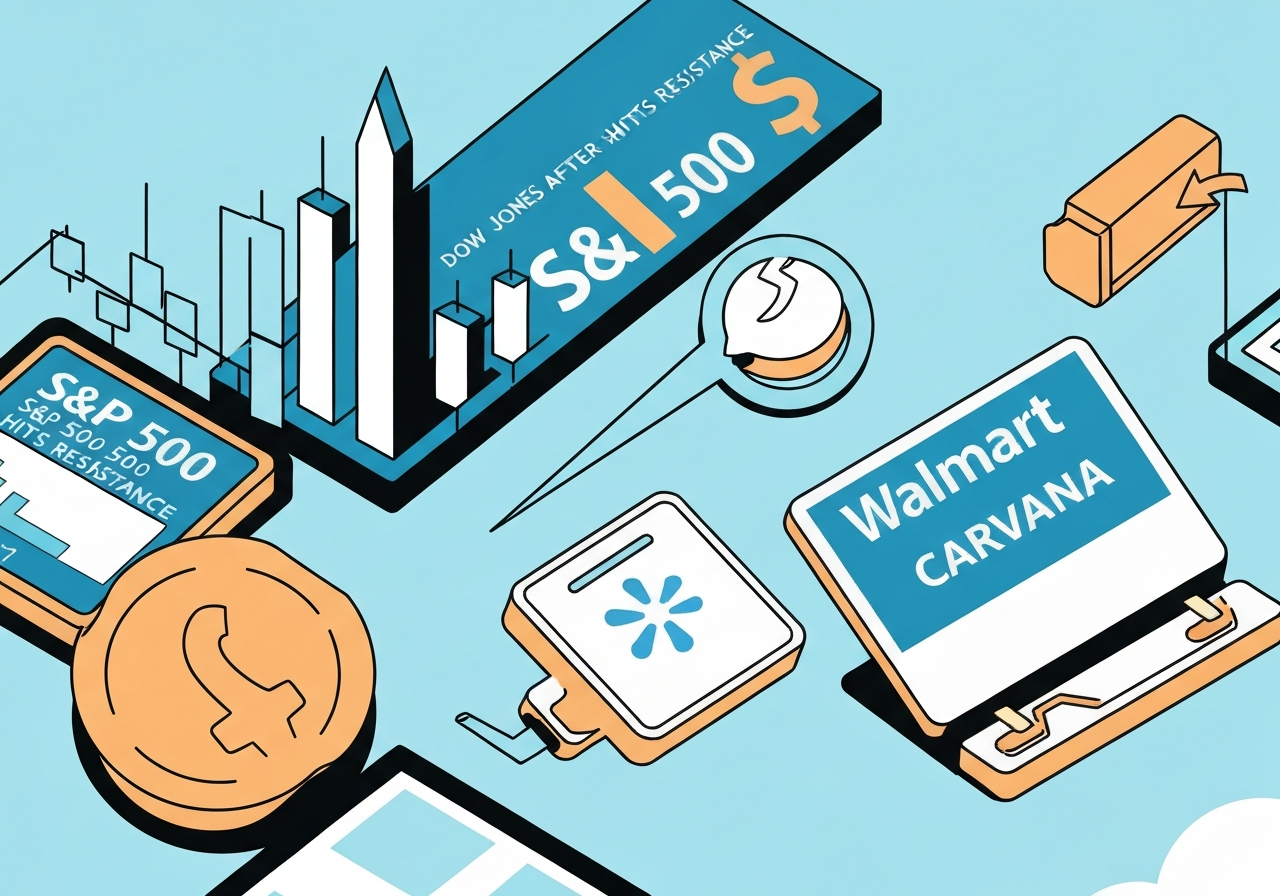
Lead: U.S. stock futures slipped in premarket trading after the S&P 500 encountered technical resistance, tempering a recent rally. The Dow Jones futures fell ahead of the opening as investors parsed mixed earnings and company-specific headlines. Walmart and Carvana were singled out as notable movers, with Walmart reacting to fresh results and Carvana shares sliding on trading updates. Overall, the tone shifted from risk-on to cautious as market participants weighed near-term catalysts.
Key Takeaways
- Dow futures were trading lower in premarket after the S&P 500 ran into resistance, pausing a short-term advance in broad equity markets.
- Walmart reported earnings and commentary that prompted investor reassessment of near-term retail margins and guidance.
- Carvana shares declined sharply after the company released trading updates and delivery-related commentary that raised questions about near-term execution.
- Semiconductor names including Nvidia and equipment suppliers such as ASML were mentioned as part of the market breadth driving the S&P 500’s recent move.
- Real-time price data used in the coverage is provided by Nasdaq Last Sale; ownership data comes from LSEG and estimate data from FactSet, per the publisher’s note.
- The article and related trademarks are held by Investor’s Business Daily, LLC, with the copyright year noted as 2026.
Background
Equity benchmarks have traded with narrower intraday ranges when major indices approach well-watched technical levels. The S&P 500’s resistance is a focal point for algorithmic traders and portfolio managers who often reduce exposure near established highs. Historically, tests of resistance can produce short-term consolidation or pullbacks before a decisive breakout or reversal, depending on incoming economic data and earnings flows.
Corporate earnings remain a central driver of stock-specific moves. Large-cap retailers and online auto sellers tend to elicit outsized responses when results differ from expectations, reflecting fine margins and inventory sensitivity. Market participants also factor in macro signals—such as interest-rate guidance and consumer-spending data—that interact with company-specific news to shift sentiment.
Main Event
In premarket trade, Dow Jones futures declined following reports that the S&P 500 stalled near a technical ceiling established during the recent rally. Traders cited profit-taking and position adjustments by funds as contributors to the softer tone. The move in futures suggested a more cautious open rather than an abrupt change in trend.
Walmart’s latest results and management commentary drew attention from investors focused on retail-profit dynamics. Though the company remains a large-cap bellwether for consumer spending, nuances in guidance and margin discussion prompted some reassessment among short-term traders. The reaction illustrates how even a single major retailer’s update can temporarily sway broader index behavior.
Carvana’s shares slid after the company provided trading-related updates and operational remarks that investors interpreted as signs of continued execution risk. Given Carvana’s history of sensitivity to funding and logistics headlines, the stock’s move underscored the market’s lower tolerance for operational uncertainty in high-leverage retail models.
Analysis & Implications
The S&P 500 hitting resistance signals a potential pause in the rally, where momentum-driven flows often reverse or consolidate. If sellers sustain pressure at that level, it could widen intraday volatility and prompt short-term reallocations into defensive sectors. Conversely, a successful breach of resistance would likely reaccelerate risk-on positioning, particularly among passive funds and momentum strategies.
Retail earnings and updates—exemplified by Walmart and Carvana—underscore the bifurcation between earnings-driven stock moves and broader macro-led market trends. Large-cap retailers that meet or slightly beat expectations can still face selling if guidance is cautious, while companies with funding or execution questions face quicker and deeper sell-offs regardless of near-term sales figures.
For portfolio managers, the current mix of technical resistance and selective earnings risk argues for active risk management: trimming concentrated long positions near technical ceilings, reassessing exposure to names with opaque near-term cash flow profiles, and monitoring liquidity conditions in premarket and early trade hours. International spillovers are possible but likely limited unless global growth or central-bank signals change materially.
Comparison & Data
| Item | Source/Role |
|---|---|
| Real-time trade prices | Nasdaq Last Sale (market data) |
| Ownership data | LSEG (data provider) |
| Analyst estimates | FactSet (estimate provider) |
The table summarizes the market-data partners specifically referenced in publisher disclosures. These providers support pricing, ownership, and estimate feeds that feed both real-time trading desks and publication reporting. Their roles are distinct: transaction-level pricing, institutional ownership records, and consensus estimate aggregation.
Reactions & Quotes
The premarket weakness reflects traders reducing exposure after the index met a known technical barrier rather than a single fundamental shock.
Market strategist (comment to press)
This quote captures the tactical nature of the move: technical resistance prompting profit-taking. It does not speak to longer-term fundamental shifts.
Walmart’s quarterly commentary suggests we should watch margin drivers closely in the coming quarters.
Equity analyst note (summary)
An analyst summary emphasized margin trends as the proximate reason for the market’s reaction to the retail report.
Carvana’s trading update raised questions about near-term delivery cadence and working-capital needs.
Industry observer (summary)
Observers pointed to operational cadence and capital structure as the key factors behind the stock’s sensitivity.
Unconfirmed
- Reports attributing the entire premarket decline to a single institutional fund’s rebalancing have not been independently verified.
- Attributions that Carvana’s slide was driven solely by a specific operational incident remain unconfirmed pending company disclosures.
- Any linkage between the S&P resistance test and an imminent policy shift by central banks is speculative and not substantiated by public statements.
Bottom Line
The trading session’s early weakness reflects a mix of technical and company-specific drivers rather than a broad macro shock. Investors should distinguish between temporary volatility around chart levels and changes to fundamentals that justify repositioning for the medium term.
Near-term market direction will hinge on whether the S&P 500 can clear its resistance on follow-through buying, and on upcoming corporate reports and economic prints that could tilt sentiment. For now, active risk management and careful reading of earnings commentary remain prudent.