
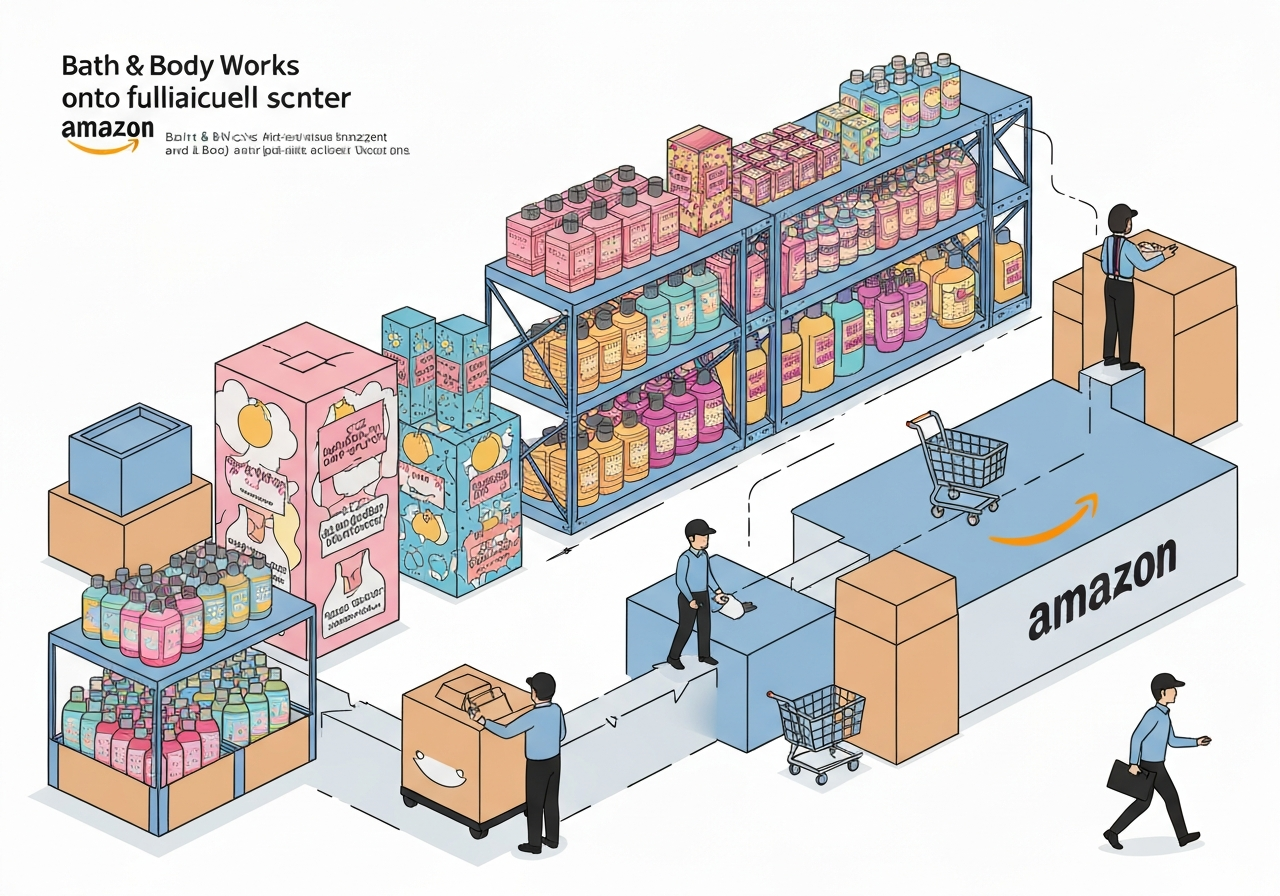
Bath & Body Works has launched a branded storefront on Amazon in the U.S., making a selection of its top fragrances, body washes, hand soaps and candles available with Prime-eligible shipping. The move was announced in February 2026 and is intended to reach customers on a platform that accounts for a large share of online beauty purchases. The company will retain ownership of inventory and set pricing while using Amazon’s fulfillment partners to qualify products for Prime. Bath & Body Works’ CEO framed the deal as a tactical step to meet shoppers where they already buy.
Key Takeaways
- Bath & Body Works began selling select items on Amazon in February 2026, offering Prime-eligible shipping for U.S. customers.
- The brand keeps inventory ownership and pricing control but uses Amazon’s fulfillment network for Prime benefits.
- Amazon held an estimated 47% share of the U.S. online beauty and personal care market in 2024, per Euromonitor.
- Bath & Body Works has expanded other channels recently, including more than 1,000 college campus locations and its 2,600 owned/franchised stores.
- Last month the company lowered its own free-shipping threshold to $50 from $100 to boost direct-site competitiveness.
- Executives present the Amazon storefront as the first step in a broader plan to restore profitable, sustainable growth under CEO Daniel Heaf.
Background
Bath & Body Works, based in Columbus, Ohio, has long relied on its own stores and direct-to-consumer website as primary sales channels. In 2025 the company opened points of sale beyond malls by placing products in over 1,000 college campus stores, marking a deliberate shift toward more diversified distribution. The move to Amazon follows a wider industry trend: vertically integrated apparel and personal-care brands are increasingly treating Amazon as a logistics and distribution partner rather than a traditional retailer. Historically, third-party resellers had been the main source of Bath & Body Works listings on Amazon; the new arrangement establishes an authorized, company-controlled storefront.
The strategy arrives amid a company turnaround plan introduced by CEO Daniel Heaf after he joined Bath & Body Works in May 2025. Heaf, formerly a senior Nike executive, has framed the recovery around a four-pillar, consumer-first formula: product innovation, brand reinvigoration, marketplace wins, and faster, leaner operations. The Amazon launch is presented as an execution point under the marketplace pillar, designed to broaden reach without ceding control of pricing or inventory.
Main Event
In February 2026 Bath & Body Works made a curated selection of best-selling fragrances, body washes and candles available through an authorized Amazon storefront. The company said products on Amazon are Prime-eligible because they will be fulfilled using Amazon’s partnered logistics network, while Bath & Body Works retains ownership of the stock. Prior to the storefront, most Bath & Body Works listings on Amazon were offered by independent third-party sellers; the new setup aims to centralize the brand narrative and customer experience.
CEO Daniel Heaf described the launch as a way to “put ourselves directly in the path of the consumer,” emphasizing convenience and visibility on a dominant e-commerce platform. Bath & Body Works executives note the company is not trying to replicate Amazon’s next-day fulfillment capabilities with its own network; instead, the brand plans to leverage Amazon’s logistics where appropriate while improving its own site and other channels. Internally, the move was positioned as a test case for future, selectively chosen retail partnerships.
The deal differs from wholesale partnerships in which Amazon buys and sells inventory: under the new arrangement Bath & Body Works controls pricing and stock but uses Amazon’s fulfillment partners to enable Prime shipping. Comparable vertically integrated brands such as Gap, J. Crew and Everlane have taken varied approaches to Amazon; some offer limited core items via wholesale or authorized storefronts, often to reach lapsed or convenience-driven shoppers. For Bath & Body Works, the storefront supplements existing footprints rather than replaces them.
Analysis & Implications
Strategically, the Amazon storefront reduces friction for price- and convenience-oriented shoppers who prioritize Prime delivery and a single checkout experience. With Amazon accounting for a large share of online beauty sales, presence on the platform increases discoverability and offers access to consumers who may not visit brand sites or mall locations. Bath & Body Works’ decision to keep inventory and pricing control helps guard brand positioning, while outsourcing fulfillment addresses logistics scale without the capital expense of building a Prime-speed network.
Financially, the arrangement can drive incremental sales by reaching new or lapsed customers and by capturing impulse purchases on Amazon, but margins may be affected by fees tied to fulfillment and marketplace services. The lower free-shipping threshold on Bath & Body Works’ own site suggests management is simultaneously trying to reduce the convenience gap that drives customers to Amazon. Longer term, the brand must balance revenue growth on third-party platforms with customer data capture and loyalty-building on owned channels.
For the retail ecosystem, this is another data point in the evolving relationship between vertically integrated brands and Amazon. Brands gain fast, wide distribution and Prime’s convenience while retaining product control; Amazon gains catalog depth and consumer demand. Regulators and competitors are watching how such partnerships influence pricing transparency, platform dependence and competition in digital shelf space.
Comparison & Data
| Metric | 2024 Estimate |
|---|---|
| Amazon share of U.S. online beauty market | 47% |
| Sephora share of U.S. online beauty market | 9% |
| Share of beauty & personal care sales online | 39% |
The figures above, estimated by Euromonitor, illustrate Amazon’s dominant position in online beauty commerce and the ongoing digitalization of the category. For a brand like Bath & Body Works, which historically relied on physical retail, these percentages underscore why expanding into Amazon’s channel can materially affect reach. The company’s multi-channel approach — owned stores, campus locations, its website, and now Amazon — reflects an effort to meet shoppers across different purchase moments.
Reactions & Quotes
Company leadership framed the move as consumer-centric and part of a broader turnaround plan.
“Launching our first authorized brand storefront on Amazon allows us to put ourselves directly in the path of the consumer.”
Daniel Heaf, CEO, Bath & Body Works
Executives also acknowledged strategic limits when competing with Amazon on logistics speed.
“We know that we will never compete with Amazon in terms of their Prime Network.”
Daniel Heaf, CEO, Bath & Body Works
Market data providers emphasize Amazon’s scale in beauty e-commerce, a key rationale for brand listings on the platform.
“Amazon accounts for 47% of the online beauty and personal care market in the U.S. in 2024.”
Euromonitor (market research)
Unconfirmed
- No public disclosure has been made about the full list of SKUs Bath & Body Works will maintain on Amazon beyond general categories; specific assortment and launch timing for additional items remain unconfirmed.
- The long-term financial impact on Bath & Body Works’ margins from fulfillment fees and marketplace commissions has not been disclosed and remains to be reported in future earnings statements.
- Details on any data-sharing agreement between Bath & Body Works and Amazon, including access to customer transaction data, have not been publicly revealed.
Bottom Line
Bath & Body Works’ authorized Amazon storefront is a calculated move to increase visibility and convenience for shoppers in a category where the majority of buying has shifted online. By keeping inventory and pricing control, the brand seeks to preserve its identity while leveraging Amazon’s logistics to deliver Prime-like convenience. The launch complements other distribution expansion efforts, such as campus stores and a revised free-shipping threshold, indicating a broader omnichannel push under CEO Daniel Heaf’s turnaround plan.
Investors and competitors will watch whether the partnership drives meaningful top-line growth without eroding margins or brand equity. For consumers, the change promises easier access to popular Bath & Body Works items; for the company, the key test will be translating increased reach on Amazon into sustained, profitable customer relationships across channels.
Sources
- CNBC (news report)
- Euromonitor (market research)
- Bath & Body Works (company site/official)