
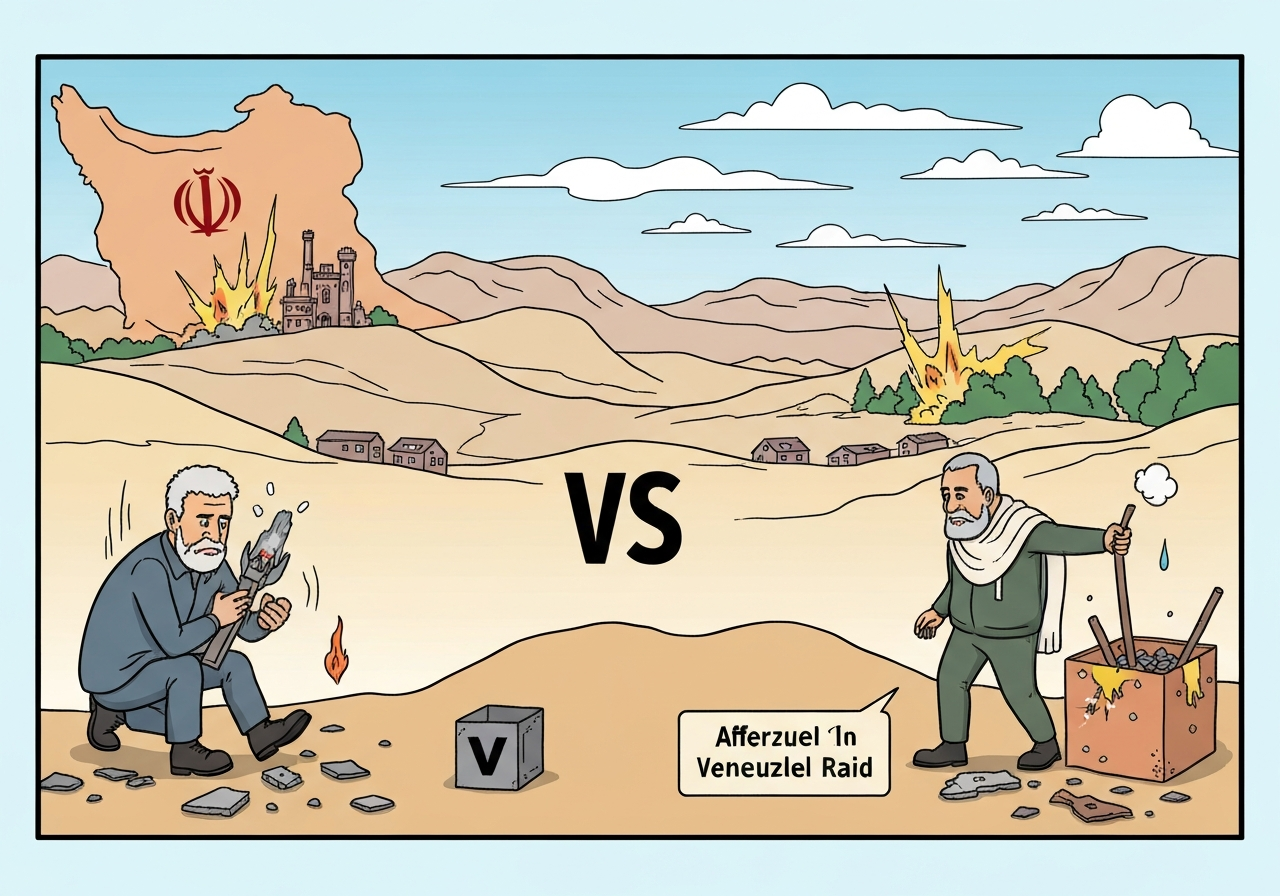
In January, President Trump framed a U.S. naval buildup toward Iran as an “armada” comparable to the rapid strike the military conducted in Venezuela, arguing a similar force could carry out a swift mission. As of Feb. 21, 2026, advisers and regional analysts warn that Iran’s geographic depth, missile inventory and extensive proxy networks make any military option far more complicated than the Caracas operation and carry a real risk of escalation and U.S. casualties. Tehran’s ability to mobilize proxies, threaten the Strait of Hormuz and defend key facilities means a limited strike could quickly widen into a prolonged confrontation. Officials say the administration has discussed goals ranging from blocking a potential nuclear pathway to, in public remarks, regime change — but has not defined a clear, limited objective that would avoid long-term entanglement.
Key Takeaways
- The White House compared a planned Iran deployment to the rapid Venezuelan operation in January; those two scenarios differ in geography and adversary capabilities.
- Iran fields medium- and long-range missile systems and has proxies across Iraq, Syria, Lebanon and Yemen, increasing options for retaliation (sources: CSIS, CFR).
- Data for Feb. 1–15, 2026 show tanker patterns in the Strait of Hormuz that highlight the route’s vulnerability to disruption (data providers: Kpler, Marine Regions).
- Experts from the International Crisis Group and regional analysts say there is no “clean” military option; U.S. forces and personnel could face direct and indirect attacks.
- Unlike the Caracas operation, which targeted a limited and isolated command environment, Iran presents dispersed, hardened targets and a political leadership integrated with its security forces.
- An ill-defined objective — preventing a nuclear weapon versus pursuing regime change — increases the chances of mission creep and international backlash.
Background
The January reference to an “armada” followed their recent claim that a swift operation in Venezuela demonstrated U.S. capability to strike quickly. That Venezuelan operation focused on a concentrated theater in Caracas, where planners could exploit limited defensive depth and secure rapid extraction. Iran is different: it has layered missile defenses, underground facilities, and a cadre of state-aligned and proxy forces across the Levant and Persian Gulf that complicate targeting and post-strike stability.
Iranian strategy has long relied on asymmetric tools — ballistic missiles, sea-denial tactics, and proxy groups — to deter conventional Western military advantages. International actors including Gulf states, Russia and China have varying appetites for escalation, making coalition-building and diplomatic isolation of Iran more difficult than in previous limited operations. The U.S. discussion of objectives — from denial of a nuclear pathway to regime change — reflects competing policy aims inside the administration and raises questions about thresholds for use of force and exit strategies.
Main Event
In early 2026, U.S. leaders publicly and privately weighed options after a series of escalatory incidents in the Gulf. The administration moved additional naval assets and positioned strike-capable platforms in the region; officials publicly cited deterrence, while some comments signaled readiness for kinetic options. Planners compared operational lessons from a recent Venezuelan action but also acknowledged the distinct operational and political challenges posed by Iran’s strategic posture.
The military planning discussed a range of limited strikes, targeting items such as missile stockpiles, radar and command-and-control nodes, and select leadership infrastructure. Analysts caution that many of those targets are dispersed, partially hardened, or embedded in civilian areas, increasing the risk of collateral damage and complicating precise removal of military capability. Iranian leadership retains the option to respond through proxies or direct strikes against coalition assets, commercial shipping, or U.S. regional partners.
Wider disruption could include attempts to interdict the Strait of Hormuz or attacks on allied bases and shipping lanes, which would immediately affect global oil flows and regional security. U.S. planners reportedly factored in election-year political constraints; potential American casualties would weigh heavily on any decision about the timing, scale and duration of strikes.
Analysis & Implications
Operationally, Iran’s geography and force structure favor a protracted contest rather than a single, decisive blow. The Islamic Revolutionary Guard Corps (IRGC) and affiliated groups operate through distributed cells that can survive decapitation attempts and sustain asymmetric campaigns. Economically and politically, prolonged conflict risks triggering energy market shocks, tightening of insurance and shipping costs, and broader damage to regional economies already strained by sanctions and the pandemic recovery.
Strategically, a strike calculated to be limited could still produce expanded retaliation because Iran’s doctrine emphasizes deterrence through credible, visible responses. Proxy forces in Lebanon, Iraq, Syria and Yemen have both capacity and incentive to retaliate in ways that complicate attribution and escalation control, pressuring U.S. partners and forcing wider coalition commitments. Diplomatically, allies may diverge: some U.S. partners would support punitive measures, while others would seek de-escalation to protect trade and energy interests.
Domestically, political calculations matter: an operation with casualties or an unclear endpoint would be politically costly in an election year, potentially constraining the administration’s willingness to follow through or prompting an extended presence. Long-term, military action without a political settlement risks hardening Iranian resolve and could accelerate clandestine development of sensitive capabilities rather than eliminating them.
Comparison & Data
| Feature | Venezuela (Caracas raid) | Iran (potential operation) |
|---|---|---|
| Operational depth | Shallow; concentrated urban theater | Deep; dispersed sites across vast territory |
| Defensive systems | Limited organized defense | Layered air defenses and missile forces |
| Proxy network | Minimal regional proxies | Extensive networks in Iraq, Syria, Lebanon, Yemen |
| Risk of escalation | Relatively low | High — regional and economic repercussions |
The table outlines core differences that drive operational risk and political cost. Tanker-tracking data from Feb. 1–15, 2026 show concentrated commercial traffic through the Strait of Hormuz, underscoring how quickly regional maritime chokepoints could be affected by hostilities. Analysts use these patterns to model economic exposure; even short interruptions can spike insurance rates and freight costs, with knock-on effects for global markets.
Reactions & Quotes
U.S. policy-makers and external analysts offered measured responses emphasizing caution and planning. Officials framed deployments as deterrence while signaling readiness to respond to Iranian aggression, but most commentators urged clear objectives and exit routes.
Officials described the deployed force as intended to deter and, if necessary, conduct targeted strikes with precision.
U.S. Department of Defense (public statement)
Security analysts warned of the limits of a narrowly kinetic approach without accompanying diplomatic pressure. They argued that absent a political strategy, strikes could prompt a cycle of retaliation through proxies that is difficult to control.
There is effectively no low-cost military quick fix; any strike risks drawing the United States into a longer, bloodier contest.
Ali Vaez, International Crisis Group (analyst comment)
Regional governments reacted with concern about escalation and commercial impact. Gulf states emphasized stability and urged restraint, while some U.S. partners called for a calibrated mix of sanctions and diplomacy rather than immediate military action.
Gulf partners and European allies stressed de-escalation and coordinated pressure to avoid a broader regional conflagration.
Council on Foreign Relations (analysis summary)
Unconfirmed
- No official U.S. policy document publicly defines a precise, limited objective for strikes; reported goals (denial of nuclear capability vs. regime change) remain part of public discussion but not formally published.
- Attribution of any future proxy attacks to Tehran would likely be contested; claims of direct orders versus independent actor initiative are unverified in advance.
- Reports of specific target lists and estimated casualty projections circulating in media outlets are not independently confirmed by the Pentagon.
Bottom Line
The operational and political dynamics make Iran a fundamentally different and far riskier target than the recent Venezuela operation. Planners face dispersed targets, hardened defenses and a network of proxies that could sustain asymmetric retaliation and widen any conflict. Without a clearly stated, achievable objective and accompanying diplomatic strategy, limited military action carries a significant chance of mission creep, regional destabilization and U.S. casualties.
Decision-makers must weigh short-term deterrence gains against long-term costs: economic disruption, allied divisions and prolonged presence in the region. The safest path to reducing risk remains a mix of clear, limited objectives, robust intelligence and parallel diplomatic pressure that includes regional partners and international institutions.
Sources
- The New York Times — media reporting on policy discussions and regional dynamics.
- International Crisis Group — NGO analysis on conflict risks and regional actor behavior.
- CSIS Missile Threat — technical data on missile ranges and systems (think tank).
- Council on Foreign Relations — policy analysis on Iran’s strategy and regional implications (think tank).
- Kpler — commercial maritime and tanker tracking data (data provider).
- Marine Regions and Flanders Marine Institute (VLIZ) — geospatial boundary and maritime reference data (research institutions).