
Lead
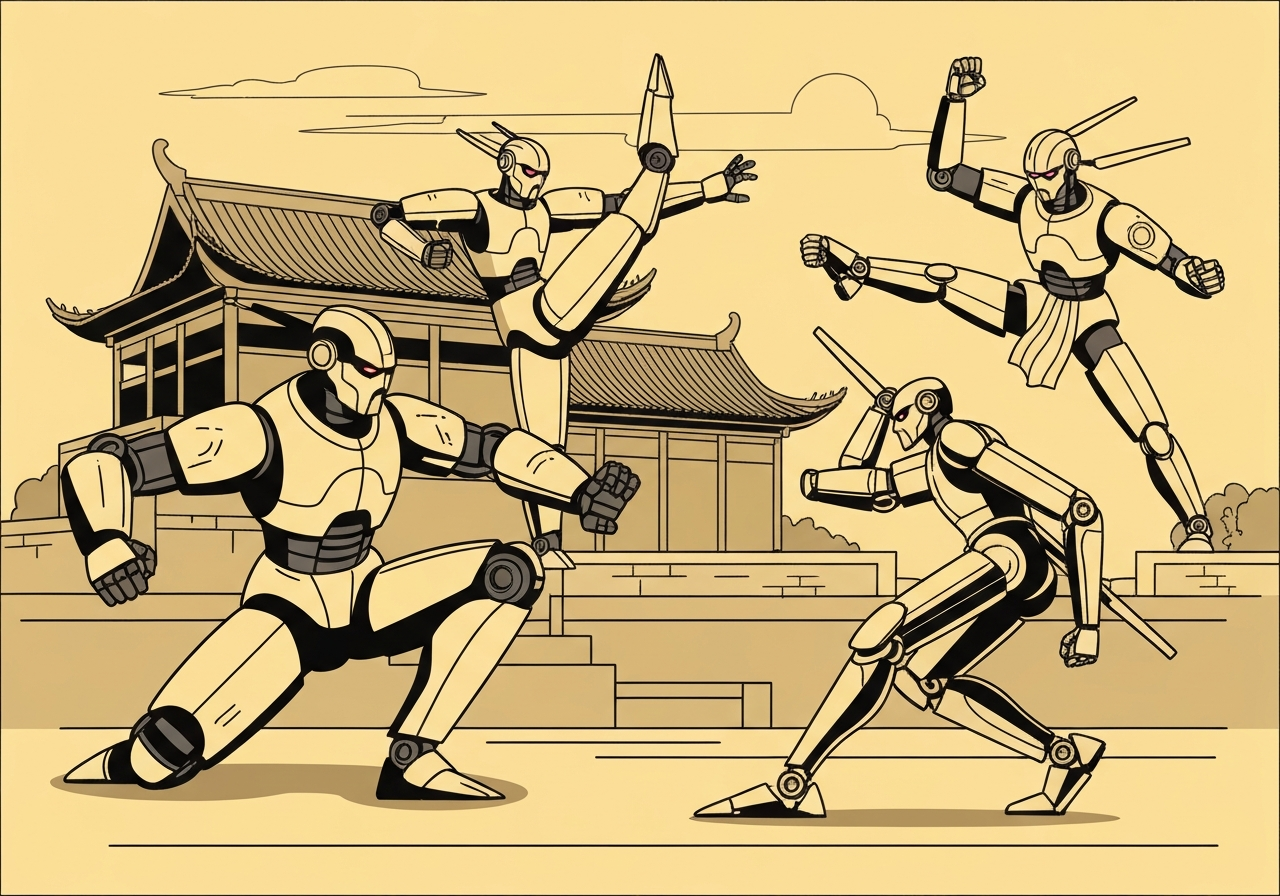
At China’s Lunar New Year gala this year, two dozen humanoid robots performed ambitious, coordinated martial-arts and parkour routines on live television, a display captured in a CCTV video posted on 21 February 2026. The show included several firsts — a continuous freestyle table-vaulting parkour, an aerial flip, continuous single-leg flips, a two-step wall-assisted backflip and a 7.5-rotation Airflare grand spin. Organizers and manufacturers described the sequences as proof of rapid progress in robot mobility and control. Observers say the demonstration advances the technical narrative but leaves open important questions about operational maturity and security implications.
Key takeaways
- Two dozen humanoid robots performed complex parkour and martial-arts moves at China’s Spring Festival gala, with several claimed firsts including a 7.5-rotation Airflare.
- CCTV posted the footage on 21 February 2026, highlighting stability and coordination improvements compared with last year’s folk-dance routine.
- Unitree Robotics, whose machines featured in the gala, lists a base price of $13,500 (about €11,280) for its G1 humanoid model.
- Tesla’s CEO said in a January 2025 earnings call that Optimus production costs could drop below $20,000 (about €16,700) if annual output reached one million units.
- The International Federation of Robotics reported that China accounted for more than half of global robot installations in 2024, underlining the country’s manufacturing scale.
- Defence experts caution that staged demonstrations can overstate field readiness and that autonomy and resilience in unpredictable environments remain the harder challenges.
Background
China has publicly prioritized robotics and AI as strategic industrial areas, combining state support with strong domestic manufacturing to accelerate development. Large-scale supply-chain integration and vertically linked component suppliers allow faster scaling and lower unit costs, a dynamic visible across robotics sub-sectors. International comparisons increasingly frame the humanoid race as dominated by China and the United States, with Europe comparatively fragmented in production capacity and commercial rollout.
Public spectacles — from factory showcases to national gala performances — have been used historically to demonstrate technological progress and national pride. Last year’s Spring Festival featured humanoids in a wobbling folk-dance sequence; this year’s routines aimed to show markedly improved balance and agility. Meanwhile commercial actors such as Unitree and Tesla pursue different strategies: Unitree offers an already-priced G1, while Tesla has tied lower costs to hypothetical, very large-volume manufacturing.
Main event
Video published by CCTV on 21 February 2026 shows 24 humanoid robots executing synchronized parkour and martial-arts elements that organizers described as rehearsed, continuous routines. The roster of claimed firsts includes continuous table vaulting in a freestyle pattern, the first aerial flip observed in a humanoid demonstration, continuous single-leg flips, a two-step wall-assisted backflip and a 7.5-rotation Airflare spin.
Observers noted the robots appeared more stable and fluid than in prior public appearances, with fewer visible resets or falls. Organizers said the display reflected improvements in actuator control, motion planning and rehearsal, though much of the choreography was evidently preplanned and staged. Engineers in the footage were seen off-camera intervening during pauses, underscoring that the sequences were not entirely autonomous in the field sense.
Manufacturers framed the gala as both a technical milestone and a marketing moment. Unitree’s publicly available G1 price point — $13,500 (≈€11,280) — signals a push toward affordability for commercial buyers, while Tesla’s comments on Optimus cost trajectories tie viability to mass production. The public spectacle, therefore, serves dual purposes: to demonstrate capability and to position firms in emerging consumer and industrial markets.
Analysis & implications
Technically, the gala advances the narrative that legged humanoid platforms are achieving faster gains in dynamic balance and complex motion than many analysts expected a few years ago. Improvements in motor controllers, perception-locomotion integration and training of motion primitives can produce impressive rehearsed sequences. However, fielded autonomy — the ability to navigate unstructured, dynamic environments without human intervention — remains an open engineering frontier that staged shows do not fully test.
From a security and defence standpoint, experts warn that shape and agility matter when robots must operate in environments designed for humans, such as stairs, doorways and vehicles. Yet the decisive factor in military uses will be robust decision-making software, resilient sensors and secure communications. A humanoid’s appearance is less important than its capacity to act reliably under stress, operate with degraded connectivity and resist tampering.
Economically, China’s near-vertical integration and manufacturing scale give it a supply-chain advantage that can lower prices and accelerate adoption in commercial contexts such as warehouses and light industrial tasks. If price points fall toward the mid-five-figure mark or below, adoption pathways into factories and, eventually, consumer spaces become more plausible — with attendant implications for labour markets, regulation and safety oversight.
Comparison & data
| Item | Source / Figure | Notes |
|---|---|---|
| Robots in gala | 24 units | Performance claimed multiple firsts (CCTV video) |
| Unitree G1 price | $13,500 (~€11,280) | Manufacturer listed base price |
| Tesla Optimus cost target | Below $20,000 (~€16,700) | Estimate if annual output = 1,000,000 units (Jan 2025 earnings call) |
| Global robot installations (2024) | China >50% | International Federation of Robotics, 2024 |
The numbers show a gap between demonstration and mass-commercial economics. A $13,500 base price places Unitree within reach for some enterprise buyers, while Tesla’s stated threshold for sub-$20,000 cost depends on unprecedented volume. China’s majority share of 2024 installations underscores manufacturing and deployment scale that competitors will find difficult to match quickly.
Reactions & quotes
Experts and stakeholders offered cautious readings that mix respect for technical progress with scepticism about overclaiming.
“There is likely room for robots in the shape of humans and animals in military and security organisations,” said Hans Liwång, noting that interactions with human-built structures are a practical driver of humanoid form factors.
Hans Liwång, Swedish Defence University (systems science for defence and security)
He also warned that staged, rehearsed displays are poor proxies for operational resilience and that much depends on autonomous decision logic and robustness, not choreography. Industry figures stressed the commercial incentives behind public showcases, while analysts highlighted China’s integrated production chain as a competitive edge.
“Production costs could fall below $20,000 if annual output reaches one million units,” commented Tesla’s CEO in a January 2025 earnings call, underlining how far economics depend on scale.
Elon Musk, Tesla (CEO, Jan 2025 earnings call)
Unconfirmed
- Whether the gala robots operated autonomously during the full sequence; footage suggests rehearsed timing and off-camera interventions.
- Direct, near-term military deployment of these exact models; experts say potential exists but no confirmed procurement has been reported.
- Short-term consumer availability at the prices cited; Tesla’s sub-$20,000 projection depends on achieving very large production volumes that have not been demonstrated.
Bottom line
The Spring Festival gala advanced the public image of humanoid robotics by showcasing smoother, more dynamic motion than in previous years — a credible technical step that also serves marketing and national prestige goals. But impressive choreography does not equal field-ready autonomy: the harder problems involve resilience, perception in uncontrolled settings and decision-making under uncertainty.
For Europe, the takeaway is not immediate alarm but strategic attention. Policymakers and industry should monitor international advances, reinforce supply-chain and R&D capacities, and accelerate standards for safety, testing and potential dual-use controls. If China’s manufacturing scale continues to drive down costs, European firms and regulators will need coordinated responses to preserve competitiveness and manage social and security risks.
Sources
- Euronews Next — news report summarizing the gala and expert reactions (news).
- CCTV video — official state broadcaster footage of the Spring Festival gala (state broadcaster / primary footage).
- International Federation of Robotics (IFR) 2024 report — industry association data on robot installations (industry association/report).
- Unitree Robotics — manufacturer product and pricing information (manufacturer).
- Tesla investor materials (Jan 2025 earnings call) — CEO comments on cost projections for Optimus (official investor call).