
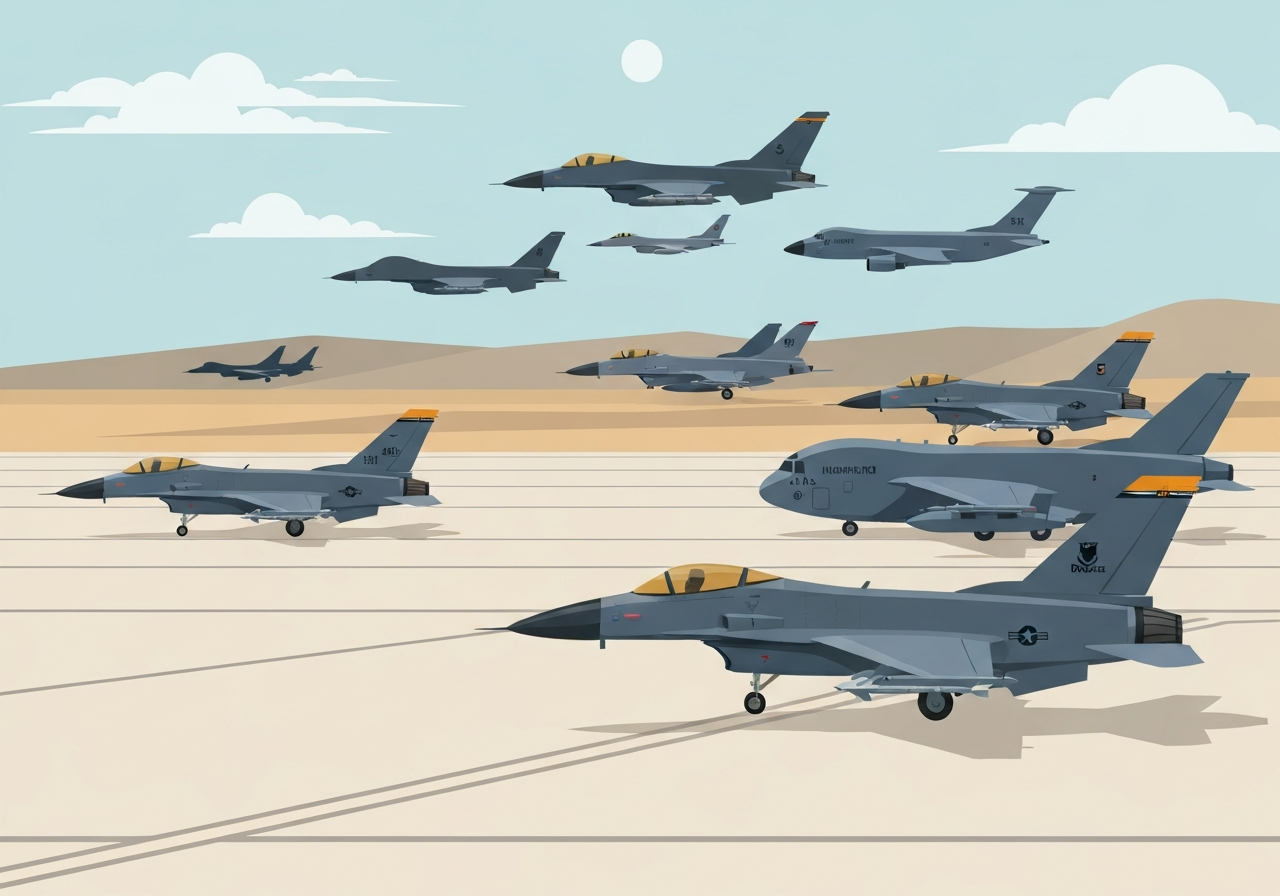
Satellite imagery and public flight-tracking records show that a central Jordanian air base has quickly grown into a focal point for U.S. military planning tied to Iran. Images taken and analyzed on Feb. 20–21, 2026 show more than 60 attack aircraft parked at Muwaffaq Salti air base, roughly triple the usual count, and at least 68 cargo flights recorded since Sunday, Feb. 15, 2026. Modern aircraft, including F-35s, drones and helicopters, are visible in the imagery, and new air-defense systems were installed around the field. U.S. and Jordanian officials characterize the deployments as part of bilateral defense arrangements amid ongoing negotiations over Iran’s nuclear program.
Key Takeaways
- Satellite imagery from Feb. 20–21, 2026 shows over 60 attack aircraft at Muwaffaq Salti air base in central Jordan, about three times the base’s normal complement.
- Flight-tracking records indicate at least 68 cargo aircraft landed at the base between Feb. 15 and Feb. 20, 2026, supporting the buildup.
- F-35 stealth fighters, multiple helicopters and several drones are visible in the latest imagery, marking a shift to more modern platforms at the site.
- New short-range air-defense systems were deployed around the base to counter possible missile threats, according to imagery analysts.
- Jordanian officials, speaking anonymously on operational grounds, said the U.S. presence is under a defense agreement and intended to strengthen deterrence.
- The buildup is one element of a broader U.S. regional reinforcement occurring while talks over Iran’s nuclear activities continue.
- President Trump publicly stated on Feb. 20, 2026 that he was weighing a limited strike to pressure Iran’s negotiating position, increasing regional tension.
Background
Muwaffaq Salti, located in central Jordan, has been a recurring logistics and training site for coalition forces but normally hosts a modest number of combat jets. Over recent weeks, analysts monitoring open-source satellite imagery and aviation feeds noted an accelerated tempo of arrivals and equipment emplacements. The current concentration of aircraft follows heightened diplomatic activity over Iran’s nuclear program and public statements by U.S. officials about maintaining all options.
Jordan has strategic reasons to host U.S. assets: it borders Syria and sits astride key air and ground lines for operations in the Levant and Persian Gulf. Amman has also worked closely with Gulf partners and Washington on regional security, balancing its desire to deter threats with political sensitivity at home. Saudi Arabia and the United Arab Emirates publicly welcomed negotiations with Iran in the same window and have said they do not permit their territory to be used for attacks on Iran.
Main Event
Between Feb. 15 and Feb. 21, 2026, public flight logs show an influx of cargo aircraft into Muwaffaq Salti that correlates with the satellite imagery of parked attack jets. Analysts who reviewed the photos say more than 60 combat aircraft were visible in the most recent images, a sharp rise from the base’s typical inventory. Several of those jets were identified as F-35s by aircraft shape and signatures in the imagery.
Imagery also shows helicopters and multiple unmanned aerial systems dispersed across the base. Some fighter jets are parked under protective shelters, which makes precise counts difficult; analysts note that the visible figure likely understates the total. On the same imagery, new emplacement points consistent with mobile air-defense batteries were recorded, positioned to cover the airfield from short- and medium-range missile threats.
Jordanian officials, speaking on the condition of anonymity to address operational sensitivities, stated the deployments fall under a defense cooperation framework with the United States and are aimed at deterrence and rapid response. U.S. military spokespeople have not published a detailed inventory for the site, citing operational security, but the pattern of flights and imagery indicate a deliberate surge of capability into the base.
Analysis & Implications
The concentration of U.S. aircraft at a forward Jordanian base shifts tactical options in the region by shortening transit times for strike and support missions toward Iran or nearby theaters. Stationing F-35s and other modern platforms nearer to potential targets expands sortie flexibility and complicates adversary calculations about timing and origin of possible operations. The presence of cargo flights—at least 68 since Feb. 15, 2026—signals sustained logistical support rather than a transient movement.
Deploying mobile air defenses around the base suggests planners anticipated counterstrikes or missile risks and sought to harden the installation quickly. For Jordan and the United States, that hardening presents a trade-off: increased protection of foreign assets on Jordanian soil, but greater exposure to regional escalation if tensions rise. Jordanian public sentiment and regional partner sensitivities constrain how overtly those forces can be used.
Politically, the buildup accompanies intense diplomatic activity over Iran’s nuclear program. Public remarks by U.S. leadership about considering limited strikes are meant to influence negotiations but also raise the odds of miscalculation. If talks falter, the forward posture could accelerate decision timelines for military options; if diplomacy succeeds, the deployments may be drawn down, though some assets could remain to reinforce deterrence.
Comparison & Data
| Metric | Observed (Feb. 20–21, 2026) | Typical / Notes |
|---|---|---|
| Attack aircraft parked | More than 60 | About one-third of that number typically |
| Cargo landings recorded | At least 68 since Feb. 15, 2026 | Unusually high logistical throughput for one week |
| Modern fighters present | F-35s identified in imagery | F-35s are not normally based there long-term |
| Air defenses | New mobile batteries emplaced | Deployed to protect the airfield from missile threats |
The table above summarizes open-source observations compared with the base’s typical profile. Analysts caution that sheltering and camouflage can obscure exact counts; nevertheless, the multiple independent indicators—satellite photos plus flight-tracking records—point to a significant, coordinated buildup rather than routine rotation.
Reactions & Quotes
The public and official reactions have been mixed, with a focus on deterrence and on avoiding regional escalation.
I am considering a limited military strike as leverage in negotiations, and we are positioning forces accordingly.
President Donald J. Trump
This comment, made to reporters on Feb. 20, 2026, framed the posture as pressure intended to influence talks over Iran’s nuclear program. Administration officials said military options remained on the table while diplomacy continued.
The deployments are part of longstanding defense cooperation and aim to strengthen regional deterrence without making Jordan a launchpad for unauthorized strikes.
Jordanian official (anonymous)
Jordanian sources emphasized their public position: they support talks and have publicly prohibited the use of their territory for attacks on Iran, seeking to avoid being drawn directly into any conflict.
The pattern indicates sustained logistical buildup and a move to reduce response times, which alters the operational picture in the region.
Regional security analyst
Analysts pointed to the combination of added fighters, logistics flights and air defenses as evidence the U.S. is preparing a range of contingency options while diplomatic channels remain active.
Unconfirmed
- Whether additional combat aircraft remain concealed under shelters at Muwaffaq Salti; imagery suggests more may be hidden but exact numbers are unverified.
- Specific rules of engagement for U.S. forces at the base were not publicly disclosed; operational intent beyond deterrence has not been independently confirmed.
- The exact provenance of every cargo flight has not been verified publicly; some flights may be logistical rotations rather than new capability deliveries.
Bottom Line
Open-source satellite imagery and flight records document a notable U.S. buildup at Muwaffaq Salti air base in Jordan between Feb. 15 and Feb. 21, 2026, including more than 60 attack aircraft, modern fighters such as the F-35, and substantial cargo traffic. The site is now clearly a regional hub for contingency planning tied to Iran, with added air defenses indicating concern about missile retaliation.
That posture simultaneously strengthens deterrence options and raises the stakes for escalation: if diplomacy falters, the deployed assets could shorten timelines for strikes, while a successful negotiation could lead to a gradual drawdown. Readers should watch for official U.S. statements on rules of engagement, subsequent satellite imagery, and any confirmation from Jordanian authorities for changes to the observed pattern.
Sources
- The New York Times (News reporting; original imagery and flight-data analysis)
- Airbus (Imagery provider credited in reporting)
- Flightradar24 (Public flight-tracking service used to assess aircraft movements)