
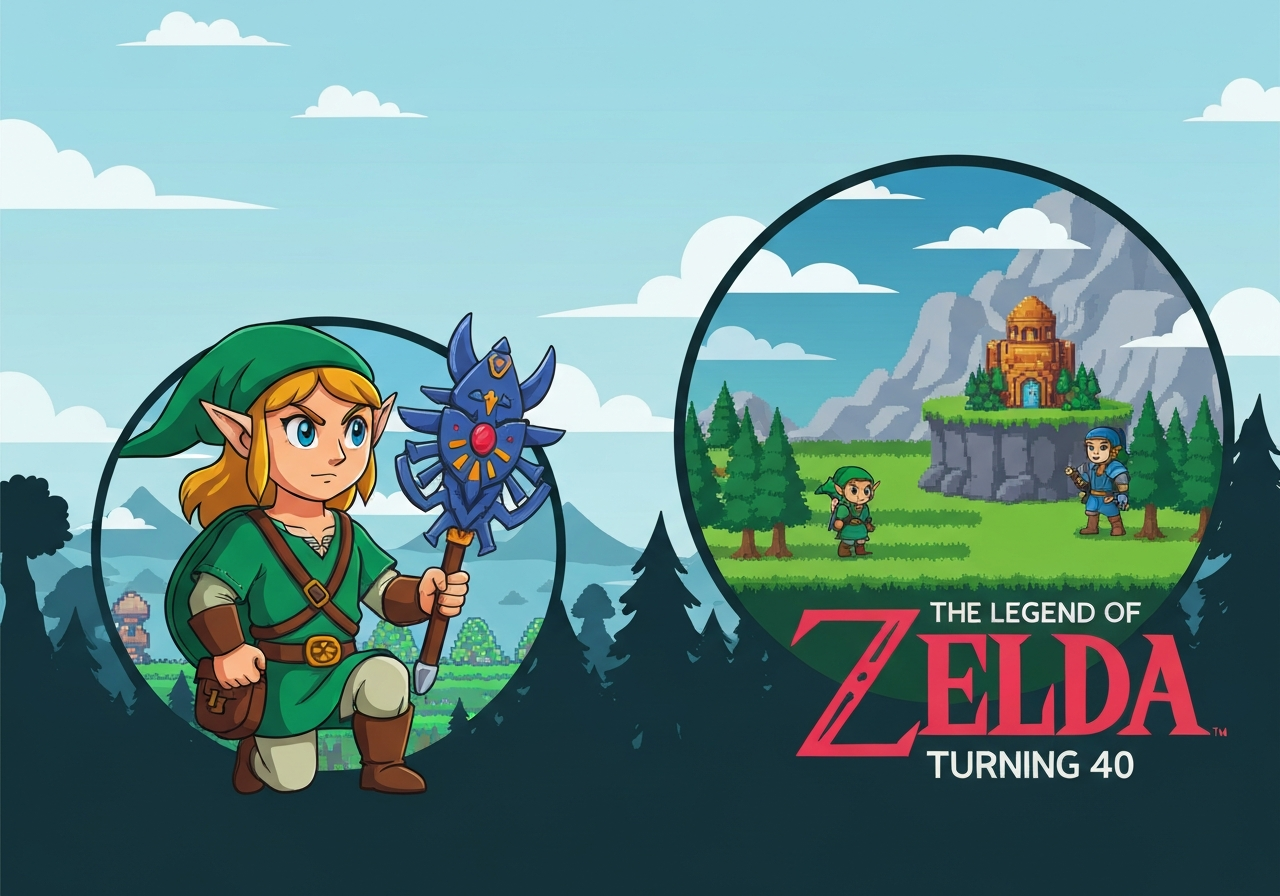
Lead: On 21 February 1986 Nintendo released The Legend of Zelda in Japan, introducing Hyrule and a new style of open-ended adventure that would reshape game design. Forty years on, the original game’s music, memorable lines and design innovations remain touchstones for the industry and its players. Nintendo Life has marked the milestone with a reader poll asking where fans first experienced Link’s debut. The anniversary underscores both the title’s lasting cultural reach and the many ways players have returned to that first map over four decades.
Key Takeaways
- The Legend of Zelda first appeared on 21 February 1986 on the Famicom Disk System; 2026 marks the 40th anniversary in Japan.
- The game introduced Koji Kondo’s now-iconic overworld theme, reportedly substituted late in development.
- The phrase “It’s dangerous to go alone! Take this.” originates from the 1986 release and remains one of gaming’s most quoted lines.
- Zelda launched an early console open world with item-based progression rather than fixed stage-to-stage guidance.
- The title has been reissued across multiple formats — GBA/GameCube collections, Virtual Console, special Game & Watch editions and Nintendo Switch Online — so modern players can still access the original.
- Nintendo Life is running a poll listing every platform variant from the Famicom Disk System to Nintendo Switch Online to capture readers’ first-play memories.
Background
In the mid-1980s Nintendo was refining how home-console games could deliver longer, more exploratory experiences. Super Mario Bros. had crystallized side-scrolling platform design, but designers soon sought different forms of engagement: Zelda answered that need by encouraging players to wander, discover items and return to earlier locations with new tools. Shigeru Miyamoto and Takashi Tezuka drew on childhood exploration and classic fantasy tropes to frame a straightforward quest: recover scattered artifacts, defeat an oppressive force and restore peace.
Technically, the Famicom Disk System allowed larger, save-enabled adventures than many cartridge-based titles of the era, and Zelda used that capability to store a more complex map and inventory. The game’s sparse guidance — few directional prompts about what to do next — made discovery itself the primary reward. As a result, subsequent designers adopted inventory-driven gating and non-linear level design that can be traced directly to Zelda’s structure.
Main Event
Today fans and outlets are marking the 40th anniversary with retrospectives, player anecdotes and community polls. Nintendo Life has published an anniversary piece and a reader poll enumerating all platform variants so that players can indicate where they first encountered the game. The piece highlights the original’s enduring elements: Kondo’s melody, the terse in-game instructions and the emergent feeling of exploration.
Across social channels, longtime players share how they first accessed Zelda — from floppy-based Famicom Disk System units in Japan to later appearances on Game Boy Advance cartridges, GameCube compilations, Virtual Console downloads and the Nintendo Switch Online library. That variety underscores Nintendo’s continuing practice of making legacy titles available on contemporary hardware, preserving access across generations.
The anniversary has also sparked conversations about how design language evolved from that first title: open maps, hidden items, and a reliance on player curiosity rather than hand-holding. Developers and historians point to Zelda as an early exemplar of rewarding players for experimenting and revisiting spaces with new tools.
Analysis & Implications
The Legend of Zelda’s most significant legacy is design pattern diffusion: its item-based progression and non-linear exploration informed not only Nintendo’s later work but the wider industry’s approach to world-building. Games such as later Nintendo open-world titles, and even modern action-RPGs, borrow the idea of environmental learning — teaching players through encounters and item use rather than explicit tutorials.
Musically, Koji Kondo’s theme set an expectation for memorable melodic identity in games; a single tune became synonymous with a franchise and showed how audio could anchor player memory. The anecdote that Kondo’s composition replaced Maurice Ravel’s Boléro late in development, if accurate, illustrates how small creative decisions can have outsized cultural effects.
Commercially, Nintendo’s strategy of repeatedly re-releasing the original across platforms has kept Zelda discoverable and monetizable for decades. That stewardship benefits legacy preservation and brand continuity, but it also raises questions about how much companies should invest in original-code emulation versus remakes or new reinterpretations.
Looking ahead, the anniversary reinforces the market appetite for both faithful re-releases and design philosophies that emphasize exploration. As developers continue to iterate on the open-world concept, Zelda’s 1986 blueprint will remain a reference point for balancing discovery with progression.
Comparison & Data
| Platform Family | How players typically first experienced Zelda |
|---|---|
| Famicom Disk System / NES | Original release and cartridge ports; first-generation players learned by map and memory. |
| GBA / GameCube | Re-releases and compilations that introduced the title to players in the 2000s. |
| Virtual Console / Digital Stores | 2000s–2010s digital availability enabled easy access for retro fans. |
| Nintendo Switch Online / Special Editions | Modern convenience for newcomers and returning players in the 2010s–2020s. |
The table above summarizes common access routes rather than exhaustive release dates. Across these channels, the preservation and curation of the original code or its emulation have enabled successive generations to form their own first-play memories.
Reactions & Quotes
“It’s dangerous to go alone! Take this.”
The Legend of Zelda (1986 game)
This in-game line has become emblematic of the title’s direct, fragmentary approach to storytelling and guidance; players often recall it as one of the first striking narrative moments in early console gaming.
“…there was an open world at your disposal…”
Nintendo Life (online gaming news outlet)
Nintendo Life’s retrospective emphasizes how the original release contrasted with contemporaneous stage-based games, highlighting open exploration as a defining feature that helped the series influence later design trends.
Unconfirmed
- The account that Kondo’s theme replaced Ravel’s Boléro at the “eleventh hour” is often repeated in retrospectives but lacks a single primary-source confirmation in public developer notes.
- Specific regional first-release dates and packaging (e.g., which markets received which physical formats first) vary across sources and require archival verification for precise timelines.
Bottom Line
The Legend of Zelda’s 40th anniversary is both a moment to celebrate a single influential title and to reflect on how one game helped codify mechanics that remain central to modern design. Its blend of exploration, concise narrative beats and memorable music created a template that has persisted across decades of game development.
Because Nintendo continued to reissue the original across many consoles and services, players from multiple generations can point to distinct first-play experiences — a fact that makes community polls about “where you first played” a meaningful way to trace the franchise’s cultural footprint. As the industry evolves, Zelda’s original design choices will remain a useful reference for creators balancing player freedom with progression.
Sources
- Nintendo Life article on the 40th anniversary (online gaming news outlet)