
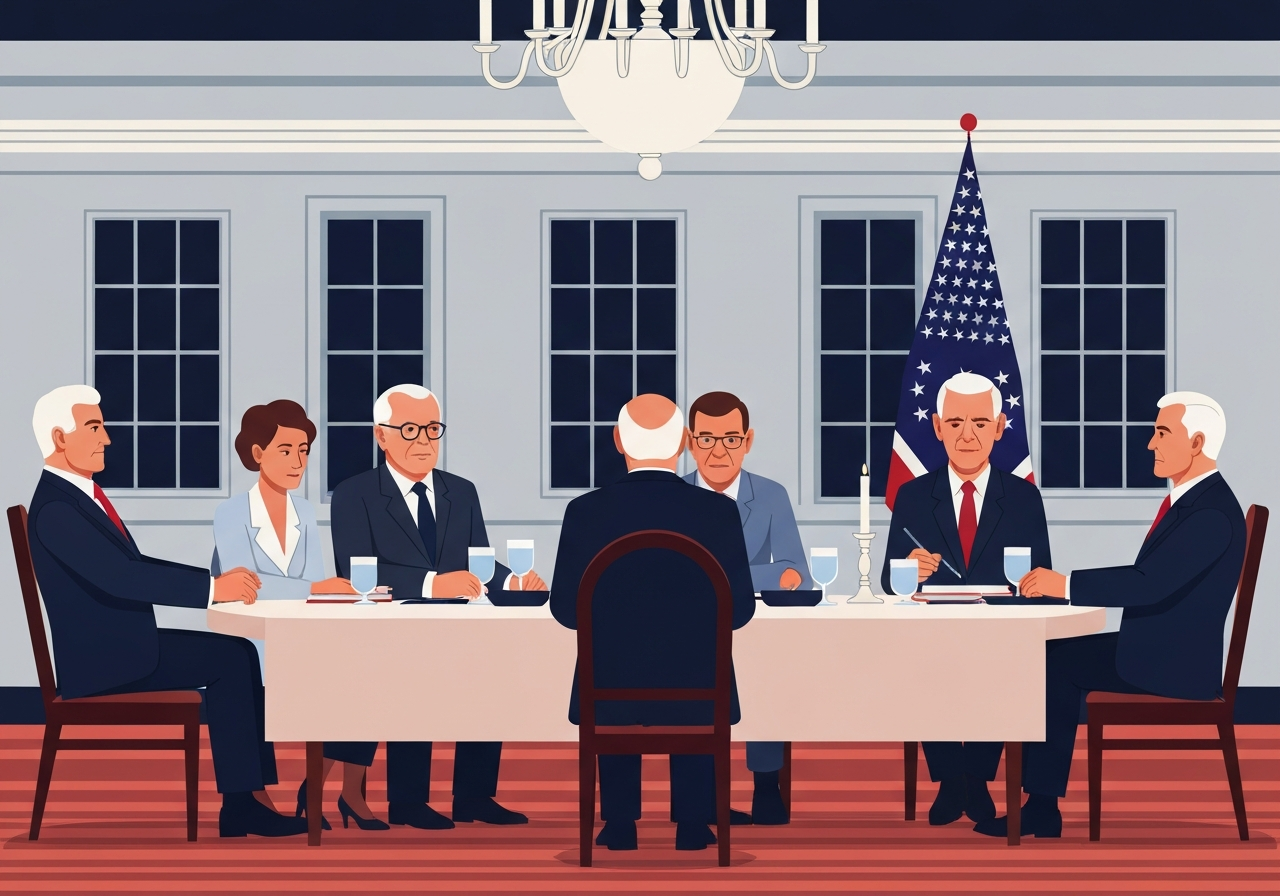
The White House governors’ dinner on Saturday, a long-standing opportunity for leaders from both parties to connect in a low-key setting, ended a fraught week in Washington after a series of disputes over invitations and an unexpected Supreme Court decision. Ahead of the National Governors Association meetings, President Donald Trump publicly criticized the bipartisan NGA leadership and initially declined to invite Maryland Gov. Wes Moore and Colorado Gov. Jared Polis to a working session on Friday before reversing course at the last minute. The working meeting was cut short when Mr. Trump left after learning the Supreme Court had struck down his broad tariff policy, a development that left some Republican allies frustrated and several Democrats threatening to boycott the weekend events. Attendance and tone at the Saturday dinner reflected that tension: some governors attended and described useful exchanges, while others stayed away in protest.
Key Takeaways
- President Donald Trump ridiculed the National Governors Association co-chairs, Republican Gov. Kevin Stitt (Oklahoma) and Democratic Gov. Wes Moore (Maryland), in the run-up to the NGA gatherings.
- Mr. Trump initially excluded Gov. Wes Moore and Gov. Jared Polis from a White House working meeting on Friday but allowed their attendance on short notice.
- The Friday event was curtailed when the president left upon learning of a Supreme Court decision that struck down his sweeping tariff policy.
- Dozens of Democratic governors threatened to boycott the White House dinner if members of their party were barred from the working meeting; some still declined to attend Saturday’s dinner.
- Louisiana Gov. Jeff Landry, a prominent Trump ally, called the timing of the court decision “unfortunate,” underscoring GOP frustration about the interruption.
- Massachusetts Gov. Maura Healey publicly explained her absence by saying the president ‘‘made this whole thing a farce.’’
- Other governors, including Maryland’s Wes Moore and New York’s Kathy Hochul, said parts of the Friday meeting were productive for sharing state perspectives on policy and enforcement.
Background
The annual White House dinner with governors is traditionally a bipartisan evening meant to ease partisan tensions and let state leaders interact with the president and Cabinet members outside formal settings. Governors from across the political spectrum typically use the occasion to trade information, build personal rapport and raise policy priorities. Over recent years, that ritual has at times offered a rare chance for face-to-face problem solving on topics ranging from federal funding to disasters and immigration enforcement.
President Trump’s second term has seen several established protocols and gatherings take on a more contentious character, and this week’s NGA stopover followed that pattern. Tensions escalated publicly after Mr. Trump criticized the group’s dual leadership structure and then took the extraordinary step of blocking two Democratic governors from a planned White House working session—an action later reversed. The dispute fed broader partisan friction at a moment when the Supreme Court’s decision on tariffs added an unexpected legal and political twist.
Main Event
On Friday, an afternoon working session hosted at the White House was meant to give governors a forum to discuss shared priorities with administration officials. Before the meeting, President Trump disparaged the bipartisan governors’ leadership and initially did not invite Gov. Wes Moore of Maryland and Gov. Jared Polis of Colorado to the closed working portion. After public pushback and warnings of a boycott from multiple Democrats, the White House permitted their attendance shortly before the session began.
The meeting itself was interrupted when President Trump was informed that the Supreme Court had rejected his administration’s sweeping tariff policy, prompting him to depart early. Several governors said the timing was awkward and that the decision truncated conversations that had been underway. Louisiana Gov. Jeff Landry, an ally of the president, told reporters the court’s ruling was ‘‘unfortunate’’ at that moment, reflecting disappointment among some Republicans.
Responses among governors were mixed. Some Democratic leaders had threatened to skip the dinner if colleagues were excluded from the working session; even after the last-minute reversal, a number of those officials still opted not to attend Saturday’s event. Others who did attend described constructive exchanges with the president and Cabinet officials, noting that such gatherings can yield practical insights and future cooperation.
Former Arkansas Gov. Asa Hutchinson, who once chaired the NGA and briefly contested Mr. Trump for the 2024 Republican nomination, described past dinners as ‘‘glowing evenings’’ where informal seating often led to meaningful conversations. Several governors made similar points on Friday, saying the quiet setting helps them air state-level concerns that rarely fit into daily press cycles.
Analysis & Implications
Politically, the episode highlighted how even routine institutional events have become battlegrounds for tone and access in Washington. The initial exclusion of Democratic governors and the president’s public criticism of NGA leadership punctured norms that have long smoothed interparty relations among state executives. That erosion of decorum can complicate future cooperation on shared issues like disaster relief, public health, and infrastructure—areas where state-federal coordination matters most.
The Supreme Court’s decision to strike down the president’s tariff policy compounded the week’s disruptions and added a legal dimension with policy knock-on effects. Beyond the immediate procedural disturbance, the ruling reshapes the administration’s trade leverage and could force a recalibration of federal-state conversations about economic impacts and manufacturing supply chains. Governors from industrial and border states may press for new federal responses or mitigation measures in the months ahead.
For Republicans, the episode exposed tension between loyalty to the White House and institutional norms that reward collegiality across parties. For Democrats, the threatened boycott demonstrated an ability to mobilize a collective response to perceived exclusion. In both parties, governors signaled a desire to preserve the usefulness of in-person meetings even as they use the moments to register political grievances.
Looking ahead, governors and the White House face a choice: let such incidents deepen polarization around routine interactions, or restore predictable protocols that enable bipartisan problem-solving. The short-term effect is reputational friction; the longer-term consequence could be diminished informal channels that have historically helped governors secure federal support quickly after emergencies.
Reactions & Quotes
Several governors and former officials framed their decisions and reactions explicitly, emphasizing either principle or pragmatism prior to and after the dinner.
“It was unfortunate that the Supreme Court came out with a bad ruling at that time.”
Jeff Landry, Governor of Louisiana
Landry’s remark captured disappointment among some Trump allies who felt the timing undercut the meeting’s agenda. His comment was offered amid wider frustration over the abrupt end to the working session.
“President Trump has made this whole thing a farce.”
Maura Healey, Governor of Massachusetts
Gov. Healey used that phrase to explain her choice to skip the dinner, framing the sequence of events as evidence that the forum had been politicized beyond its intent.
“It offered a chance for us to share our thoughts, our perspectives and our ideas.”
Wes Moore, Governor of Maryland
Gov. Moore emphasized that, despite the controversy, parts of the Friday meeting provided useful exchanges between state leaders and the administration on topics such as immigration enforcement and public safety.
Unconfirmed
- Whether the initial decision to block Govs. Moore and Polis from the Friday working session reflected a deliberate policy by the White House, or a miscommunication, remains unclarified by official documentation.
- The extent to which threatened Democratic boycotts directly influenced the White House’s last-minute reversal has not been independently verified.
- Full attendance figures for Saturday’s dinner and a complete list of governors who declined to attend have not been published publicly.
Bottom Line
This week’s White House interactions with governors underline how routine Washington rituals can become politicized, with concrete implications for intergovernmental collaboration. The combination of public criticism of NGA leadership, disputed invitations, and an intervening Supreme Court decision turned what is usually a convivial forum into a flashpoint.
For governors seeking practical outcomes—federal aid, policy clarification, or better enforcement coordination—the episode is a reminder that access matters but so does the tone set by national leaders. Watch in coming weeks for whether governors rebuild informal channels through private meetings or double down on public posturing that could complicate state-federal problem-solving.