
Lead
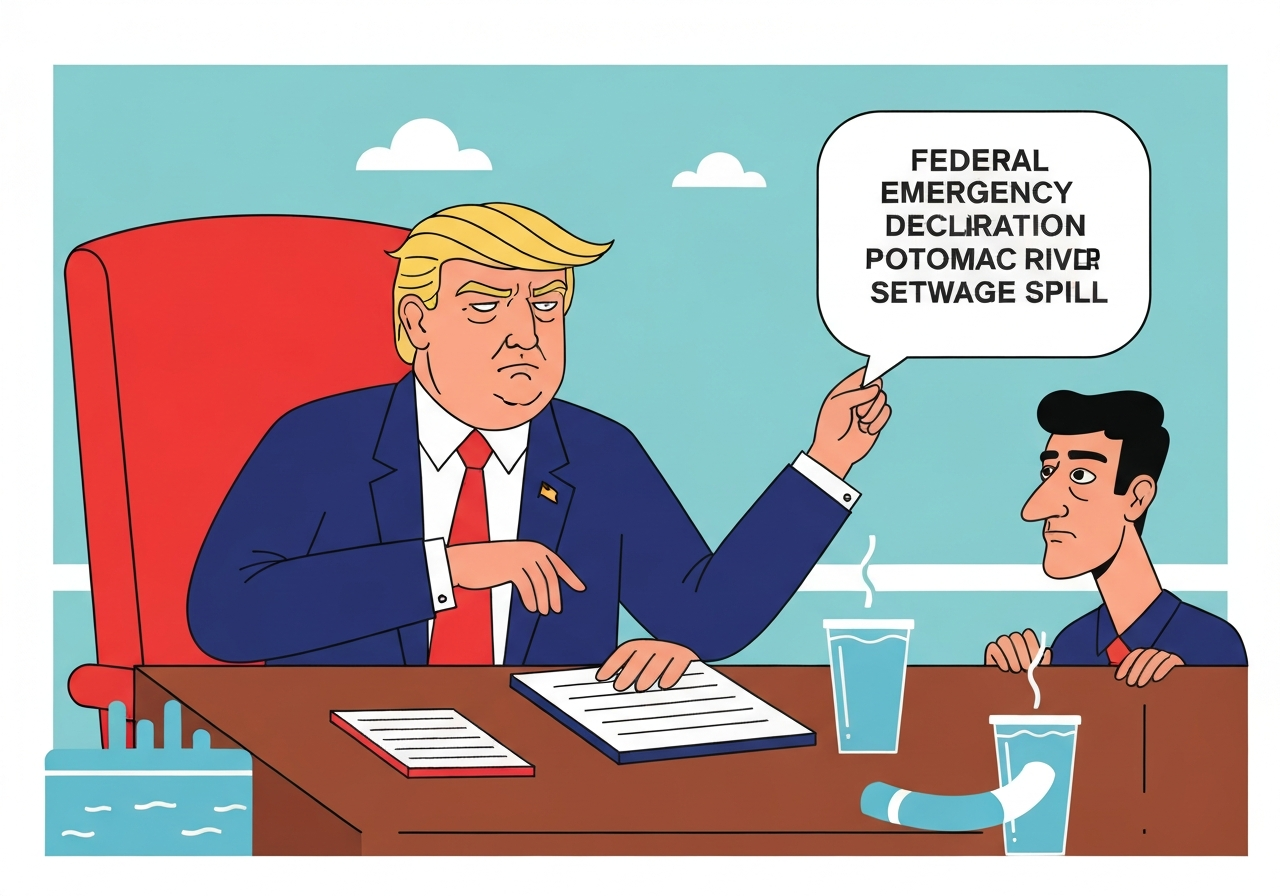
On Saturday, 21 February 2026, President Donald Trump approved a federal emergency declaration after a rupture in the 72-inch Potomac Interceptor sewer main sent raw sewage toward Washington, DC. The declaration authorizes FEMA to coordinate federal relief across the District and parts of Maryland and Virginia to support cleanup and protect public health. Local authorities had already declared a public emergency amid warnings about dangerously high E. coli counts in the Potomac. The spill—estimated by DC Water at 243 million gallons along the 54-mile (87 km) line—has raised urgent questions about infrastructure, responsibility and the safety of summer events in the capital.
Key takeaways
- President Trump issued a federal emergency declaration on 21 February 2026 to allow FEMA to coordinate relief in Washington, D.C., and adjoining Maryland and Virginia jurisdictions.
- DC Water estimated 243 million gallons of wastewater leaked from the 72-inch Potomac Interceptor before a temporary bypass was installed; the line runs roughly 54 miles (87 km).
- The rupture occurred north of Washington, discharging raw, untreated sewage into the Potomac River and prompting public-health advisories due to E. coli contamination.
- Mayor Muriel Bowser declared a local public emergency earlier in the week and formally requested a major disaster declaration from the president.
- Federal, state and local officials have publicly disagreed over ownership and oversight: DC Water operates the interceptor, but the pipe traverses federal parkland and is subject to EPA regulation, officials say.
- The declaration enables FEMA to mobilize technical, logistical and financial assistance for containment, cleanup and public-health protection.
- Officials and event planners face a compressed timeline ahead of the capital’s 250th-anniversary events this summer, with water-contact advisories and recreational restrictions already in place.
Background
The Potomac Interceptor is a major regional sewer conduit serving parts of the District and surrounding jurisdictions. The 72-inch pipe follows a roughly 54-mile (87 km) alignment and passes through multiple municipal and federal land holdings, including sections of the C&O Canal National Historical Park. Large-diameter interceptors like this one are uncommon in urban cores but central to how metropolitan wastewater is conveyed to treatment facilities.
On discovery of the rupture, crews worked to install a temporary bypass to stop the continuous outflow; DC Water’s estimate that 243 million gallons leaked refers to volume discharged before bypass operations were fully in place. That magnitude of leakage has placed the event among the largest municipal sewage releases reported in recent U.S. history, prompting intensified scrutiny of pipeline inspection, maintenance budgets and interagency oversight.
Main event
The break was first detected late last month north of Washington, and raw sewage flowed toward the city after the interceptor failed. DC Water and federal park services mobilized emergency containment and monitoring teams, while state environmental agencies issued advisories against contact with the Potomac because of elevated E. coli readings. Recreational closures affected anglers, boaters and riverside park users.
On Wednesday, Washington Mayor Muriel Bowser declared a local public emergency and requested a presidential major disaster declaration to unlock additional federal resources. On Saturday, the White House action authorized FEMA to coordinate disaster-relief efforts, citing the need to protect lives, property and public health. FEMA’s release framed the declaration as enabling federal assistance to alleviate hardship and to support cleanup operations.
Responsibility for the interceptor and for immediate mitigation has been contested. Officials pointed to overlapping jurisdictions: DC Water operates the interceptor, Maryland environmental officials stressed the pipe segment is physically in Maryland, and the ruptured segment lies within National Park Service land. That intersection of municipal operation, state territory and federal park stewardship has complicated the chain of command for repairs and liability discussions.
Analysis & implications
The spill highlights vulnerabilities in aging, large-diameter wastewater infrastructure serving major metro regions. A failure of a single, critical interceptor can produce outsized environmental and public-health consequences, particularly when it discharges into a primary river that supplies recreation and ecological services to multiple jurisdictions. The 243 million-gallon estimate underscores how infrequent but high-volume failures can overwhelm local response capacity.
Jurisdictional ambiguity—operator versus landowner versus regulator—creates friction at precisely the moment rapid, coordinated action is needed. When infrastructure crosses municipal, state and federal boundaries, emergency responsibilities and funding pathways can be unclear, delaying unified mitigation. The public dispute between elected officials and agency spokespeople has increased pressure on federal agencies to clarify roles and accelerate support.
There are also economic and reputational stakes. The capital faces high-profile 250th-anniversary events this summer. Prolonged contamination or recurring advisories could force event alterations, impact tourism and raise questions about the adequacy of preventive maintenance spending. Longer term, the incident may accelerate calls for targeted federal investment in critical regional wastewater corridors.
Comparison & data
| Metric | Potomac Interceptor spill |
|---|---|
| Estimated volume | 243,000,000 gallons (DC Water estimate) |
| Approximate Olympic-pool equivalent | ~368 Olympic-size pools (50 m × 25 m × 2 m) |
Putting the volume in familiar terms helps convey scale: at roughly 660,430 gallons per Olympic-size pool, the leaked volume equals about 368 such pools. That conversion is intended for scale perspective; containment and environmental impact depend on flow, river conditions and response speed, not just volume.
Reactions & quotes
“The president’s action authorizes FEMA to coordinate all disaster relief efforts to alleviate the hardship and suffering caused by the emergency on the local population,”
FEMA (official release)
FEMA framed the declaration as a mechanism to coordinate federal assistance for cleanup and public-health protection. The agency emphasized logistical support and technical assistance to local responders.
“[Bowser], Wes Moore and Abigail Spanberger must act, IMMEDIATELY,”
Donald Trump (Truth Social)
The president urged immediate action by local and state officials while also committing federal resources; his public posts and statements have criticized state and local responses even as the administration moved to grant FEMA authority.
“Since the last century, the federal government has been responsible for the Potomac Interceptor,”
Ammar Moussa, spokesperson for Maryland Governor Wes Moore
Maryland officials have countered that federal responsibility predates recent administrations and criticized the federal response timeline. Agency spokespeople have highlighted overlapping regulatory oversight, including EPA jurisdiction over large interceptors.
Unconfirmed
- Precise legal liability for cleanup costs and long-term remediation remains unresolved pending agency and jurisdictional review.
- The full ecological impact on aquatic life downstream and on long-term water-quality trends is not yet established and requires follow-up sampling.
- The exact timeline of decisions that delayed or accelerated federal engagement is under dispute between officials and has not been independently verified.
Bottom line
The federal emergency declaration signed on 21 February 2026 unlocks FEMA support for a large, complex sewage release that has already contaminated sections of the Potomac and disrupted recreation. The 243 million-gallon estimate highlights the scale of the failure and the need for sizable, coordinated response resources to limit public-health and ecological harm.
Beyond immediate cleanup, the incident exposes governance and infrastructure gaps: transjurisdictional pipelines require clearer chains of responsibility, sustained inspection regimes and dedicated funding to prevent catastrophic ruptures. Watch for federal funding decisions, interagency determinations of liability, and updated water-quality sampling in the coming weeks as the primary indicators of recovery and accountability.
Sources
- The Guardian — UK news outlet reporting on the federal declaration and local responses.
- FEMA — official federal agency site for the emergency declaration and program details (official agency).
- DC Water — regional utility that provided the 243 million-gallon estimate and operational updates (utility/official).
- The Washington Post — U.S. news outlet cited for characterizing the spill among the largest municipal releases (media).
- The Hill — U.S. political news site where Maryland officials’ exchange was reported (media).