
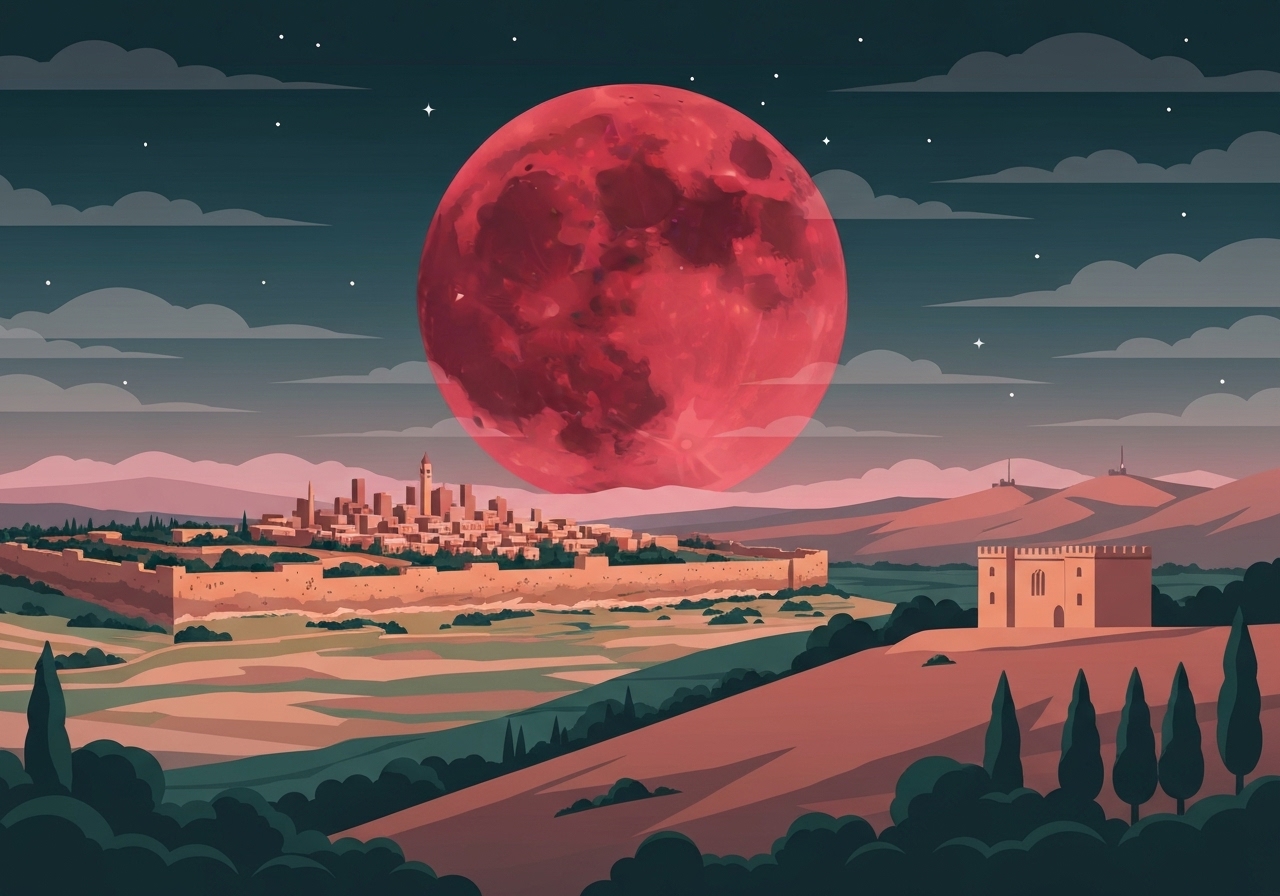
On September 7, 2025, a total lunar eclipse — widely called a “blood moon” — was visible in Israel and across large parts of Asia and the Middle East; in Israel the eclipse began at 7:27 P.M. local time, reached totality at 8:30 P.M. (peak 9:12 P.M.), and the event concluded at 11:55 P.M.
Key Takeaways
- The eclipse began in Israel at 7:27 P.M., about 37 minutes after moonrise.
- Totality lasted 1 hour and 22 minutes, with the peak at 9:12 P.M. local time.
- The red coloration is caused by Earth’s atmosphere refracting longer (red) wavelengths onto the lunar surface.
- Visibility extended from the Middle East and Horn of Africa east to the Philippines and Western Australia, and as far north as the Arctic and south to Antarctica.
- This was the second total lunar eclipse of 2025; the next total lunar eclipse is expected in late 2028.
Verified Facts
In Israel observers saw the Earth’s shadow contact the moon at 7:27 P.M., roughly 37 minutes after moonrise. The moon entered full shadow at approximately 8:30 P.M., producing the deepened reddish tint associated with a “blood moon.” Totality persisted for about 1 hour and 22 minutes, with the maximum at 9:12 P.M., before the moon gradually moved back into partial eclipse and the event concluded at about 11:55 P.M.
A lunar eclipse occurs when Earth lies between the sun and the moon and casts its shadow across the lunar surface. During totality, the planet’s atmosphere scatters shorter wavelengths (blue and violet) while bending longer red wavelengths toward the moon, producing the characteristic coppery hue. The effect was enhanced this time because the moon was relatively close to Earth and therefore appeared slightly larger and brighter than average.
The phenomenon was reported visible to the naked eye across the Middle East and the Horn of Africa, extending eastward to the Philippines and Western Australia and reaching polar latitudes in both hemispheres. While darker, unobstructed sites offered the best views, some areas experienced cloud cover; organized public viewing events were held in several locations.
Context & Impact
This was the second total lunar eclipse in 2025; an earlier total eclipse earlier in the year was best observed from the Americas. The next total lunar eclipse is not expected until late 2028, making this a relatively rare opportunity for many regions to view a full eclipse.
Beyond public interest and amateur astronomy gatherings, lunar eclipses offer scientists predictable opportunities to study Earth’s atmosphere via the color and brightness changes on the lunar surface. Changes in atmospheric dust or aerosols can subtly alter the eclipse’s appearance, and observers sometimes compare measured brightness to historical records.
In addition to the lunar event, a partial solar eclipse is forecast later in September 2025, visible only from New Zealand, parts of Antarctica and select areas of Australia, offering more astronomy events for southern-hemisphere observers.
The eclipse was visible to the naked eye across wide regions, with darker locations providing the clearest views.
Haaretz reporting
Unconfirmed
- Comprehensive turnout numbers for public viewing events across all affected countries have not been compiled.
- Local cloud cover and viewing conditions varied by city and have not been fully consolidated into a single report.
Bottom Line
The Sept. 7, 2025 total lunar eclipse offered observers across Israel, the Middle East and far beyond a prolonged “blood moon” spectacle, with totality centered at 9:12 P.M. local time and lasting roughly 1 hour 22 minutes. For many regions this was the last total lunar eclipse before late 2028, making the event a notable opportunity for public viewing and atmospheric study.